| Size in ft: | Width: 6'7" x Length: 9'8" |
| Size in Inch: | Width: 79" x Length: 116" |
| Size in meters: | Length: 2.95 x Width: 2.01 m |
| Colors: | Ivory, Sage Green, Blue, Rust |
| Shape: | Rectangular |
| Woven: | 100% Hand-knotted | Handmade |
| Foundation: | Cotton |
| Pile: | Wool and Silk |
| KPSI: | 60 Raj | Approx. 400 |
| Age: | 1980s | Unused |
| Design: | Tabriz | Lobed floral medallion | Corner spandrels |
| Origin: | Persian Tabriz | Made in Persia |
| Condition: | Perfect | Never used |
6'7" x 9'8" Persian Tabriz Rug | Ivory & Sage Green Floral Medallion | 60 Raj Wool & Silk, Never Used
This is a 1980s workshop Tabriz that was rolled and stored rather than used, and it shows: the pile stands full and even from selvage to selvage, the ivory field has none of the greying that comes from traffic, and the silk highlights still flash when you walk around the rug. At 6'7" x 9'8" it sits right in the most useful of the 7x10 Persian rugs range, large enough to carry a seating group or a 6 seat table and still show its borders. Woven at roughly 60 Raj on a cotton foundation with wool and silk pile, it ships with our certificate of authenticity documenting origin, age, materials and weave.
Design and Motifs
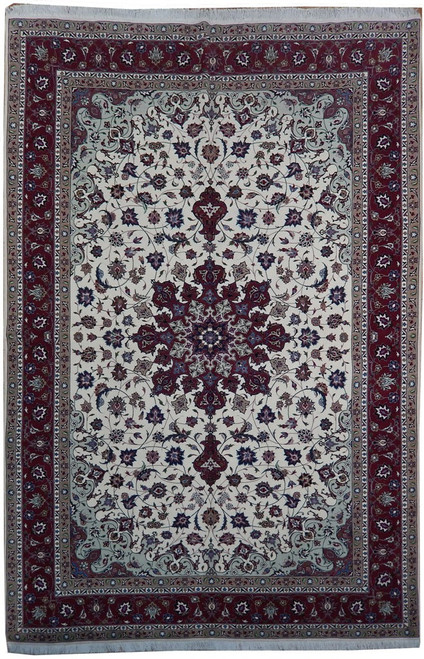
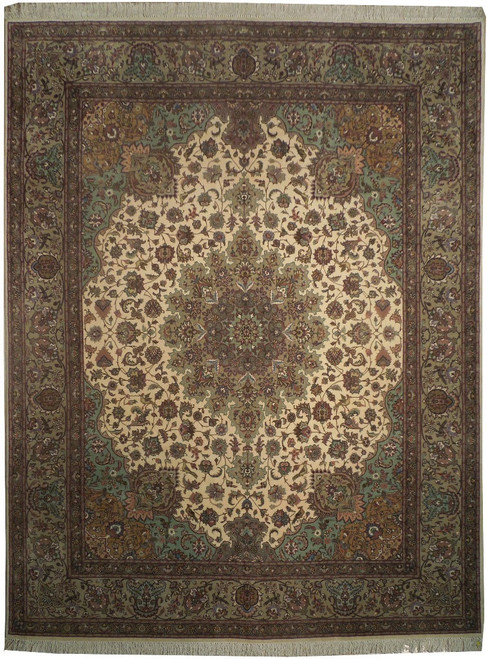
The center holds a layered floral medallion built outward from a small ivory square panel and its 4 part rosette, ringed by 8 lobed cartouches filled with dark blue fans and rust flowerheads, then by a broader taupe and slate blue tier of serrated leaves. Slender pendants reach toward each end of the field, and the drawing around them is pure curvilinear Tabriz work: thin vine scrolls swinging out to large Shah Abbasi palmettes, split leaves, rosettes and small buds, all placed with the symmetry a workshop cartoon allows. The 4 corners carry sage spandrels with their own small squared medallions, so the field reads as a framed panel rather than a loose all over. A single wide main border of alternating palmettes and flowering sprays is held between narrow guard stripes of meandering rosette vine, four on each side, which is more framing than a village loom usually bothers with.
A Soft Ivory and Sage Green Palette
The field is a warm undyed ivory, closer to cream than white, and it stays quiet enough that every flower reads clearly against it. The main border is the anchor: a muted sage green with an olive cast, deeper in the photographed corners and lighter where the silk catches light. Inside the field the secondaries are deliberately dusty rather than bright, with slate blue and pale sky blue in the fans and leaf tips, taupe and greige in the medallion tiers, terracotta rust and soft salmon in the palmettes, and small hits of near navy and dark green used as outlines to keep the drawing crisp. There is no strong red anywhere, which is why this rug behaves like a neutral in a room: it lives happily with grey, oatmeal, camel and walnut, and it lifts pale oak or bleached wood flooring rather than fighting it.
Tabriz Weaving and Quality
Tabriz, in the northwest of Persia, is the city that put the Raj system into everyday dealer language: Raj counts the knots per gereh across the width, so 40 Raj is commercial goods, 50 is fine, and 60 Raj lands around 400 knots per square inch, the level at which a weaver can draw a true curve instead of stepping it. That is exactly what you see in the vine work and in the tiny rosettes of the guard stripes here. Tabriz weavers work with a hooked knife on a cotton warp, which lets them keep a very regular knot and a low, tight pile, and the silk is used sparingly as highlight rather than as whole motifs. The 1980s dating is consistent with the wool quality, the dye palette and the finish of the selvages and fringe, and if you want the reasoning behind that kind of judgement our guide on how to date an Oriental rug walks through the same checks we ran on this piece.
6'7" x 9'8" Persian Tabriz Rug | Ivory & Sage Green Floral Medallion | 60 Raj Wool & Silk, Never Used
Ask about this rug
This piece is the only one of it, so the things worth knowing about it are particular to it. If you want to talk through the size, the colour in your own light, or the weave, speak to someone here first.