Watch the film
| Size in ft: | Width: 7'10" x Length: 10'2" |
| Size in Inch: | Width: 94" x Length: 122" |
| Size in meters: | Length: 3.10 x Width: 2.39 m |
| Colors: | Ivory, Blue, Dark Salmon |
| Shape: | Rectangular |
| Woven: | 100% Hand-knotted | Handmade |
| Foundation: | Cotton |
| Pile: | |
| Design: | Sarouk | Central Medallion | Boteh & Floral Field |
| Origin: | Persian Sarough | Made in Persia |
| Condition: | Excellent | Full even pile |
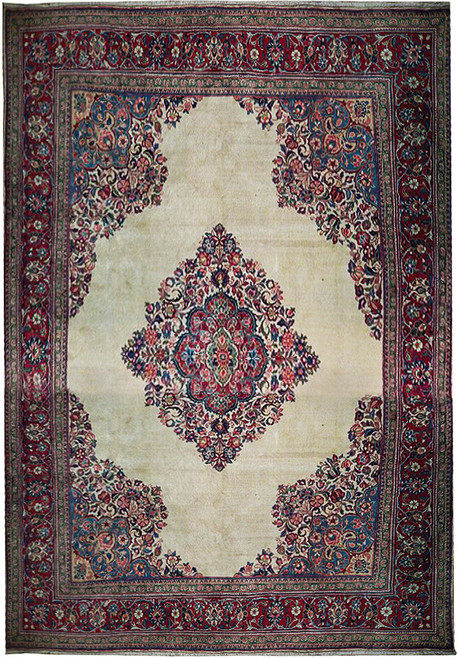
7'10" x 10'2" Persian Sarouk Rug | Ivory Field Medallion with Boteh Border | Excellent Condition
This is the kind of piece that makes people stop in a room and look down. The field is a warm ivory, the drawing across it is unusually detailed for a rug of this weight, and the whole thing measures 7'10" x 10'2", squarely in the classic 8x10 Persian rug footprint that most American living rooms are built around. It is hand-knotted in wool on a cotton foundation with a 3/8" pile that still stands full and even from selvage to selvage, and the back photograph shows a tight, regular knot face with no repairs, no reweaves and no thin spots. If you want the background on how these pieces are built and graded, our guide to Persian Sarough rugs covers it in detail. Every rug we ship travels with a certificate of authenticity identifying origin, materials and construction.
Design and Motifs
The layout is a formal central medallion with matching pendants and quartered corner spandrels, drawn in the curvilinear Sarouk manner rather than the angular village style. The medallion itself is a lobed salmon cartouche outlined in navy, filled with a lattice of small diamond hatching and four olive green rosette panels that mirror each other across both axes. Above and below it, tall blue pendant panels carry a large red boteh at their center, each boteh packed with its own miniature floral spray. What really carries the field are the boteh: oversized paisley forms in navy, mid blue and grey green scattered through the 4 corners of the ivory ground, curling back on themselves and outlined in fine pale vine. Between them run thin flowering branches with small rose and pink blossoms, so the ivory never reads as empty. The main border is a broad salmon band of alternating palmettes and turtle style floral heads, flanked by a blue floral guard on the inner edge and several narrow reciprocal stripes, and the ends finish in plain ivory kilim with a hand-tied wool fringe.
Ivory, Blue and Dark Salmon in the Palette
The ground is a soft ivory that leans cream rather than white, which is what keeps this rug from feeling cold underfoot or in photographs. Against it, the two dominant tones are blue and dark salmon. The blue works in at least three registers: a deep navy used for outlines, the larger boteh bodies and the medallion edge, a clear mid blue in the pendant panels and the inner guard border, and a softer denim blue in the trailing vines. The dark salmon is the warmer half of the conversation, a coral tone rather than a fire engine red, and it fills the main border and the heart of the medallion so the eye moves from the frame inward without a jolt. Supporting colors are limited and used with restraint: olive and sage green in the leaves and rosette panels, rose and pale pink in the small blossoms, a caramel brown in the narrow guard stripes, and touches of near black in the flower centers. In daylight the ivory and coral come forward; under lamplight the blues deepen and the rug reads noticeably more formal.
Sarouk Weaving in Central Persia
Sarouk is a weaving town in the Arak district of central Persia, and its name has stood for dependable, heavy, finely drawn town rugs for well over a century. The weave is done on a cotton warp and weft with a dense Persian knot, and the tradition there favors a thicker, harder handle than you find in the softer studio cities, which is exactly why Sarouk rugs have a reputation for outlasting the houses they are bought for. The drawing here is town work rather than village work: the medallion is symmetrical on both axes, the border repeat resolves correctly at all 4 corners, and the curved vine lines hold their arc instead of stepping, all of which take a cartoon, a trained weaver and a high enough knot count to carry the curve. Look at the reverse in the last photograph and you can see the knot rows sitting straight and even, the mark of a well-tensioned loom. Handled properly, with rotation every year or so and a pad underneath, a rug built like this one stays in a family for generations.
7'10" x 10'2" Persian Sarouk Rug | Ivory Field Medallion with Boteh Border | Excellent Condition
Ask about this rug
This piece is the only one of it, so the things worth knowing about it are particular to it. If you want to talk through the size, the colour in your own light, or the weave, speak to someone here first.