Watch the film
| Size in ft: | Width: 7'3" x Length: 10'3" |
| Size in Inch: | Width: 87" x Length: 123" |
| Size in meters: | Length: 3.12 x Width: 2.21 m |
| Colors: | Red, Black, Blue, Olive |
| Shape: | Rectangular |
| Woven: | 100% Hand-knotted | Handmade |
| Foundation: | Cotton |
| Pile: | |
| Age: | 1970's | Semi-antique |
| Design: | Heriz | Stepped geometric medallion | Ivory corner spandrels |
| Origin: | Persian Heriz | Made in Persia |
| Condition: | Excellent | Even pile throughout |
7'3" x 10'3" Persian Heriz Rug | Tribal Geometric Medallion | 1970s Red Wool
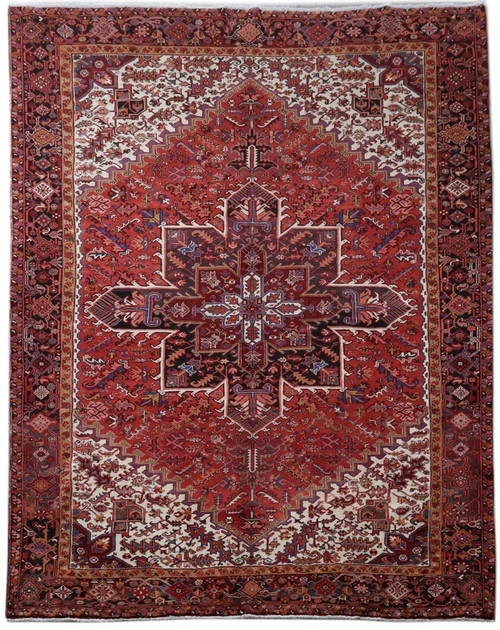
This is a village-woven Persian Heriz from the 1970s, hand-knotted in wool on a cotton foundation and still carrying a full, even pile after 50 years of careful life. At 7'3" x 10'3" it sits right in the most usable range of 7x10 Persian rugs, large enough to carry a seating group with the front legs of the sofa on the wool, compact enough for a normal living room or a 6 chair dining table. The drawing is confident and entirely hand-plotted, with the small asymmetries between the 4 corners that tell you a weaver worked from memory rather than a printed grid. Every rug we ship leaves Freeport with a certificate of authenticity stating origin, age, materials and exact measurements, and if you want to understand how a piece like this is placed in time, our guide on how to date an Oriental rug walks through the same clues we used here.
Design and Motifs
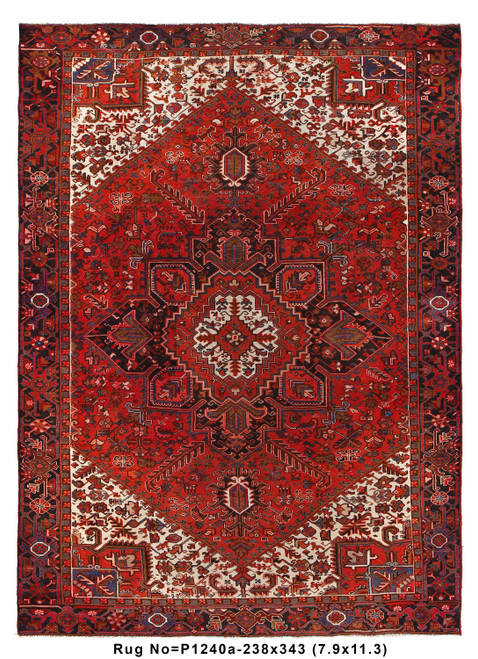
The field is organized around a stepped diamond medallion, outlined in ivory and filled with a navy lozenge that holds a small red rosette cartouche at its exact center. From that core, serrated pendants run north and south and hooked arrowheads push east and west, so the medallion reads less like a court ornament and more like a piece of architecture built out of straight lines. Four large ivory spandrels close the corners, each one carrying a dark, leaf-shaped palmette and a scatter of angular vines, and the open red ground between them is packed with tiny tribal filler: hooked brackets, barbed leaves, latch-hook squares and stray birds and rosettes that give the surface its restless texture. The inner border runs a row of 8 petal rosettes on a black-blue ground, flanked by narrow reciprocal guard stripes and a fine outer stripe of linked diamonds. This is geometric rug drawing at its most honest, closely related to the broader tribal rug vocabulary of northwest Persia.
The Color: Madder Red, Black-Blue and Ivory
Red dominates, but it is not a single red. The open ground is a warm madder tone that shifts toward brick where the light hits the pile straight on and toward deep cherry where the nap lies the other way, and the close-up images show at least 3 distinct reds working together: the bright field red, a darker oxblood used in the palmettes and medallion framing, and a soft rose-pink that outlines small motifs. Against that, the main border and the medallion core sit in a near-black navy that photographs as black in the full view and opens up into true indigo blue in the detail shots, with a lighter cornflower blue picked out in individual rosette petals. The ivory spandrels and ivory outlining do the heavy lifting, cutting the red into legible shapes and keeping the whole field from going flat. Olive-gold appears in measured doses, mostly in the border rosettes and a few field flowers, and it is what keeps the palette warm rather than cold. The ends finish in clean white cotton fringe.
Heriz Weaving in Northwest Persia
Heriz is a cluster of weaving villages east of Tabriz, below the slopes of Mount Sabalan, and its reputation rests on two things: wool and water. The mineral-rich water of the region sets dyes with unusual depth, and the local sheep grow a famously tough, slightly coarse fleece that resists crushing. Heriz weavers never chased knot count; village work of this type generally sits under 200 knots per square inch, because the point was a thick, heavy, hard-wearing rug rather than a fine one. Instead the skill shows in the drawing, which is angular by necessity and brilliant by tradition: straight lines, stepped corners, and a medallion plotted square to the loom. The back of this piece shows firm, regular knotting with no bulges or waisting, and the reverse of the border reveals how cleanly the weaver held the pattern repeat across the full 7'3" width. That combination of dense wool, honest geometry and 1970s dye quality is exactly why Heriz rugs stay on floors for generations instead of being retired to a guest room.
7'3" x 10'3" Persian Heriz Rug | Tribal Geometric Medallion | 1970s Red Wool
Ask about this rug
This piece is the only one of it, so the things worth knowing about it are particular to it. If you want to talk through the size, the colour in your own light, or the weave, speak to someone here first.