Watch the film
| Size in ft: | Width: 8'2" x Length: 11'6" |
| Size in Inch: | Width: 98" x Length: 138" |
| Size in meters: | Length: 3.51 x Width: 2.49 m |
| Colors: | Brick Red, Blue, Olive, Ivory |
| Shape: | Rectangular |
| Woven: | 100% Hand-knotted | Handmade |
| Foundation: | Cotton |
| Pile: | |
| Age: | 1980's |
| Design: | Heriz | Stepped Geometric Medallion |
| Origin: | Persian Heriz | Made in Persia |
| Condition: | Excellent | Ready to use |
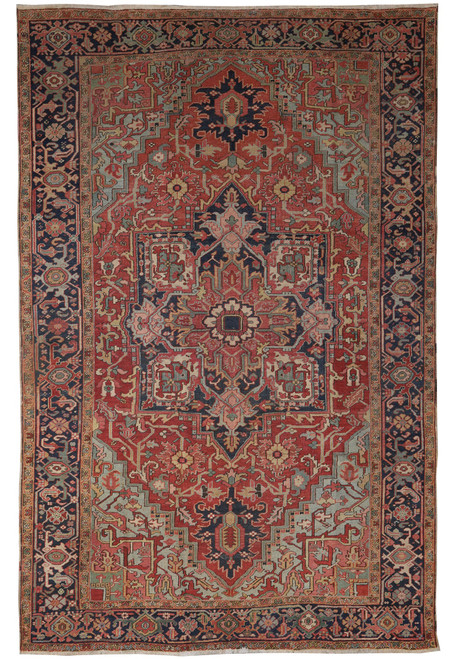
8'2" x 11'6" Persian Heriz Rug | Stepped Geometric Medallion | 1980s Tribal Wool
This is a full room size Heriz from the 1980s, hand-knotted in wool on a cotton foundation, and it carries the honest village character that collectors look for in this weave: heavy wool, confident angular drawing, and dyes that have settled into a deep madder brick red. At 8'2" x 11'6" it sits comfortably in the 8x11 Persian rug range that most seating groups and dining tables are planned around, and the pile still has good height with even, unrestored ends and original ivory fringe. The back photograph shows a clean, tight weave with the pattern reading crisply from the reverse, a reliable sign of a well beaten village rug. Every piece ships with a certificate of authenticity confirming it as a genuine hand-knotted Persian rug.
Design and Motifs
The field is built around a large stepped medallion with an 8 petal rosette at its heart, ringed by an ivory outline that steps out into hooked points and then into navy anchor pendants at the top and bottom. Around it the field fills with serrated palmettes, hooked vinery, small blossoms and angular leaf forms, all drawn in the straight-line vocabulary that makes Heriz weaving instantly recognizable among geometric Persian rugs. Four ivory corner spandrels frame the medallion with dense scrolling vine work, and the main navy border runs a rhythm of turtle palmettes and rosettes between narrow guard stripes, the outermost one in a warm tan that gives the whole rug a lit edge.
Color Palette
The dominant note is brick red, a warm madder tone that shifts gently across the field with natural abrash and reads slightly deeper toward the ends, which is exactly what you want from village dyeing. Against it, the blues do most of the work: an inky navy in the border and medallion ground, with a lighter sky blue and a touch of teal picking out leaves, hooks and palmette centers. Ivory carries the spandrels, the medallion outline and the fine drawing in the field, while olive green and soft camel appear in small quantities on stems, guard stripes and individual blossoms. Placed in a room it behaves like a classic red and burgundy Persian rug, warming cream walls and pulling together dark wood furniture without going flat under lamplight.
Origin and Weaving Quality
Heriz is a group of villages east of Tabriz, on the slopes below Mount Sabalan in northwest Persia. The water there is mineral rich and the sheep produce famously tough, springy wool, which is why Heriz rugs outlast most other village weaves and why the drawing stays angular: the weavers work from memory and village cartoons in straight lines and stepped corners rather than the curved court cartoons of city workshops. Village Heriz weaving usually sits below 200 knots per square inch, and the strength of the rug comes from the wool and the beat-down rather than fineness. This example shows a firm handle, a heavy pile, and squared-off selvedges, a piece made to be walked on for generations rather than admired from a distance.
8'2" x 11'6" Persian Heriz Rug | Stepped Geometric Medallion | 1980s Tribal Wool
Ask about this rug
This piece is the only one of it, so the things worth knowing about it are particular to it. If you want to talk through the size, the colour in your own light, or the weave, speak to someone here first.