Watch the film
| Size in ft: | Width: 7'5" x Length: 9'5" |
| Size in Inch: | Width: 89" x Length: 113" |
| Size in meters: | Length: 2.87 x Width: 2.26 m |
| Colors: | Red, Navy Blue, Black, Beige, Brown, Light Blue |
| Shape: | Rectangular |
| Woven: | 100% Hand-knotted | Handmade |
| Foundation: | Cotton |
| Pile: | |
| Age: | 1980's | Semi-antique |
| Design: | Heriz | Stepped Geometric Medallion | Ivory Spandrels |
| Origin: | Persian Heriz | Made in Persia |
| Condition: | Excellent | Even pile throughout |
7'5" x 9'5" Persian Heriz Rug | Stepped Geometric Medallion | 1980's Wool
This Heriz was knotted in Persia in the 1980's, which puts it at roughly 40 years old and squarely in semi-antique territory. It measures 7'5" x 9'5", so it lands in the practical 8x10 Persian rug range that fits under a sofa group or a six-seat table without crowding the walls. The pile is hand-spun wool at 3/8" on a cotton foundation, still even across the whole field with no thin spots, and the wool has taken on the light-catching sheen that village Heriz weaving develops once it has been walked on for a few decades. Every rug we sell ships with a certificate of authenticity confirming origin, materials and hand-knotted construction.
Please Note About the Photographs:
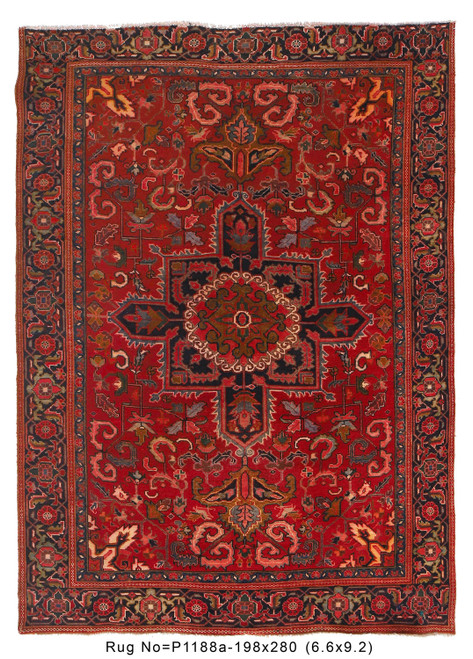
The field photographs differently under different light. In the straight-on studio shot the red reads deep and brick-toned, while the daylight close-ups read as a lighter salmon. It is the same wool in both; the true tone sits between the two, a warm salmon red that darkens where the pile leans away from the light.
Design and Motifs
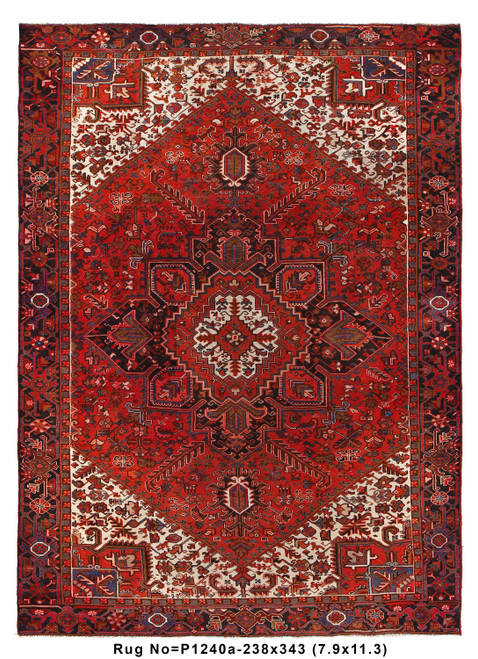
The center holds a stepped, serrated medallion built entirely from straight lines, with an 8 petal rosette at its core in ivory and light blue and navy anchor panels stacked above and below it. Four large ivory spandrels fill the corners, each one packed with angular vinework, hooked leaves and small stylized birds and animal figures that the weaver clearly drew from memory rather than from a full cartoon. Between the medallion and the spandrels the field carries serrated palmettes, tiny geometric rosettes and free-floating filler motifs, none of them repeating exactly. The main border runs a navy ground with paired rosettes and angular stems, framed by narrow ivory and brown guard stripes. It is textbook drawing for geometric Persian rugs: no curved line anywhere, every arc resolved into steps and points.
A Salmon Red Field With Navy, Ivory and Light Blue
Red is the dominant color, a warm salmon red with brick and terracotta depth where the pile shifts direction, and it covers the open field and much of the medallion. Navy blue does the structural work: the main border, the medallion outline, the anchor panels and the dark cartouches inside the spandrels are all set in it, with true black used sparingly at the deepest outlines. Ivory and beige carry the four corner spandrels and the guard stripes, giving the composition its light and keeping the red from reading heavy. Light blue appears as a secondary drawing color, tracing the serrated edges of the medallion and the vine scrolls in the corners, and soft brown fills a handful of leaves and palmettes and the outer edge frame. The overall effect is warm and lived-in rather than saturated, which is why a rug like this sits comfortably with both antique furniture and plain modern upholstery.
Heriz Weaving in the Villages East of Tabriz
Heriz is a cluster of weaving villages east of Tabriz, on the slopes below Mount Sabalan, and its reputation comes from two things: mineral-rich water that gives the local fleece unusual toughness, and a drawing tradition that works in straight lines and stepped corners instead of the flowing curves of the city workshops. Heriz rugs are woven on cotton at a relatively coarse gauge, and that is the point, because the thick wool and heavy knot make them among the hardest-wearing rugs Persia produces. Village work of this kind is usually knotted below 200 knots per square inch, which is why the design has to be bold enough to read at that scale, and this piece is drawn confidently, with the medallion and spandrels lining up cleanly on both ends. If you want to understand how weave, wool and wear combine to place a piece in a decade, our guide on how to date an Oriental rug covers the same signals we used here.
7'5" x 9'5" Persian Heriz Rug | Stepped Geometric Medallion | 1980's Wool
Ask about this rug
This piece is the only one of it, so the things worth knowing about it are particular to it. If you want to talk through the size, the colour in your own light, or the weave, speak to someone here first.