| Size in ft: | Width: 8'7" x Length: 13'6" |
| Size in Inch: | Width: 103" x Length: 162" |
| Size in meters: | Length: 4.11 x Width: 2.62 m |
| Colors: | Brick Red, Black, Olive, Ivory, Blue |
| Shape: | Rectangular |
| Woven: | 100% Hand-knotted | Handmade |
| Foundation: | Cotton |
| Pile: | |
| Age: | 1980s | Vintage |
| Design: | Heriz | Geometric Medallion | Ivory Spandrels |
| Origin: | Persian Heriz | Made in Persia |
| Condition: | Excellent | Even pile throughout |
8'7" x 13'6" Persian Heriz Rug | Geometric Medallion | 1980s Brick Red Wool
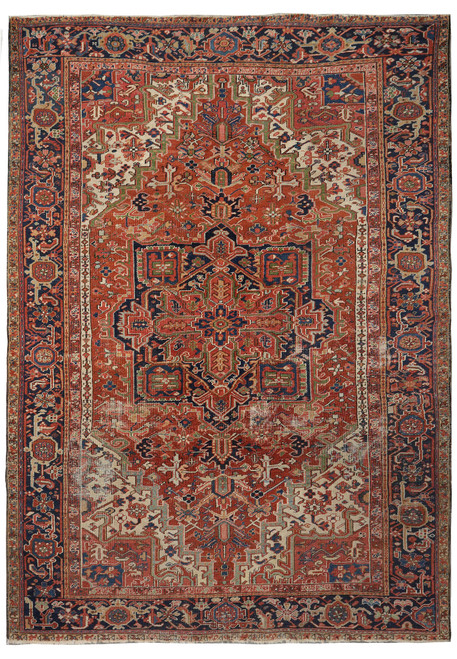
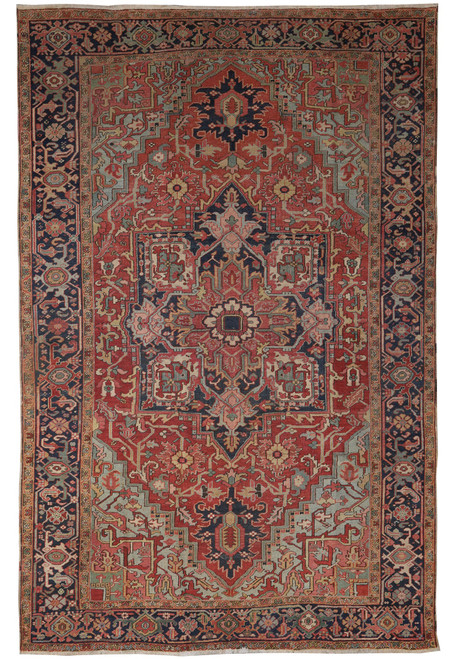
This is a full room-size Heriz from the 1980s, hand-knotted in wool on a cotton foundation and still carrying an even, honest pile from edge to edge. At 8'7" x 13'6" it sits squarely among large Persian rugs that anchor a whole living room or a long dining table without crowding the walls. The drawing is classic northwest Persian village work: one broad angular medallion, deep ivory corner spandrels, and a black main border of palmettes and rosettes. Every piece ships with a certificate of authenticity confirming origin, materials and hand-knotted construction.
Please Note About the Photographs:
The field reads as a deep brick red in the flat overhead image and lifts toward a lighter rose tone in the close-up and angled shots taken under direct showroom light. That shift is lighting and pile direction, not fading or wear. Wool changes tone with the nap, and the rug will look darker walking one way across it and brighter walking the other. Every rug is professionally steamed and pressed before it leaves us.
Design and Motifs
The center holds an 8 petal rosette in blue and rose, ringed by a stepped octagonal medallion that throws out hooked arms and long leaf pendants north and south. Around it, four cartouche-shaped sub-panels carry small animal and bird figures drawn in the free village manner, a detail that rewards a close look at the middle of the rug. The field between medallion and corners fills with serrated palmettes, angular vine scrolls and rigid blossom heads, all built from straight lines rather than curves, which is the signature of geometric Persian rugs from this district. Ivory spandrels at the 4 corners open the composition up, and the black main border runs a steady rhythm of large rosettes alternating with leafy palmettes, framed by olive gold guard stripes.
The Brick Red, Black and Ivory Palette
Brick red carries the field, warm and slightly variegated the way naturally dyed village wool always is, with faint abrash bands that move across the width and give the surface depth. Against it the medallion ground and the main border sit in a near-black charcoal, the hardest contrast in the rug and the reason the drawing reads clearly from across the room. Ivory does the lifting work in the corner spandrels and in the outlines of every leaf and hook, while olive gold guard stripes bridge the red and the black. Small quantities of slate blue, teal green, salmon pink and soft apricot appear inside the rosettes and palmettes, enough to keep the piece lively without pulling it away from the red and burgundy family that most buyers are shopping when they come to Heriz.
Heriz Weaving East of Tabriz
Heriz is a cluster of villages on the slopes east of Tabriz, below Mount Sabalan, where the mineral-rich water is credited with producing some of the toughest wool in Persia. Weavers there work from memory and from simple grids rather than fully painted cartoons, which is why the lines stay angular and each rug differs slightly from the next. That wool, combined with a firm cotton foundation and a medium pile, is why Heriz rugs of this size end up under dining tables and in family rooms and are still solid decades later. This one dates to the 1980s, old enough to have settled and mellowed but nowhere near worn, and if you are curious about reading age from weave and finish, our guide on how to date an Oriental rug walks through the same signals we use on the floor.
8'7" x 13'6" Persian Heriz Rug | Geometric Medallion | 1980s Brick Red Wool
Ask about this rug
This piece is the only one of it, so the things worth knowing about it are particular to it. If you want to talk through the size, the colour in your own light, or the weave, speak to someone here first.