Watch the film
| Size in ft: | Width: 8'2" x Length: 11'6" |
| Size in Inch: | Width: 98" x Length: 138" |
| Size in meters: | Length: 3.51 x Width: 2.49 m |
| Colors: | Brick Red, Blue, Black, Green, Brown |
| Shape: | Rectangular |
| Woven: | 100% Hand-knotted | Handmade |
| Foundation: | Cotton |
| Pile: | |
| Design: | Heriz | Stepped Geometric Medallion | Ivory Corner Spandrels |
| Origin: | Persian Heriz | Made in Persia |
| Condition: | Excellent |
8'2" x 11'6" Persian Heriz Rug | Geometric Medallion & Ivory Corners | Excellent Condition Wool Pile
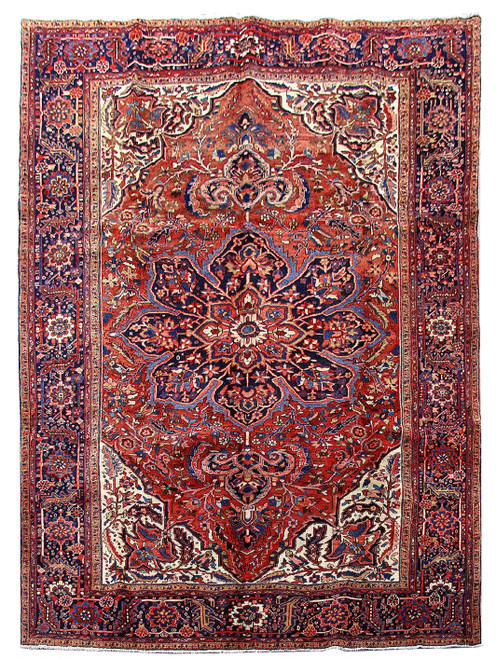
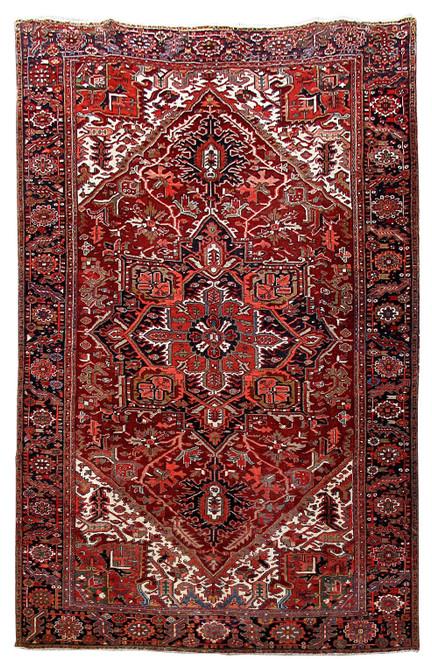
This is a classic village Heriz in the format most people are actually looking for: a brick red field, a big stepped medallion in navy and ivory, and heavy ivory corner spandrels that lift the whole piece. The pile is a full 3/8" of dry, springy highland wool on a cotton foundation, and the handle is firm rather than floppy, which is exactly how a well woven Heriz should feel in the hand. Condition is excellent, with even pile from edge to edge and tight, original selvages. Shoppers comparing 8x11 Persian rugs generally end up in this bracket because it covers a seating group without crowding the walls. Every rug we ship leaves Freeport with a certificate of authenticity documenting origin, materials and hand-knotted construction.
Please Note About the Photographs:
The first full overhead photograph was shot in warmer, lower light and reads darker and more oxblood than the rug does in person. The close-up images show the truer brick red, navy blue and ivory. That difference is lighting only, not fading, staining, wear or damage.
Design and Motifs
The center holds a stepped, cruciform medallion with ivory hooked arms radiating from a small rosette core, set on a navy ground and ringed by a serrated outline that steps out in short, deliberate jogs rather than curves. Four anchor pendants run out along the vertical axis, and the field around the medallion is filled with angular vine work, hooked leaves, blocky palmettes and small squared cartouches, each one drawn in straight lines because this is knot-counted graph drawing done from memory rather than from a fine cartoon. The ivory spandrels repeat the same vocabulary at larger scale, with stepped inner edges that echo the medallion profile. A navy main border carries alternating medallions and rosettes between two narrow guard stripes and an outer barber-pole minor border. Among geometric Persian rugs, this is the drawing that reads well from a standing height and still rewards a close look from a sofa.
A Detailed Look at the Colors
The field is a deep brick red that moves between tomato and oxblood across the width, a natural abrash from separate dye lots of hand-spun wool that gives the ground depth instead of a flat printed look. The medallion ground and the main border run to a saturated indigo navy, cooled with a lighter cornflower blue in the outlines and small fill motifs. Undyed ivory does the structural work: it forms the hooked arms of the medallion, the two big corner spandrels, the hairline guard stripes and the tiny dots along the outer minor border, and it is what keeps the red and navy from closing in. Olive and sage green appear in the pendant leaves, the spandrel cartouches and scattered rosettes, while camel and walnut brown warm the corner fillers and some of the vine work. Near black outlines every major shape, and small touches of soft rose and pale blue flicker through the field like confetti when the light moves across the pile.
Heriz Origin and Weaving Quality
Heriz is a group of weaving villages east of Tabriz in northwest Persia, spread out below Mount Sabalan, and its reputation rests on two things: mineral-rich water that sets dye with unusual permanence, and mountain wool so tough and high in lanolin that Heriz floors routinely outlive the houses they were bought for. Weavers here work from memory on a coarser knot scale than the city workshops, which is why the drawing is angular and the medallion steps instead of sweeping, and village pieces like this generally sit under 200 knots per square inch. That is not a shortcoming, it is the point: fewer, larger knots in thick wool give you a dense, heavy structure with a long pile that takes traffic, sun and furniture legs for decades. The back of this rug shows clean, regular knot rows and no repairs, and the 3/8" pile still stands up straight, which tells you this 8'2" x 11'6" Heriz has plenty of service life ahead of it.
8'2" x 11'6" Persian Heriz Rug | Geometric Medallion & Ivory Corners | Excellent Condition Wool Pile
Ask about this rug
This piece is the only one of it, so the things worth knowing about it are particular to it. If you want to talk through the size, the colour in your own light, or the weave, speak to someone here first.