Watch the film
| Size in ft: | Width: 8'2" x Length: 11'6" |
| Size in Inch: | Width: 98" x Length: 138" |
| Size in meters: | Length: 3.51 x Width: 2.49 m |
| Colors: | Antique Red, Blue, Green, Ivory |
| Shape: | Rectangular |
| Woven: | Hand-Knotted |
| Pile: | 3/8" Wool |
| Origin: | Persia |
| Design: | Heriz |
| Age: | 1970's |
| Condition: | Perfect |
8'2" x 11'6" Persian Heriz Rug | Antique Red Geometric Medallion | 1970s, Perfect Condition
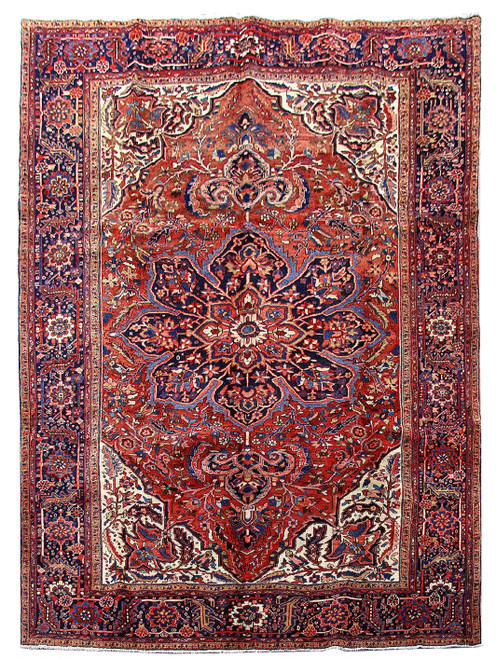
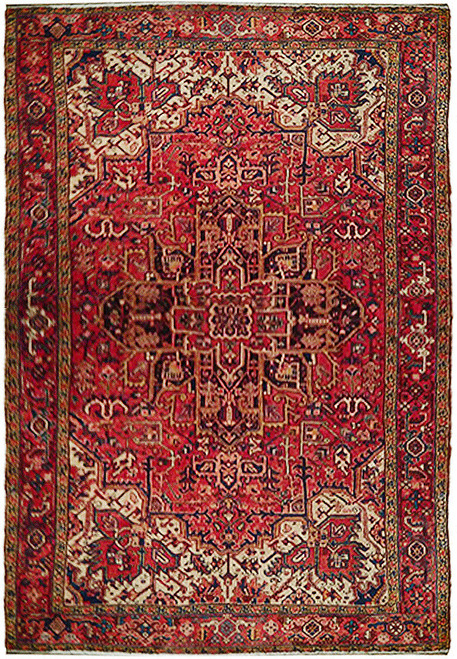
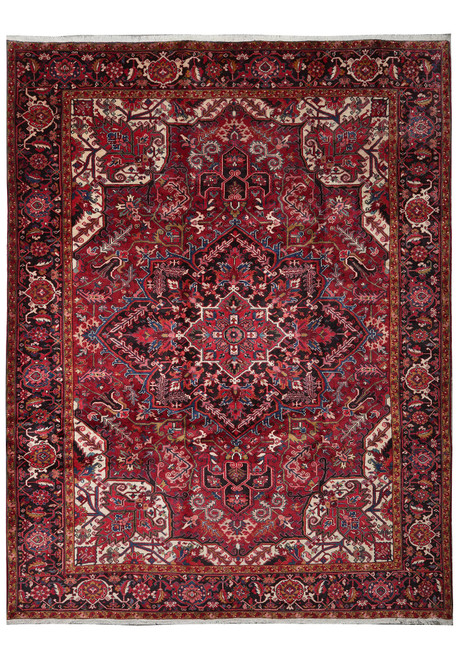
This 8'2" x 11'6" Persian Heriz is the kind of village rug a family keeps for three generations. A deep antique red field carries an 8 lobed star medallion in navy and camel, and ivory spandrels open up all 4 corners so the drawing never feels heavy. It was woven in the 1970s, yet the wool still stands a full 3/8" deep, the ends and sides are original and untouched, and the condition reads Perfect rather than merely good. At just under 95 square feet it covers a full seating group or sits under a long dining table with chairs pulled back, which puts it squarely among the 8x11 Persian rugs most American rooms are built for. It ships with a certificate of authenticity recording origin, materials, age and hand-knotted construction.
Design and Motifs
The center holds a camel ground cartouche filled with pale blue and coral stepped squares around a small 8 petal rosette, ringed by ivory outlined petals and heart shaped pendants. From that core, 8 navy lobes radiate outward, each packed with coral palmettes and olive leaf sprays, and two navy pendant palmettes drop away along the length toward each end. The open red field between medallion and border is drawn with the angular vocabulary that defines geometric Persian rugs: curled vine tendrils in ivory, serrated leaves, small blocky rosettes and tiny bird forms tucked between stems. The ivory corner spandrels repeat the medallion idea in miniature, each with its own hooked outline and central rosette. The wide navy main border alternates hexagonal cartouches filled with teal leaf sprays against coral 8 petal flowers, with grey lilac floral guard stripes and fine barber pole stripes framing it on both sides.
Antique Red, Navy, Green and Ivory
The field is an antique red with real depth to it, closer to brick and terracotta than to fire engine, and it shifts slightly from one end of the rug to the other the way naturally dyed village wool does. Against that sits a near black navy blue in the medallion lobes, the pendants and the main border, which is what gives the rug its graphic punch in photographs and in person. The greens run two ways: a bright lime olive in the leaves and a cooler teal that fills the border cartouches and flickers through the medallion. Ivory does the lighting work, in the corner spandrels, the outlines around the medallion petals and the thin guard stripes. Coral, salmon, camel, soft grey blue and a few small violet rosettes round out the palette, so the rug reads warm and traditional while still carrying enough blue and green to sit beside cooler upholstery.
Heriz: Village Weaving East of Tabriz
Heriz is a cluster of villages east of Tabriz in northwest Persia, on the lower slopes below Mount Sabalan. The wool there is famously tough and the local water is mineral rich, a combination credited with the wiry lustre and the extraordinary wear resistance these rugs are bought for. Weavers work from memory and from small drawings rather than a full workshop cartoon, which is why the line stays straight, the corners step rather than curve, and no two Heriz medallions are identical. Village weave of this type usually sits under 200 knots per square inch, and that is by design: a heavier knot on a strong cotton foundation, with a 3/8" wool pile that takes furniture, dogs and decades of foot traffic without thinning. If you want to understand where a piece like this falls between semi-antique and antique, our guide on how to date an Oriental rug walks through the same clues we used to place this one in the 1970s.
8'2" x 11'6" Persian Heriz Rug | Antique Red Geometric Medallion | 1970s, Perfect Condition
Ask about this rug
This piece is the only one of it, so the things worth knowing about it are particular to it. If you want to talk through the size, the colour in your own light, or the weave, speak to someone here first.