Watch the film
| Size in ft: | Width: 10'3" x Length: 13'10" |
| Size in Inch: | Width: 123" x Length: 166" |
| Size in meters: | Length: 4.22 x Width: 3.12 m |
| Colors: | Brick, Black Blue, Olive, Ivory |
| Shape: | Rectangular |
| Woven: | 100% Hand-knotted | Handmade |
| Foundation: | Cotton |
| Pile: | |
| Design: | Heriz | Geometric medallion | Ivory corner spandrels |
| Origin: | Persian Heriz | Made in Persia |
| Condition: | Excellent |
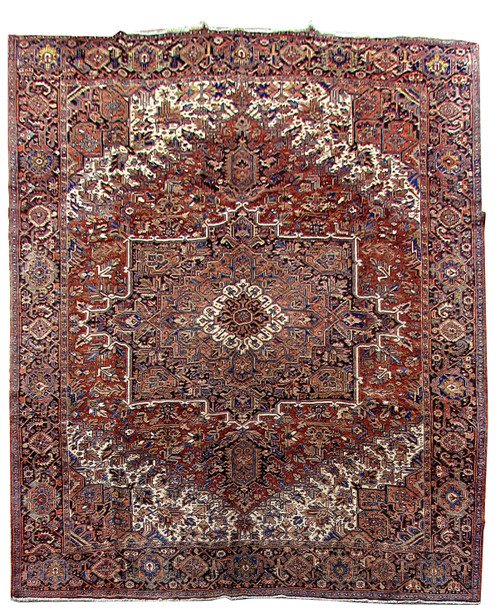
10'3" x 13'10" Persian Heriz Rug | Brick Red Geometric Medallion | Ivory Spandrels
This is a full room size Persian Heriz, 10'3" x 13'10", hand-knotted in wool on a cotton foundation and built the way the village looms east of Tabriz have built rugs for well over a century. The field is brick red, the medallion is drawn in blue black with a blue and ivory core, and the corner spandrels are ivory, which is the drawing collectors look for first when they judge a Heriz. The pile is even and full, the sides and ends are sound, and the rug reads as one clean piece of work rather than a patchwork of repairs. It ships with a certificate of authenticity confirming it as a hand-knotted Persian rug, and at this footprint it belongs with the 10x14 Persian rugs that anchor a large living room or a long dining table without crowding the walls.
Design and Motifs
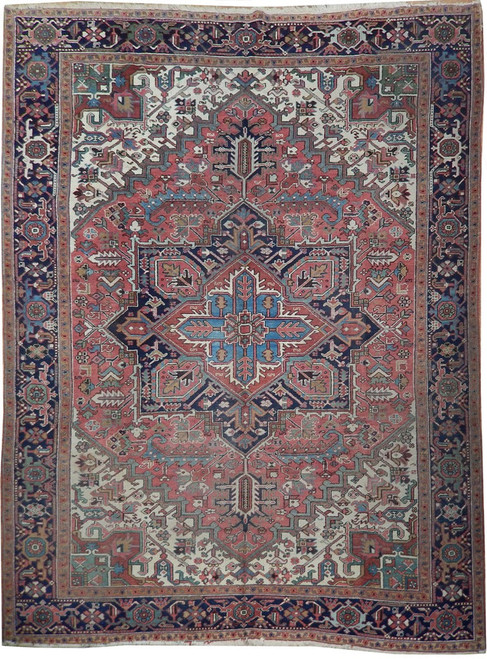
The center carries a large stepped medallion with 8 lobes, outlined in ivory and filled with a lattice of blue palmettes, small rosettes and hooked leaf forms over a deep blue black ground. Anchor pendants run off the top and bottom on the long axis, each one a stacked arrangement of hooks and serrated leaves rather than a single vase form. Around the medallion the brick field is packed with angular vinework: large serrated leaves, split palmettes, small birds worked in blue, and scattered 4 petal blossoms that fill every open inch. The 4 ivory corner spandrels repeat the same vocabulary against a pale ground, which throws the whole geometry into relief. Borders run 5 deep, a wide blue black main band of alternating rosettes and diamond cartouches flanked by olive and rust guard stripes and a fine reciprocal ivory zigzag. Every line here is straight or stepped, never curved, which is the honest mark of geometric Persian rugs drawn from memory at the loom.
Colors in This Heriz
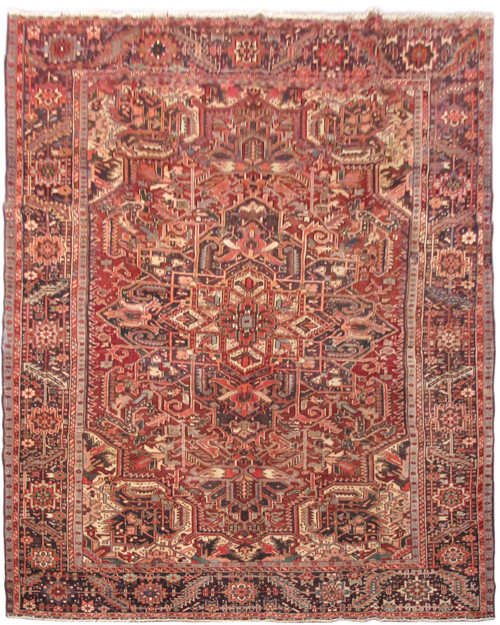
The field is a warm brick red that shifts between a terracotta tone and a deeper madder rose depending on which way the pile is brushed, visible in the angled photographs where the nap turns lighter across the top half. Against it the medallion and main border sit in a blue black so dark it reads almost charcoal until light hits the blue in it. The ivory is a soft unbleached cream, not a bright white, and it appears in the spandrels, in the medallion outline and in the fine reciprocal border stripe. Olive green runs through the guard stripes and through many of the serrated leaves, giving the red something cool to push against. Smaller accents fill in the detail work: cornflower and indigo blue in the birds and palmette hearts, salmon and dusty rose in the flower heads, camel and light gold in the vine tips, and a rust brown in the outer band. Nothing in the palette is loud. It is a red rug, but a red built from many dyes rather than one.
Heriz Weaving and Origin
Heriz is a cluster of villages east of Tabriz in northwest Persia, sitting below Mount Sabalan. The water there is mineral rich, and the local sheep grow a wool that is famously tough, high in lanolin and slow to abrade, which is why Heriz rugs from a century ago are still on floors in American houses today. Weavers work from memory on cotton warps, which is what produces the bold angular drawing instead of the flowing curved line of a city workshop cartoon. Village Heriz work usually sits under 200 knots per square inch, and that is by design: the heavy wool pile and thick handle are the point, not fineness. The back of this rug, shown against the ruler, has the regular knot lines and firm handle of a properly beaten weave, and the pile is deep enough to take decades of traffic. As a floor covering it is one of the most practical serious rugs in the Persian canon, and one of the few that genuinely improves as it wears.
10'3" x 13'10" Persian Heriz Rug | Brick Red Geometric Medallion | Ivory Spandrels
Ask about this rug
This piece is the only one of it, so the things worth knowing about it are particular to it. If you want to talk through the size, the colour in your own light, or the weave, speak to someone here first.