Watch the film
| Size in ft: | Width: 7'5" x Length: 10'1" |
| Size in Inch: | Width: 89" x Length: 121" |
| Size in meters: | Length: 3.07 x Width: 2.26 m |
| Colors: | Red, Navy Blue, Ivory, Sky Blue, Gold, Green |
| Shape: | Rectangular |
| Woven: | 100% Hand-knotted | Handmade |
| Foundation: | Cotton |
| Pile: | |
| Design: | Heriz Geometric Medallion | Ivory Spandrels | Turtle Border |
| Origin: | Persian Heriz | Made in Persia |
| Condition: | Excellent |
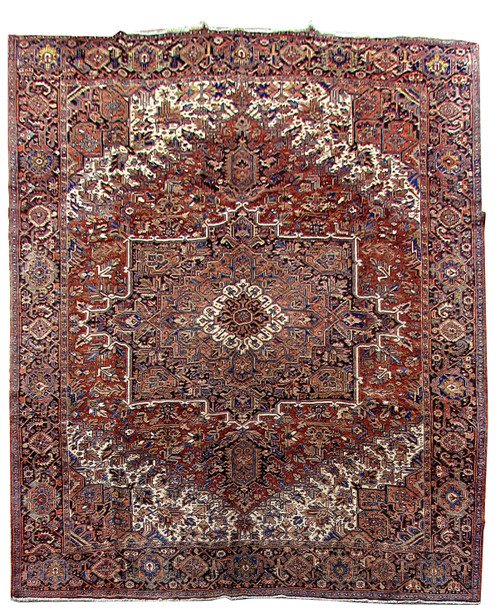
7'5" x 10'1" Persian Heriz Rug | Geometric Medallion on Red Field | Ivory Spandrels
This is a classic village Heriz in the size most people are actually shopping for, a true room piece that sits comfortably in the 7x10 Persian rug range at 7'5" x 10'1". It is hand-knotted with a wool pile on a cotton foundation, and the handle tells you everything: heavy, dense, with the springy compressed feel that comes from tough northwest Persian wool packed down hard on the loom. The back photograph shows an even, disciplined knot line across the full width with no repairs or reweaving visible. Condition is excellent, the pile is full from selvage to selvage, and both end finishes are intact. Every rug we sell ships with a certificate of authenticity confirming it is a genuine hand-knotted Persian piece.
Design and Motifs
The drawing is pure Heriz: everything curved in a city workshop cartoon has been translated here into straight lines and stepped angles, which is exactly why geometric Persian rugs from this district read so well in modern rooms. A large indigo diamond medallion anchors the center, built in tiers of notched outline, with an ivory rosette cross at its heart and 4 leaf-shaped ivory palmettes radiating from it. Above and below the medallion sit hooked anchor pendants tipped with serrated cypress leaves. The ivory corner spandrels are filled with angular vine work, blossoms and small stepped crosses, and the red field between them carries scattered hooked leaves, tiny bird-like devices and barbed palmettes, each one drawn slightly differently by hand. The main border runs a turtle palmette and rosette chain on navy, framed by narrow reciprocal guard stripes and a final barber-pole outer line.
Color Palette
The field is a warm brick red with a madder depth to it, softening toward terracotta where the light catches the pile and deepening to an almost oxblood tone in the shaded passages of the close-up photographs. Against it the medallion and border read as a dark indigo navy, with visible variation through the ground that gives the blue movement rather than a flat printed look. The spandrels are a creamy undyed ivory, warm rather than stark white, and the same ivory outlines the medallion and picks out the central cross. Secondary colors come in small, confident touches: mid sky blue in the border rosettes and leaf fills, mustard gold along the outer guard stripe and in scattered blossoms, sage and olive green in the serrated leaves, and occasional soft rose and brown notes in the corner panels. The overall effect is a red and navy rug with enough ivory to keep it bright.
Heriz Weaving and Origin
Heriz is a group of villages east of Tabriz in northwest Persia, spread out below Mount Sabalan, where the mineral-rich water is credited with producing wool that is unusually strong and takes dye with real saturation. Weavers there work from memory and from simple village cartoons rather than a fully plotted workshop drawing, which is why the two halves of a Heriz field never mirror each other perfectly and why the medallion often sits a fraction off true. That is the character collectors buy these rugs for. The knot count in village work of this type is modest by city standards, but the construction is what matters: a thick wool pile beaten down hard on a cotton foundation, producing a rug that takes decades of traffic and simply keeps going. This is the reason Heriz pieces from the early and mid 20th century are still in service in American houses today, and why a clean, complete example in this size is worth owning.
7'5" x 10'1" Persian Heriz Rug | Geometric Medallion on Red Field | Ivory Spandrels
Ask about this rug
This piece is the only one of it, so the things worth knowing about it are particular to it. If you want to talk through the size, the colour in your own light, or the weave, speak to someone here first.