Watch the film
| Size in ft: | Width: 7'5" x Length: 10'4" |
| Size in Inch: | Width: 89" x Length: 124" |
| Size in meters: | Length: 3.15 x Width: 2.26 m |
| Colors: | Navy Blue, Ivory, Terracotta, Light Blue, Rose, Sage Green, Gold |
| Shape: | Rectangular |
| Woven: | 100% Hand-knotted | Handmade |
| Foundation: | Cotton |
| Pile: | Kork Wool & Silk |
| Age: | Semi-Antique |
| Design: | Esfahan | Central Medallion | All Over Floral |
| Origin: | |
| Condition: | Excellent |
7'5" x 10'4" Persian Isfahan Rug | Navy Blue Floral Medallion | Semi-Antique Kork Wool & Silk
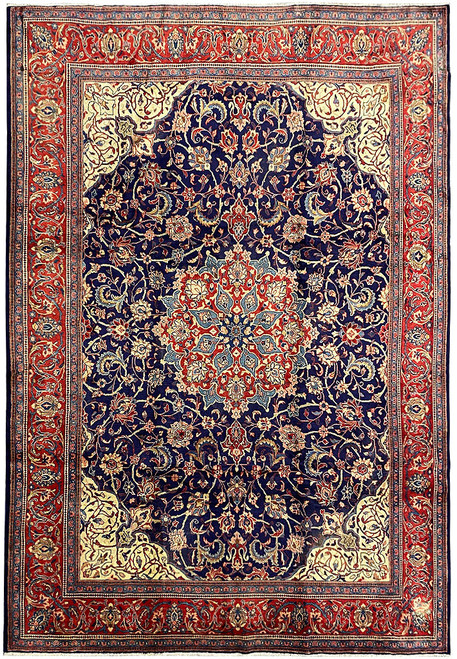
This is a semi-antique city piece from one of the great drawing towns of central Persia, and the photographs show why Persian Isfahan rugs hold their reputation. At 7'5" x 10'4" it sits right in the most usable band of 7x10 Persian rugs, large enough to anchor a seating group yet still easy to place in a room of ordinary proportions. The pile is kork wool with silk accents on a cotton foundation, and the handle is firm and even with a low, tightly clipped surface. Condition is excellent throughout: full pile edge to edge, straight sides, original hand-tied ivory fringe on both ends, and the pale blue selvage still clean and intact. Every rug we sell ships with a certificate of authenticity that records origin, materials and measurements.
Design and Motifs
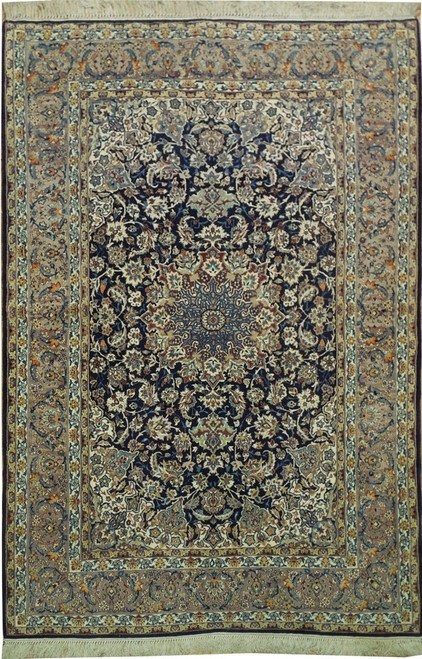
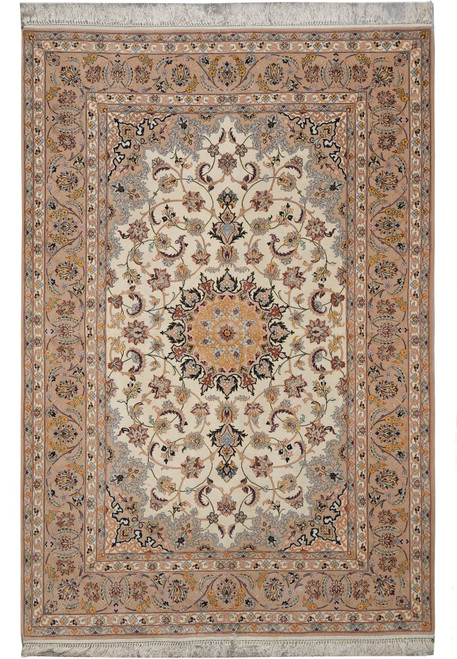
The field carries a single round medallion set on a dense all over floral ground. At the very center is a small 8 petal rosette inside a blue 8 pointed star, ringed by an ivory cloud band of split palmettes and lanceolate leaves that reads almost like a rose window. From that ring the drawing radiates outward in tiers of Shah Abbas palmettes, serrated saz leaves, and fine vine scrolls that curl back on themselves without ever crossing awkwardly. Pendant cartouches sit at the head and foot of the medallion, and the 4 corners are filled with quarter spandrels that repeat the ivory ground of the center so the composition stays in balance. The border system runs 5 bands deep: a terracotta main border of alternating palmettes and rosettes on a meandering vine, framed by narrow ivory and navy guard stripes and finished with a plain light blue outer edge. Look closely at the close-up photograph and you can follow single outline rows in black and ivory around each flower, which is the kind of detail only a fine knot count allows.
The Navy Field and Its Ivory, Terracotta and Sage Palette
The ground is a deep navy blue that reads nearly midnight indigo in shade and opens to a softer ink blue where the light catches the pile. Against it the medallion and spandrels glow in warm ivory and buttery cream, with the silk accents picking up the light differently as you walk around the rug. The floral work is drawn in a controlled palette: terracotta and brick red in the palmettes, dusty rose and salmon in the vine tips, sage and olive green in the leaves, gold in the small buds, and 2 distinct blues, a mid sky blue and a saturated cobalt, in the rosettes and star center. The main border swaps the balance, putting terracotta underneath and ivory on top, which frames the dark field and keeps the whole piece from reading heavy. The plain pale blue outer edge is an unusual and very pretty finishing touch. Buyers shopping navy blue Persian rugs will find this one works with both warm wood floors and cool grey stone.
Isfahan: Weaving Town and Weave Quality
Isfahan sits in central Persia and has been a weaving capital since the Safavid court workshops of the 16th century. The city's reputation rests less on brute knot count than on drawing: the curved line, the flowing vine, the symmetry that holds true from one side of the medallion to the other. That precision only survives at a high density of knots, which is why Isfahan looms are strung fine and the pile is clipped low. The kork wool used here is the soft short staple fleece taken from the lamb's neck, shoulders and underbelly, which is what gives the ivory ground its faint sheen and lets the weaver hold a single row outline cleanly. The reverse, shown against a tape measure in the last photograph, is tight, flat and regular, with fine cotton warps and no slack or buckling anywhere across the 7'5" width. This is workshop city weaving rather than village work, and after decades of careful keeping it still has the full pile and crisp drawing of a piece that was looked after from the day it left the loom.
7'5" x 10'4" Persian Isfahan Rug | Navy Blue Floral Medallion | Semi-Antique Kork Wool & Silk
Ask about this rug
This piece is the only one of it, so the things worth knowing about it are particular to it. If you want to talk through the size, the colour in your own light, or the weave, speak to someone here first.