Watch the film
| Size in ft: | Width: 7'9" x Length: 10'6" |
| Size in Inch: | Width: 93" x Length: 126" |
| Size in meters: | Length: 3.20 x Width: 2.36 m |
| Colors: | Salmon, Navy Blue, Ivory, Sky Blue, Soft Green |
| Shape: | Rectangular |
| Woven: | 100% Hand-knotted | Handmade |
| Foundation: | Cotton |
| Pile: | |
| Design: | Heriz | Stepped Geometric Medallion | Ivory Spandrels |
| Origin: | Persian Heriz | Made in Persia |
| Condition: | Excellent | Even low pile with age patina |
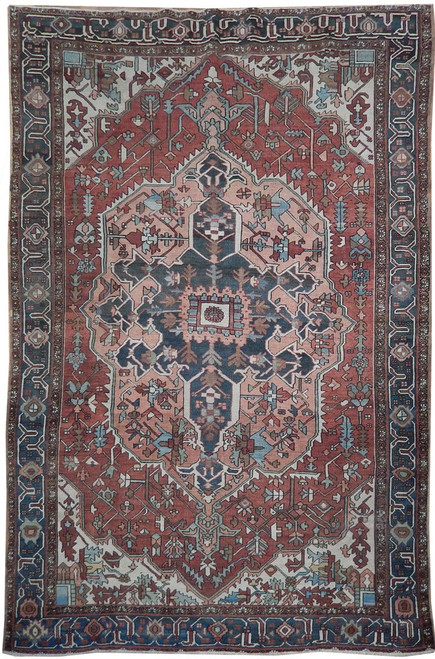
7'9" x 10'6" Persian Heriz Rug | Salmon Field with Blue Stepped Medallion | Antique Village Weave
This is a classic room-size Heriz from northwest Persia, woven on a cotton foundation with a hard-wearing wool pile and finished at 7'9" x 10'6". The field has settled into a warm salmon tone that only decades of use and light produce, and the drawing is pure village Heriz: one large stepped medallion, heavy angular pendants above and below it, and deep ivory spandrels filling the 4 corners. It sits squarely in the most usable proportion we sell, wide enough to carry a sofa group and long enough to hold a table, which is why 8x11 Persian rugs in this drawing rarely stay in stock. Every rug we sell ships with a certificate of authenticity confirming its origin, materials and hand-knotted construction.
Design and Motifs
The center holds a sky blue diamond medallion outlined in navy, stepped rather than curved, with a small dark rosette at its exact heart and serrated leaf forms radiating out to each side. Two navy anchor pendants extend north and south, and the salmon field around them is packed with angular palmettes, hooked vinery, tiny comb devices and stylized cypress forms drawn in navy, blue, ivory and soft green. The ivory spandrels repeat the same vocabulary at larger scale, with curling vines and blossom heads that give the eye a rest between the medallion and the border. The main navy border runs a rhythm of rosettes, palmettes and leaf brackets between narrow ivory and green guard stripes, while every line in the rug is straight or stepped, never curved, which is the signature of the best geometric Persian rugs.
The Salmon, Navy and Ivory Palette
The dominant color is salmon, a soft brick-coral that reads warm terracotta in daylight and deepens toward rose under lamplight. It is not a flat dye: the ground shifts subtly across the width in the gentle banding that natural madder produces, so the field breathes instead of sitting dead. Against it the border is a saturated inky navy, almost black at the outer edge, which frames the rug hard and makes the salmon look brighter than it is. The spandrels and guard stripes bring in a chalky ivory that has warmed to cream, and the medallion introduces two blues, a clear sky blue in the center and a darker indigo in the outlines. Scattered through the field are small accents of moss green, soft gold, brown and pale rose in the flower heads. The overall effect is warm rather than loud, and the palette sits comfortably with brown leather, dark wood, brass and off-white walls.
Heriz: Village Weaving East of Tabriz
Heriz is a cluster of villages east of Tabriz, below Mount Sabalan, where mineral-rich water and high pasture produce a wool so tough that Heriz rugs are the ones you still find in service after 3 generations of family traffic. The weavers work from memory and from a small cartoon rather than a full workshop drawing, which is why the medallion is not perfectly symmetrical and why the two ends of the field are not identical twins. That is the charm of the type, not a fault. Village Heriz weaving usually sits under 200 knots per square inch, the knots are heavy and the pile is cut with body, and the result is a rug built for floors rather than for walls. The even low pile, warm patina and softened dyes on this example all point to real age; if you want to understand what those signals mean, read our guide on how to date an Oriental rug before you buy.
7'9" x 10'6" Persian Heriz Rug | Salmon Field with Blue Stepped Medallion | Antique Village Weave
Ask about this rug
This piece is the only one of it, so the things worth knowing about it are particular to it. If you want to talk through the size, the colour in your own light, or the weave, speak to someone here first.