| Size in ft: | Width: 7' x Length: 11'2" |
| Size in Inch: | Width: 84" x Length: 134" |
| Size in meters: | Length: 3.40 x Width: 2.13 m |
| Colors: | Ivory, Blue, Navy, Sky Blue, Camel, Burgundy, Green |
| Shape: | Rectangular |
| Woven: | 100% Hand-knotted | Handmade |
| Foundation: | Cotton |
| Pile: | Wool and Silk |
| Age: | 2000's |
| Signature: | Woven cartouche in the upper end border |
| Design: | Nain | Central medallion | All-over floral vine |
| Origin: | Persian Nain | Made in Persia |
| Condition: | Perfect |
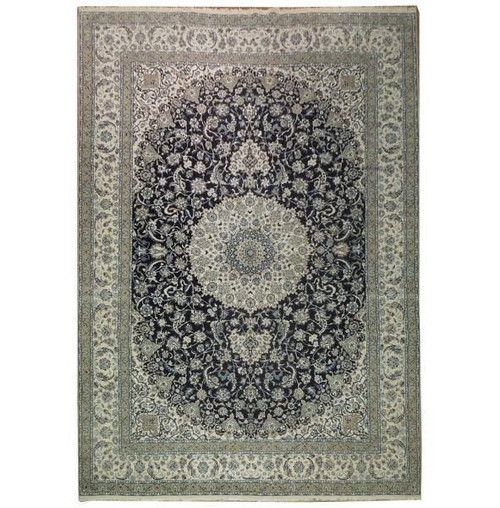
7' x 11'2" Persian Nain Rug | Ivory & Blue Wool and Silk Medallion | Signed Cartouche
This 7' x 11'2" Persian Nain rug is the town's classic statement piece: an ivory ground, a single round medallion, and a pile of fine wool lifted with silk in the outlines and the small floral heads. The drawing is tight and symmetrical from end to end, the ivory has the faint sheen that only silk-highlighted Nain work gives, and the end border carries a woven cartouche, which on a piece of this town is the weaver or workshop putting a name to the finished rug. Woven in the 2000's on a cotton foundation and in perfect condition, it ships with a certificate of authenticity confirming origin, materials and hand-knotted construction.
Please Note About the Photographs:
The first catalogue image was taken on a white studio sweep and reads cooler and greyer than the rug actually is. The floor photographs, shot in daylight, show the true tone: a warm ivory ground with camel and navy borders. Judge the color from those images and from the close-ups of the medallion and border.
Design and Motifs
The field is built around one large round medallion whose core is an 8 petal star, each petal filled with a dense curl of islimi scrollwork and ringed by two tiers of small rosettes and palmettes. Out of the medallion run thin vines that carry Shah Abbasi palmettes, lotus heads and feathered leaves across the ivory ground in strict mirror symmetry, top to bottom and side to side. The 4 corners answer the medallion with quarter spandrels in deep navy, and the main border sets large cartouche panels and lobed rosettes against a camel field, framed inside and out by narrow guard stripes of running vine. The end border adds a row of upright tulip finials above the fringe, and it is in that band that the signature cartouche sits, a small woven inscription in the ivory strip just below the kilim end.
The Ivory Ground and the Blue Palette
Nain works in a narrow, disciplined palette and this rug is a textbook example. The ground is a warm ivory, closer to unbleached cream than to white, and it stays even across the full 11'2" length. Against it the blues do the work: near black navy in the medallion cartouches, the corner spandrels and the vine tracery, then a soft powder sky blue in the flower heads and the lobed rosettes of the border, with a mid denim blue bridging the two. The main border shifts to a camel tan that warms the whole rug and keeps the ivory from reading cold. Scattered through the florals are small quantities of burgundy, bottle green, chestnut brown and taupe, used a few knots at a time in a petal center or a leaf tip. The silk sits mostly in the outlines and the pale blue accents, so the pattern catches light and changes value as you walk around it.
Nain: The Town and the Weave
Nain sits on the edge of the central desert east of Isfahan, and its rug industry is young by Persian standards, growing out of a fine wool cloth trade in the 1930s. The weavers took the Isfahan vocabulary of curved vine and court florals and reworked it in ivory and blue on a cotton foundation, and within a generation Nain was one of the most recognizable names in Persia. Quality there is described by the number of threads twisted in each warp, which is why collectors talk about Nain 6La and Habibian rugs as the top of the town's output. What you can judge on this piece is the evidence in the photographs: small, even knots, a clean curved line through the vine, silk holding the outlines crisp, and a signed cartouche that tells you a workshop was willing to be identified with it.
7' x 11'2" Persian Nain Rug | Ivory & Blue Wool and Silk Medallion | Signed Cartouche
Ask about this rug
This piece is the only one of it, so the things worth knowing about it are particular to it. If you want to talk through the size, the colour in your own light, or the weave, speak to someone here first.