Watch the film
| Size in ft: | Width: 8'1" x Length: 10' |
| Size in Inch: | Width: 97" x Length: 120" |
| Size in meters: | Length: 3.05 x Width: 2.46 m |
| Colors: | Beige, Brown, Olive, Rust |
| Shape: | Rectangular |
| Woven: | 100% Hand-knotted | Handmade |
| Foundation: | Cotton |
| Pile: | Wool and Silk |
| Age: | New |
| Design: | Tabriz Mahi | Herati Fish Pattern | Central Medallion |
| Origin: | Made in India |
| Condition: | Perfect | Never used |
8'1" x 10' Tabriz Mahi Rug | Wool and Silk Herati Fish Pattern | Brand New
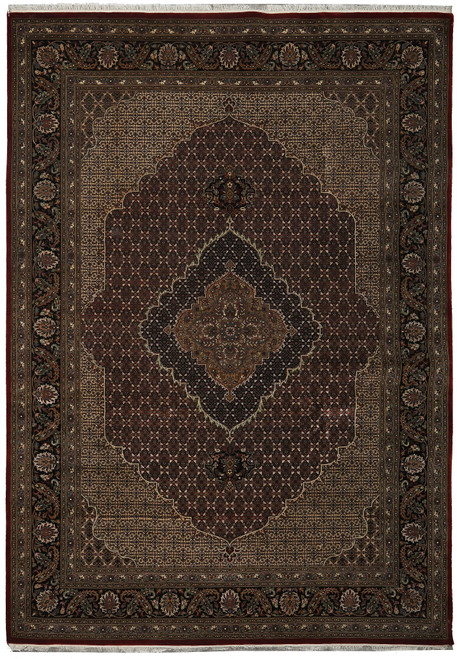
At 8'1" x 10' this is one of the most disciplined drawings in the hand-knotted repertoire, worked at a scale that sits under a sofa group or a 6 seat table without crowding either. The whole field is a fine herati fish lattice in beige, brown and rust, interrupted only by a single scalloped medallion, two pendants and 4 quartered corners. The pile is wool with silk accents on a cotton foundation, the knotting is tight enough to keep every tiny rosette legible, and the rug is brand new with no wear anywhere. Buyers comparing 8x10 area rugs will find this one unusually quiet in color for how busy the drawing is. It ships with a certificate of authenticity.
Please Note About the Photographs:
In the overhead showroom photographs a pale, slightly hazy area appears in the upper part of the field. That is studio light bouncing off the pile direction and the silk accents, not wear, fading or damage. The condition is perfect and the rug has never been used. Every rug is professionally steamed and pressed before it leaves us.
Design and Motifs
Mahi means fish, and the name comes from the small curved leaves that flank each rosette inside the lattice diamonds, read for generations as fish circling a pond. Here that unit repeats across the entire field in perfect register, hundreds of times, each diamond framed by a thin rust outline with a darker floret at every intersection. The center holds a scalloped medallion with a lobed inner cartouche, both filled with the same herati units on a deep brown ground so the medallion reads as a change of color rather than a change of drawing. Slim pendants rise and fall from the medallion on the long axis, and matching brown spandrels fill the 4 corners, their scalloped edges outlined in a pale line that traces the shape cleanly against the light field. The main border is an ivory vine carrying alternating palmettes and open rosettes, and it is flanked by 6 narrow guard stripes, including a reciprocal zigzag in ivory and a small repeating floret band, that step the pattern down to the tan selvedge.
A Beige Field with Brown, Olive and Rust
The ground is a warm beige that reads closer to cream in the close-up photographs and closer to camel in the full overhead views, which is what happens when silk accents sit next to matte wool. Against it the medallion and the corner spandrels are a deep chocolate brown that darkens almost to charcoal at the core. The lattice lines are rust and terracotta, the leaf and rosette fillings pick up olive and sage green, and scattered through the field are tiny florets in soft blue and clean ivory that keep the repeat from turning flat. The main border inverts the balance, putting rust palmettes and olive foliage on ivory, while the guard stripes add a dusty rose and a near black outline for definition. Nothing here is loud. It is a neutral rug in the practical sense, brown and beige at a distance, with the greens and rusts only showing up when you stand over it.
Made in India, Woven in the Mahi Tradition
This rug was hand-knotted in India, which is where most of the world's best contemporary hand-knotted work is now produced, and we say that with no hedging. The Mahi drawing itself belongs to the weavers of Tabriz, and Indian workshops adopted it because it is the hardest kind of pattern to fake: a repeat that fine shows every dropped knot and every wobble in the line. On this piece the repeat holds straight from selvedge to selvedge, the medallion outline curves without stepping, and the pile is clipped low so the small motifs stay sharp. The back shows an even, tight weave on cotton warps, and the wool has a soft handle with the silk catching light along the border scrolls. If you are weighing what separates one Oriental rug from another, this is the kind of execution that answers the question in the hand rather than on paper.
8'1" x 10' Tabriz Mahi Rug | Wool and Silk Herati Fish Pattern | Brand New
Ask about this rug
This piece is the only one of it, so the things worth knowing about it are particular to it. If you want to talk through the size, the colour in your own light, or the weave, speak to someone here first.