Watch the film
| Size in ft: | Width: 8'1" x Length: 11' |
| Size in Inch: | Width: 97" x Length: 132" |
| Size in meters: | Length: 3.35 x Width: 2.46 m |
| Colors: | Brown, Gray, Rust, Ivory, Sand Beige, Teal |
| Shape: | Rectangular |
| Woven: | 100% Hand-knotted | Handmade |
| Foundation: | Cotton |
| Pile: | Wool | Low pile |
| Age: | 1960s | Vintage |
| Design: | Vintage Tabriz | Floral rosette medallion | Pendant finials |
| Origin: | Persian Tabriz | Made in Persia |
| Condition: | Good | Low pile throughout | No repairs |
8'1" x 11' Persian Tabriz Rug | Vintage 1960s Low Pile | Muted Brown, Gray & Rust
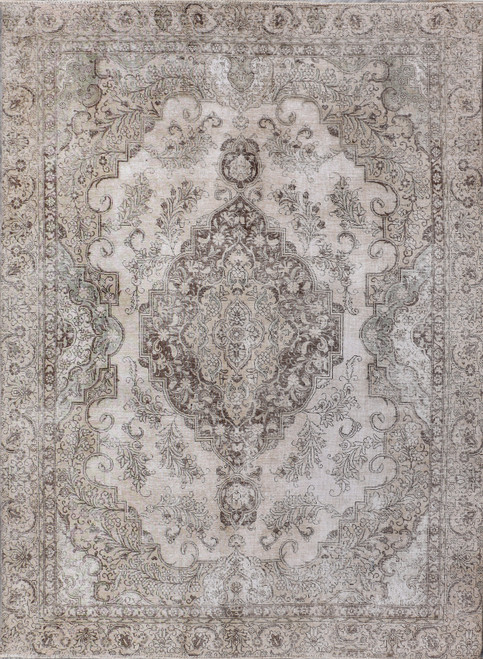
This 8'1" x 11' Tabriz was knotted in northwest Persia in the 1960s, and six decades of living have taken it exactly where decorators now go looking: a gray-brown field the color of weathered driftwood, a rust medallion that has burnished toward salmon, and ivory that reads like old parchment. The pile is low and evenly worn across the whole rug, which is what gives it that flat, almost woven-linen surface and lets the fine drawing show without a shadow of plush standing in the way. Foundation is cotton, the pile is hand-knotted wool, and the rug carries no repairs or reweaves. Every piece we ship travels with a certificate of authenticity. At 8 feet by 11 feet it belongs squarely with our 8x11 Persian rugs, large enough to carry a full sofa and two chairs with all legs on the wool.
Please Note About the Photographs:
This is a genuinely vintage rug with a low pile, and we photograph it that way on purpose. The close-up images show the short, softened wool and the pale, chalky tones that come from age and use, not from bleaching or a chemical wash. The wear is even, there are no holes, open areas or repairs, and the rug lies flat and sound. Colors look softer and grayer in daylight than in direct flash, and every rug is professionally steamed and pressed before it ships.
Design and Motifs
The center holds a 12 petal rosette medallion built in layers: an ivory core packed with fine vine work and small rose sprays, then a ring of rust petals, each one outlined in dark brown and filled with its own blossom. Slim pendant finials reach from the top and bottom of the medallion into the open field, a workshop detail that village weavers rarely attempt. The field is not empty, it carries a quiet all over tracery of leaves, buds and tiny blossoms drawn in curved line rather than the angular, stepped forms you see in rugs from the villages east of the city. All 4 corner spandrels answer the medallion in rust, each one filled with ivory arabesques and anchored by a single teal rosette, the one truly cool note in the whole rug. A sand-beige main border runs with alternating palmettes and rose sprays, framed by narrow guard stripes of reciprocal cartouches and a fine running meander that keeps the composition tight.
A Softened Palette of Brown, Gray and Rust
The field is the whole story: a warm gray-brown that swings toward mushroom under lamplight and toward a dusty lavender-gray in daylight, the kind of neutral that is almost impossible to reproduce in new production. Against it the medallion and spandrels carry rust, brick and salmon, warm but never loud, with pinkish coral showing where the pile has burnished most. Ivory and buttery cream open up the medallion core and the small guard stripe, soft teal and sea green appear in the corner rosettes and scattered leaf tips, and the borders settle into sand-beige with olive shading and brown outlines that hold every motif in place. Because the pile is low, the colors sit flat and chalky rather than deep and saturated, which is precisely why a rug like this works so easily with white walls, dark wood floors, chrome and leather, and warm oak furniture, as the room photo shows.
Woven in the Tabriz Tradition
Tabriz, in the northwest of Persia, is the city that made the curved line a commercial standard, and its weavers measure fineness in Raj, the number of knots across a gereh of about 2.75 inches. This piece carries the hallmarks of that workshop culture: a cotton foundation with firm double wefting, a dense and regular knot count visible on the reverse in the fold photo, flat-lying selvedges and a pre-drawn cartoon behind the symmetry of the medallion, pendants and spandrels. The back reads clean and tight, with no tension waves or crowding, which is why a rug worn this low still lies perfectly flat. Mid-century production like this, roughly 1960s by weave, wool and palette, is now the sweet spot for buyers who want real age without antique pricing, and if you want to understand how weavers and dealers put a date on a piece, our guide on how to date an oriental rug walks through the same clues we used here.
8'1" x 11' Persian Tabriz Rug | Vintage 1960s Low Pile | Muted Brown, Gray & Rust
Ask about this rug
This piece is the only one of it, so the things worth knowing about it are particular to it. If you want to talk through the size, the colour in your own light, or the weave, speak to someone here first.