| Size in ft: | Width: 8'1" x Length: 9'9" |
| Size in Inch: | Width: 97" x Length: 117" |
| Size in meters: | Length: 2.97 x Width: 2.46 m |
| Colors: | Ivory, Sage Green, Blue, Rust |
| Shape: | Rectangular |
| Woven: | 100% Hand-knotted | Handmade |
| Foundation: | Cotton |
| Pile: | Wool and Silk |
| KPSI: | 60 Raj | Approx. 400 |
| Age: | Recent | Unused |
| Signature: | Small woven inscription in the border |
| Design: | Tabriz Medallion | Floral Vine | Bird and Animal Motifs |
| Origin: | Persian Tabriz | Made in Persia |
| Condition: | Perfect | Never used |
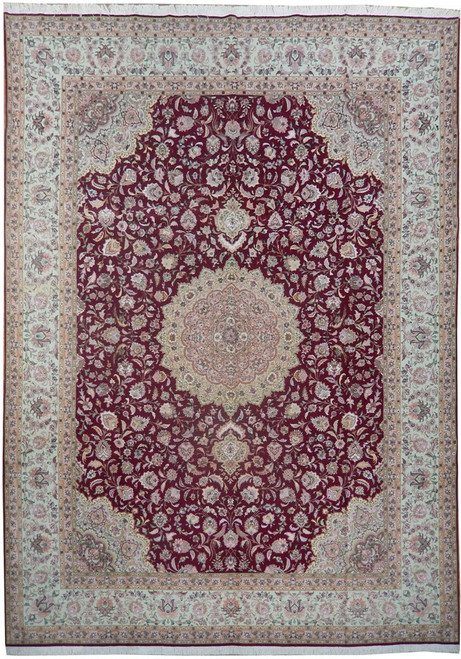
8'1" x 9'9" Persian Tabriz Rug | Ivory Wool and Silk Medallion | 60 Raj, Approx. 400 KPSI, Never Used
This is a workshop piece, not a village rug. Woven at roughly 400 knots per square inch (60 Raj) in fine wool with silk worked into the highlights, the 8'1" x 9'9" format sits right in the sweet spot of 8 x 10 Persian rugs, large enough to carry a full seating group and still fine enough to read like a drawing rather than a pattern. The pile is dense and low, the handle is firm over a cotton foundation, and the rug has never been used, so the silk accents still throw light the way they did on the loom. A small woven inscription sits in the rose border along one end, the maker's mark that separates a named workshop from anonymous production. Every rug ships with a certificate of authenticity.
Design and Motifs
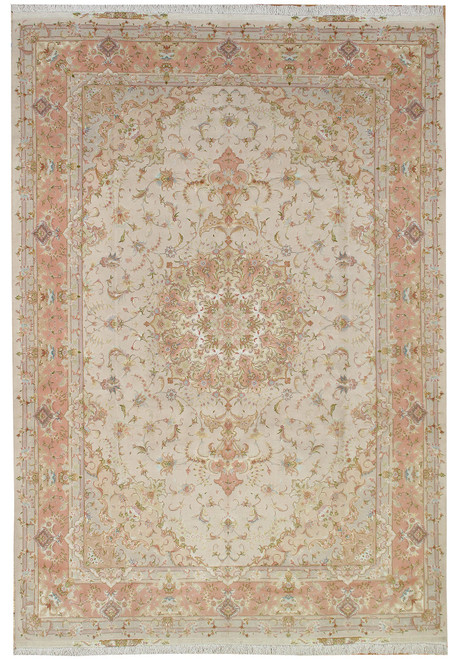
The drawing is the classic Tabriz medallion formula executed at a very high level. A layered central medallion fills the middle of the field, built from a small starburst rosette at the core, then rings of palmettes and cupped leaves, then a scalloped outline with slender pendants top and bottom. Around it the ivory field is covered edge to edge with a fine arabesque vine that never repeats crudely: split palmettes, 8 petal rosettes, tulip heads, curling saz leaves and tiny birds tucked into the scrollwork, all mirrored across both axes. The 4 corner spandrels drop out of the field in green and gold, each one filled with large palmettes, cypress like leaf forms and more perched birds, so the ivory ground reads as a lobed cartouche floating inside a darker frame. The main border runs a camel gold ground with alternating rounded medallions and flowering vine, flanked by rose guard stripes carrying small turtle palmettes and bud chains. What makes it convincing is the curvature: at this knot count the weaver can turn a vine in a true arc instead of stepping it, and the close-up photographs show exactly that.
Ivory Field, Sage Green Corners and Rust Rose Medallion
The ground is a warm ivory, closer to unbleached cream than white, and it is the reason the rug feels light in a room despite the density of the drawing. Against it the medallion is worked in dusty rust and old rose, shading through salmon and soft brick, with a sage and mint green center that cools the whole middle of the rug. The corner spandrels move from sage green into a deep camel and tobacco brown, and that gold carries straight out into the main border, so the perimeter reads as honey and bronze rather than red. Rose and clay pink handle the guard stripes and the outer edge. Through the vine work there are small hits of slate blue and steel grey in the palmette hearts, cream white in the little five petal blossoms, and dark charcoal brown used as an outline color that keeps every element crisp. The blue listed in the specification appears in these accents rather than as a field color. The silk shows up where the light hits the pale stems and the rosette centers, giving a subtle sheen that shifts as you walk around the rug.
Woven in Tabriz, Northwest Persia
Tabriz sits in the northwest corner of Persia and has been the commercial and technical capital of Persian weaving for centuries, the city that supplied the great court cartoons and later the export trade. Fineness there is measured in Raj, the number of knots counted across a gereh of about 2.75 inches: 40 Raj is ordinary commercial work, 50 Raj is genuinely fine, and 60 Raj, which is where this rug sits at roughly 400 knots per square inch, is the grade serious collectors look for. Above that only a handful of ateliers attempt 70 Raj. Tabriz weavers use a hook ended knife and work on a cotton warp, which is what gives a rug like this its flat, disciplined back and its ability to hold a curved line without wobbling. The presence of a woven signature in the border, the silk highlighting and the symmetry of the cartoon all point to a named urban workshop rather than a general market weave. A Tabriz at this count is a rug you buy once.
8'1" x 9'9" Persian Tabriz Rug | Ivory Wool and Silk Medallion | 60 Raj, Approx. 400 KPSI, Never Used
Ask about this rug
This piece is the only one of it, so the things worth knowing about it are particular to it. If you want to talk through the size, the colour in your own light, or the weave, speak to someone here first.