Watch the film
| Size in ft: | Width: 8'10" x Length: 11'6" |
| Size in Inch: | Width: 106" x Length: 138" |
| Size in meters: | Length: 3.51 x Width: 2.69 m |
| Colors: | Red, Brick Red, Navy Indigo, Ivory, Sky Blue, Salmon, Olive |
| Shape: | Rectangular |
| Woven: | 100% Hand-knotted | Handmade |
| Foundation: | Cotton |
| Pile: | |
| Design: | Heriz | Floral Medallion | Ivory Spandrels | Navy Main Border |
| Origin: | Persian Heriz | Made in Persia |
| Condition: | Excellent |
8'10" x 11'6" Persian Heriz Rug | Semi-Antique Floral Medallion | Red Field with Navy Palmettes
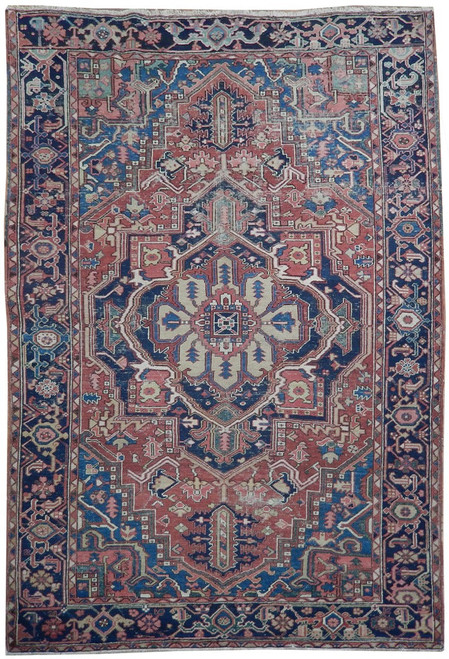
This 8'10" x 11'6" Heriz is a semi-antique piece with the softened, slightly muted color that only decades of honest use give a wool pile, and it has come to us in excellent condition with even pile from end to end and clean, original cotton fringe. It is a more refined drawing than the average village Heriz: the medallion is lobed and floral rather than strictly angular, and the weaver held the drawing steady across nearly 12 feet of length. At just under 9 feet wide it sits squarely in the 9x12 Persian rug range, the size most buyers want under a sofa group or a full dining set, while reading a touch trimmer than a true 9x12. Every rug we ship carries a certificate of authenticity naming origin, materials and construction.
Design and Motifs
The center holds an 8 petal ivory rosette with a small navy core, ringed by 8 large navy cartouches that together read as one great flowering medallion. Each cartouche is filled with its own rose and sky blue floral spray, so the medallion has depth rather than a flat silhouette. Above and below it, crisp navy and ivory palmettes with curling split leaves anchor the field, and the open red ground between them is scattered with small rosettes, serrated leaves and thin vines. All 4 corners carry ivory spandrels drawn with dark palmettes and leaf forms, which frames the field and pulls the eye inward. The wide navy main border runs an alternating rhythm of rosette heads and angular vine, flanked by ivory and salmon guard stripes with a fine zigzag ribbon, the sort of fully resolved border a village workshop weaver drew from memory.
The Color: Brick Red, Indigo and Ivory
The field is a brick red with a terracotta warmth to it, lighter and dustier than a Kashan crimson, and it carries the faint horizontal variation of a naturally dyed wool that has aged gracefully. Against it, the navy indigo of the cartouches and the main border reads almost black in the shadows and clearly blue where light hits the pile. Ivory does the structural work: the center rosette, the outlines around every cartouche, the 4 corner spandrels and the guard stripes. Inside the flowers you find salmon pink, soft rose, a clear sky blue, a deeper teal and small passages of olive and camel that give the drawing its age. It is a warm, forgiving palette that lives easily with oak and walnut floors, cream walls and leather, and it belongs with the red and burgundy Persian rugs that read rich rather than loud.
Heriz: Woven in the Villages East of Tabriz
Heriz names a group of villages east of Tabriz in northwest Persia, on the slopes below Mount Sabalan, where mineral-rich water is credited with the tough, slightly glassy wool that makes these rugs famous for outlasting the houses they are bought for. The classic Heriz is bold and angular; this one belongs to the better end of the tradition, where a workshop weaver kept the curved line and the floral fill while holding the sturdy Heriz structure underneath, cotton warp and weft with a firm wool pile clipped at a practical height. That combination is why a Heriz takes a hallway of traffic, a dining chair pushed back and a family dog without going thin. The soft, settled tones and the wear pattern place it a generation or more back rather than new; if you want to read the signs yourself, our guide on how to date an oriental rug walks through the same details we look at on the bench.
8'10" x 11'6" Persian Heriz Rug | Semi-Antique Floral Medallion | Red Field with Navy Palmettes
Ask about this rug
This piece is the only one of it, so the things worth knowing about it are particular to it. If you want to talk through the size, the colour in your own light, or the weave, speak to someone here first.