Watch the film
| Size in ft: | Width: 8'3" x Length: 11'1" |
| Size in Inch: | Width: 99" x Length: 133" |
| Size in meters: | Length: 3.38 x Width: 2.51 m |
| Colors: | Blue, Tan, Brown |
| Shape: | Rectangular |
| Woven: | Hand-Knotted |
| Pile: | Wool |
| Origin: | Persia |
| Design: | Tabriz |
| Age: | 1970's |
| Condition: | Excellent- Low Pile See Photos |
8'3" x 11'1" Persian Tabriz Rug | Navy Field Floral Medallion | Signed, 1970s Semi-Antique
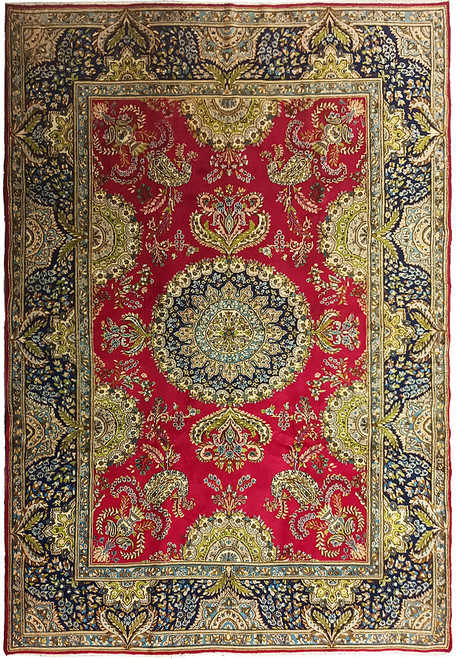
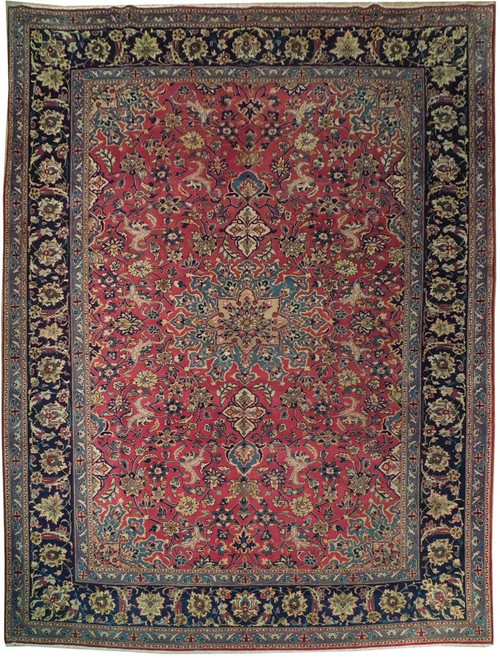
This is a signed, semi-antique Tabriz woven around the 1970's, a room-size piece at 8'3" x 11'1" that reads far older than its date because of how softly the wool has mellowed. The field is deep navy, almost ink black under low light, carrying a soft salmon and sage medallion at center, and the whole drawing is contained by a wide camel border of rosettes and scrolling vine. Decades of careful use have brought the pile down low and even, which is exactly why the drawing looks so crisp and why the colors sit together quietly instead of shouting. It is hand-knotted in wool on a cotton foundation, sized for a dining table or a full seating group, and it slots naturally alongside other 8x11 Persian rugs if you are comparing options at this footprint. Every rug we ship leaves Freeport with a certificate of authenticity.
Please Note About the Photographs:
The macro photograph of the medallion was taken at a sharp angle and close range to show the pile honestly. This rug has a low, evenly worn pile from years of gentle use, with no holes, no repairs and no bare foundation showing. On the floor it looks like the full views, flat, tight and uniform. Every rug is professionally cleaned, steamed and pressed before it ships.
Design and Motifs
The layout is the classic curvilinear Tabriz formula, drawn with a workshop hand rather than a village one. A lobed central medallion sits on a stepped pointed base, built from an 8 petal rosette core ringed by palmettes and split leaves, with small pendants rising and falling along the vertical axis. Around it the navy field is filled edge to edge with a continuous vine that carries large Shah Abbas palmettes, serrated lanceolate leaves and small 5 petal blossoms, the scrollwork balanced so that each quarter answers the other without ever repeating mechanically. The 4 corners carry matching spandrels drawn in the same vocabulary, so the eye reads the field as one garden rather than a medallion dropped onto a background. The main border is a wide camel band of alternating cartouches and open rosettes joined by a thin blue vine, flanked by narrow guard stripes of stars and flowering sprigs, and a plain navy outer stripe finishes the edge. At one end of the field, just inside the navy band, a small woven inscription appears in pale wool, the mark the weaver or workshop left behind, which is uncommon on a rug at this size.
Colors: Navy, Camel and Soft Salmon
The field is a very dark indigo navy that reads nearly black from across the room and opens into true blue where daylight catches the pile, the kind of ground that makes navy blue Persian rugs so easy to live with. Against it the vinework is worked in warm tan and camel, dusty gold, and a pale ivory that has gone slightly creamy with age, with cool sage green used for the leaf interiors so the floral forms separate cleanly from the dark ground. The medallion shifts the temperature: its interior is a soft salmon and apricot, shaded with muted peach and outlined in sage and steel blue, and that same salmon repeats in the border cartouches and the spandrels to tie the whole piece together. Dark brown, almost chocolate, does the outlining throughout, giving every flower a quiet contour instead of a hard black line. The border is the lightest area, a sandy camel that cools toward soft celadon in the guard stripes, so the rug reads dark in the middle and luminous at the edges. The ends finish in ivory fringe above a narrow navy band, visible in the corner and reverse photographs.
Tabriz: The Weaving City of Northwest Persia
Tabriz sits in Azerbaijan province in the far northwest of Persia and has been the commercial and technical capital of Persian weaving for centuries, the city where the cartoon driven workshop model was refined and where fineness is still counted in Raj, the number of knots per gereh across the width. That workshop discipline is what you see here: the curved line never wobbles, the vine closes correctly at every turn, and the mirrored halves of the field match because the weavers were following a drawn design rather than improvising. The wool is the dense, slightly lustrous northwest clip that takes dye deeply and wears down evenly rather than shedding, which is why a rug of this age still shows every detail of its drawing. The cotton foundation keeps the rug flat and dimensionally stable at 8'3" x 11'1", so it lies true without curling corners. If you want to understand how a signed semi-antique like this gets placed in time, our notes on how to date an Oriental rug walk through the same evidence we used: dye behavior, wear pattern, selvage treatment and the character of the inscription.
8'3" x 11'1" Persian Tabriz Rug | Navy Field Floral Medallion | Signed, 1970s Semi-Antique
Ask about this rug
This piece is the only one of it, so the things worth knowing about it are particular to it. If you want to talk through the size, the colour in your own light, or the weave, speak to someone here first.