Watch the film
| Size in ft: | Width: 8'3" x Length: 11'4" |
| Size in Inch: | Width: 99" x Length: 136" |
| Size in meters: | Length: 3.45 x Width: 2.51 m |
| Colors: | Maroon, Brick Red, Ivory, Charcoal Brown, Salmon, Camel |
| Shape: | Rectangular |
| Woven: | 100% Hand-knotted | Handmade |
| Foundation: | Cotton |
| Pile: | |
| Age: | Semi-Antique |
| Design: | Heriz | All Over Geometric | No Central Medallion |
| Origin: | Persian Heriz | Made in Persia |
| Condition: | Excellent | Even semi-antique patina |
8'3" x 11'4" Persian Heriz Rug | All Over Geometric Design | Semi-Antique Maroon Field
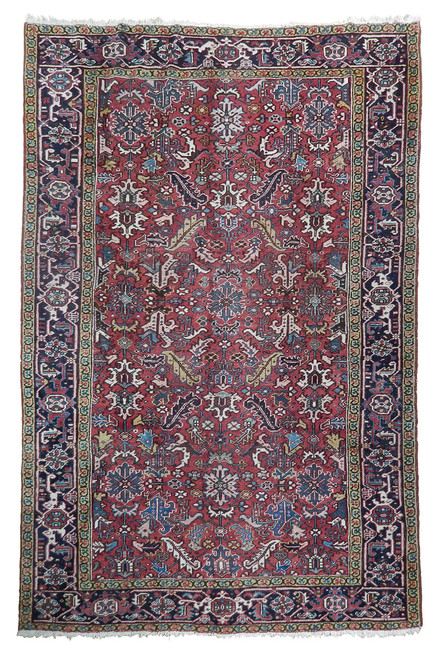
A semi-antique village weave from northwest Persia, this rug carries an unusual all over Heriz drawing instead of the familiar single medallion, so the maroon field reads as one continuous garden of angular palmettes from end to end. It is hand-knotted in wool on a cotton foundation, and decades of gentle use have left the pile low, even and glossy, the state collectors look for in a Heriz of this age. At 8'3" x 11'4" it covers a standard seating group with the front legs of the furniture on the wool, and it sits comfortably among our 8x11 Persian rugs. Every rug we sell ships with a certificate of authenticity.
Please Note About the Photographs:
The first image was taken under bright studio lighting and reads lighter and pinker than the rug is in person. The floor photographs and the close-up details are the truer record of the color, where the field is a deeper maroon with brick and rose variation through it.
Design and Motifs
The weaver laid out a repeating lattice of large serrated palmettes, hooked stepped leaves and small eight petal rosettes across the whole field, an all over design that gives the rug a calm, even rhythm rather than one dominant center. Every line is drawn on the diagonal or the straight, with no curved vine anywhere, which is exactly how the villages around Heriz build a pattern and why these pieces sit so well with both antique furniture and plain modern rooms. Three borders frame the field: a broad charcoal brown main band filled with angular turtle palmettes and small checkerboard cartouches, flanked by ivory guard stripes of linked rosettes, and the 4 corners are resolved with the stepped, slightly improvised solutions typical of hand-drawn village work. Collectors of geometric Persian rugs will recognize the small drawing irregularities as proof the pattern was carried in the weaver's head, not copied from a cartoon.
A Maroon Field with Age-Softened Color
The ground is maroon, but it is not a flat maroon. Natural dye lots and years of light have opened the color into bands of brick red, dusty rose and deeper wine that shift as you walk around the rug, the abrash that only comes with age. Against that field the motifs are drawn in ivory and cream, soft salmon and pale peach, warm camel, muted sage green and a very dark charcoal that reads almost black in the palmette centers. The main border is a smoky brown-black filled with the same salmon, ivory and sage, and the narrow guard stripes are pale ivory, which pulls a clean line around the whole design. It is a warm, low-contrast palette that flatters oak and walnut floors, aged leather, brass and cream plaster walls, and it hides everyday traffic far better than a bright new red.
Heriz: The Villages Below Mount Sabalan
Heriz is a group of weaving villages east of Tabriz, on the slopes below Mount Sabalan, and the reputation of the district rests on two things: the mineral-rich water the flocks drink, which is credited with the famously tough, high-lanolin wool, and a drawing tradition built entirely on straight lines and stepped angles. Heriz weavers work on a sturdy cotton foundation with a thick wool pile and a heavy beat, which is why these rugs survive generations of hard family use and why a semi-antique example like this one still has firm, upright pile and straight selvages. Village knot counts here usually sit under 200 knots per square inch by design, since the whole point of a Heriz is durability and scale rather than miniature detail. The back of this rug, shown against a ruler in the final photograph, tells the story plainly: a regular, honest hand-knotted weave with cotton fringe, woven to be walked on for another lifetime.
8'3" x 11'4" Persian Heriz Rug | All Over Geometric Design | Semi-Antique Maroon Field
Ask about this rug
This piece is the only one of it, so the things worth knowing about it are particular to it. If you want to talk through the size, the colour in your own light, or the weave, speak to someone here first.