Watch the film
| Size in ft: | Width: 8'3" x Length: 11'4" |
| Size in Inch: | Width: 99" x Length: 136" |
| Size in meters: | Length: 3.45 x Width: 2.51 m |
| Colors: | Red, Blue |
| Shape: | Rectangular |
| Woven: | Hand-Knotted |
| Pile: | 3/8" Wool |
| Origin: | Persia |
| Design: | Lilihan |
| Age: | 1980's |
| Condition: | Perfect |
8'3" x 11'4" Persian Lilihan Rug | Red Floral Medallion | 1980s Village Weave
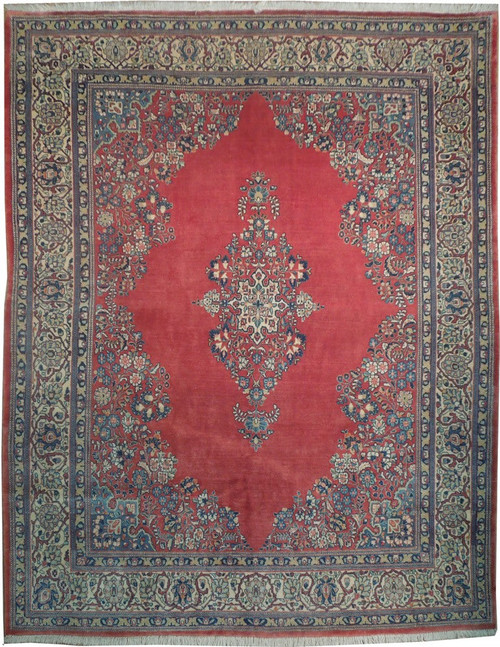
From across a room this 8'3" x 11'4" Lilihan reads as one solid sheet of red, and only at closer range does the drawing break apart into hundreds of separate flower stems, leaf sprays and little bud clusters. It was woven in the 1980s in the village tradition of the Arak valley, with a heavy 3/8 inch wool pile packed onto a cotton foundation, so it sits flat and feels substantial underfoot. The selvedges are intact, the ivory fringe is original at both ends, and the pile is even from end to end with no wear, no low spots and no repairs. A certificate of authenticity recording the origin, materials and exact size ships with the rug.
Please Note About the Photographs:
The overhead photographs show the true color of the field, a deep red framed by a near black border. Several close-up frames were shot in direct sunlight, which pushes that same red toward pink and magenta on screen. Nothing has been retouched, and the wool is one consistent tone across the whole field.
Design and Motifs
The center holds a small cusped medallion with an ivory core carrying a 4 petal rosette in red and blue, ringed first in pink, then in turquoise, then in camel gold. Four dark lobes loaded with palmettes and curling tendrils push out from it, and a shield-shaped pendant runs off the top and bottom on the long axis. Everything around the medallion is drawn in mirror symmetry: paired leafy sprays, serrated saz leaves, stiff bouquets rising from the end panels, and rows of small navy buds that behave almost like a sprinkled Sarouk field rather than a continuous vine scroll. The main border sits on a black ground and alternates vase-like palmettes with rosette clusters in rose, ivory and gold, separated from the field by a camel guard stripe and a fine turquoise zigzag that runs the full perimeter. To the right of the medallion the weaver worked in a small numeral panel, the village habit of dating a piece in the field, which is consistent with the stated 1980s weaving.
The Red Field and Its Blues
The field is a saturated true red, the classic Lilihan ground color, with just enough natural variation across the weft lines to keep it alive rather than flat. Against it the blues do most of the work: a deep indigo navy in the border ground and in the medallion lobes, a brighter petrol teal in the leaf sprays, and a clear turquoise picked out in the guard stripes and in tiny dots inside the rosettes. Camel gold outlines the medallion and the palmettes, ivory appears in small sharp accents that keep the eye moving, and there are quiet notes of rose pink, deep burgundy and olive green inside the flower heads. The overall effect is warm and formal at the same time, and the dark border acts like a frame, holding all that red inside a clean rectangle.
Lilihan and the Arak Weaving Villages
Lilihan is a village in the Arak district of central Persia, in the same weaving group that produced the pieces sold in America as Persian Sarough rugs, and the family resemblance is obvious here in the red ground, the detached floral drawing and the thick clipped pile. What distinguishes the Lilihan hand is a single wefted, slightly looser weave that gives the wool room to bloom, and a preference for one compact medallion instead of the fully sprinkled field seen in much of the Sarough rug collection. Village looms in this district work to a medium knot count by design, because the local wool is long stapled and greasy and rewards a heavier pile that burnishes with use rather than a fine tight weave. That is why rugs like this one survive decades of traffic. In an 8x11 Persian rug the format is generous enough to set a full seating group on, and this piece has the weight and the honest village drawing to justify that place.
8'3" x 11'4" Persian Lilihan Rug | Red Floral Medallion | 1980s Village Weave
Ask about this rug
This piece is the only one of it, so the things worth knowing about it are particular to it. If you want to talk through the size, the colour in your own light, or the weave, speak to someone here first.