Watch the film
| Size in ft: | Width: 9' x Length: 11'7" |
| Size in Inch: | Width: 108" x Length: 139" |
| Size in meters: | Length: 3.53 x Width: 2.74 m |
| Colors: | Burgundy, Ivory, Blue, Pink |
| Shape: | Rectangular |
| Woven: | 100% Hand-knotted | Handmade |
| Foundation: | Cotton |
| Pile: | |
| Age: | 1980's | Vintage |
| Design: | Bakhtiar Medallion | Corner spandrels | All over floral field |
| Origin: | Persian Bakhtiar | Made in Persia |
| Condition: | Excellent | Full even pile |
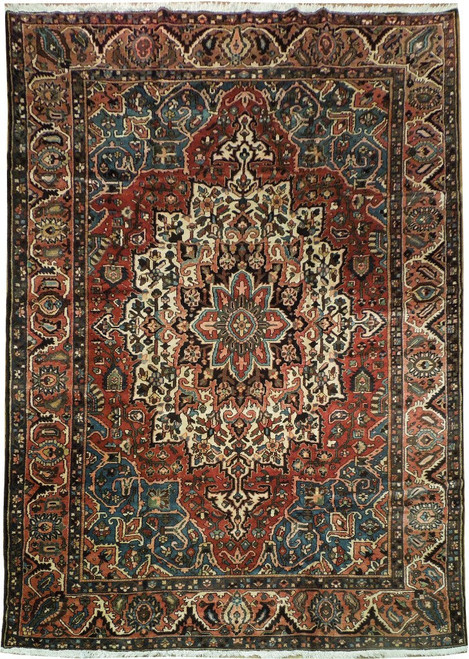
9' x 11'7" Persian Bakhtiar Rug | Ivory Medallion on Burgundy Field | 1980s Village Weave
This is a true room size piece, a 9' x 11'7" hand-knotted Bakhtiar woven in the 1980s and still carrying a full, even pile from edge to edge. The weight of it tells you most of the story before you look at the drawing: heavy wool on a cotton foundation, a firm handle, and the kind of thick, springy surface that village looms in the Zagros foothills have always produced. It reads as one of the more usable sizes in the market, which is why buyers searching 9x12 Persian rugs tend to land on pieces like this one. Every rug we ship leaves Freeport with a certificate of authenticity recording its origin, materials and measurements.
Design and Motifs
The layout is a classic Bakhtiar medallion and corner composition, but drawn with the loose, confident hand of a village weaver rather than a city cartoon. A large ivory medallion sits dead center, stepped and hooked around its outline, and inside it a dark navy inner panel holds a mirrored arrangement of hooked palmettes and small hexagons. Four anchor pendants run out from the medallion top and bottom into the burgundy ground, where the field is filled with rosettes, serrated leaves, curled boteh forms and small vase shapes that never repeat exactly. The 4 corner spandrels drop into deep blue and carry their own floral clusters, which is what gives the rug its strong diagonal read from across a room. Framing all of this is a wide ivory main border of linked palmettes and blossoms, held between narrow red and navy guard stripes with a small running vine. The little irregularities in the field, one blossom slightly larger than its partner, a color shift where a new batch of yarn came onto the loom, are exactly what separates a hand-knotted rug from a machine copy.
A Burgundy and Ivory Palette with Indigo Corners
The field is a deep burgundy that leans wine and brick rather than bright red, and in raking light it shows the gentle abrash that dyed village wool always develops. Against it the medallion is a warm ivory, closer to sand and cream than to white, so the contrast is rich instead of harsh. The corner spandrels and the smaller field motifs pull in a strong indigo blue, dark enough at the corners to frame the composition and lighter within the flowers where the dye sat differently in the yarn. Through the whole rug runs a soft rose and salmon pink, used for the hooked bars inside the medallion core, for individual blossoms, and along the inner guard stripe, which keeps the burgundy from feeling heavy. Touches of walnut brown in the vinework and small charcoal outlines give every motif a clean edge. It is a warm palette overall, one that sits naturally on oak and walnut floors and works with cream upholstery, leather, and dark wood furniture without competing with any of them.
Bakhtiar Weaving from the Chahar Mahal Villages
Bakhtiar rugs come from the villages of the Chahar Mahal district southwest of Isfahan, woven by settled Bakhtiari families whose flocks graze the Zagros highlands. That wool is the point: long staple, high in lanolin, and famously resilient underfoot, which is why these rugs survive decades of real use and still hold their pile the way this one has. The weave here is a sturdy symmetric knot on a cotton foundation, moderate in count but tightly beaten, with the flat, dense back you can see in the fold photograph and the original hand-tied fringe intact at both ends. Bakhtiar is one of the few Persian weaving groups where a strong village rug outperforms a fine city rug for everyday floors, and a piece from the 1980s like this sits in the sweet spot between age and usable life. If you want to understand what the wear, the dye behavior and the back of a rug tell you, our guide on how to date an Oriental rug walks through the same clues we used on this one.
9' x 11'7" Persian Bakhtiar Rug | Ivory Medallion on Burgundy Field | 1980s Village Weave
Ask about this rug
This piece is the only one of it, so the things worth knowing about it are particular to it. If you want to talk through the size, the colour in your own light, or the weave, speak to someone here first.