Watch the film
| Size in ft: | Width: 7' x Length: 10' |
| Size in Inch: | Width: 84" x Length: 120" |
| Size in meters: | Length: 3.05 x Width: 2.13 m |
| Colors: | Crimson red, black, ivory, navy blue, teal, saffron orange, rose pink |
| Shape: | Rectangular |
| Woven: | 100% Hand-knotted | Handmade |
| Foundation: | Cotton |
| Pile: | |
| Age: | 1980's | Vintage |
| Design: | Heriz | Geometric Star Medallion | Ivory Spandrels |
| Origin: | Persian Heriz | Made in Persia |
| Condition: | Excellent | Perfect |
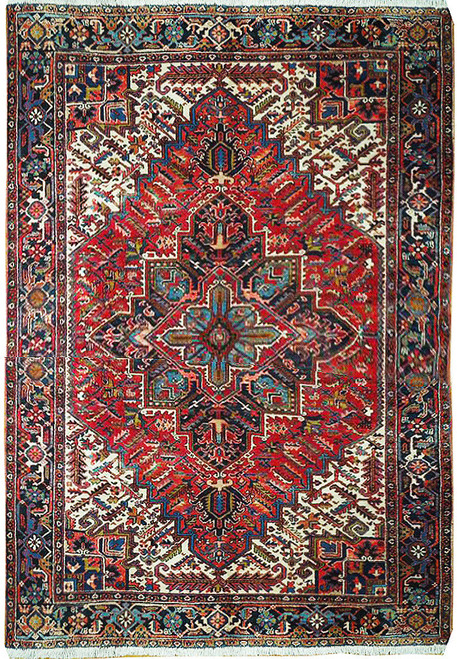
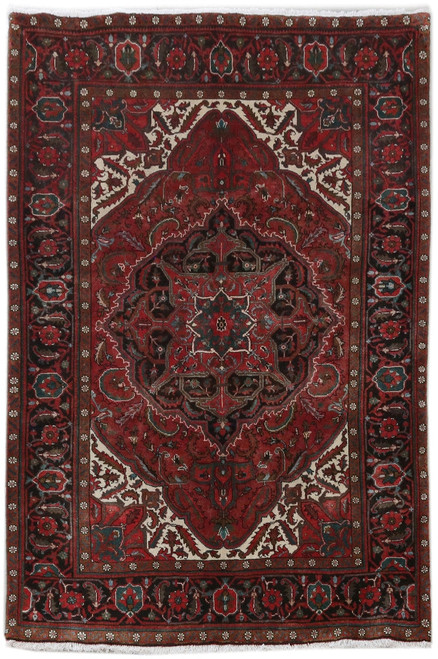
7' x 10' Persian Heriz Rug | Crimson Field, Black Star Medallion | 1980s Village Weave
This 7' x 10' Persian Heriz was knotted in the 1980s on a cotton foundation with a full, springy wool pile, and it has the weight and handle you expect from a village loom in the Heriz district. The field reads crimson from across the room, with a black star medallion anchoring the center and deep ivory spandrels opening each of the 4 corners. Photographs 5 and 6 show the drawing up close: hooked leaf forms, small rosettes and stepped outlines carried in teal, saffron and rose against the red. The wool is glossy where the light crosses it, the pile stands evenly with no low spots, and the ends and sides are intact with clean ivory fringe. Every rug we sell ships with a certificate of authenticity identifying origin, materials and construction. If you are comparing 7 x 10 Persian rugs, this one earns its place on color strength alone.
Design and Motifs
The layout is the classic Heriz formula drawn with confidence. A black eight-point star medallion sits dead center, filled with a small stepped lozenge in rose, teal and cream, and it throws long hooked pendants north and south into the field. Around it the crimson ground is packed with angular palmettes, serrated leaves and little hook-and-comb forms, all drawn in straight lines rather than curves because the design is carried in the weaver's head rather than off a cartoon. The 4 ivory corner spandrels are the strongest secondary element, filled with jagged vinework, tiny bird-like figures and orange tree forms that stand out sharply against the cream ground. The main border runs black with alternating rosettes and turtle palmettes in red, orange and cream, flanked by a checkered gold and blue minor guard that you can see clearly in the close-up photographs. That bold, angular vocabulary places it squarely among geometric Persian rugs, and it is the reason a Heriz sits so comfortably with both antique furniture and plain modern seating.
The Crimson, Black and Ivory Palette
Color is the first thing you notice and the last thing you tire of. The field is a warm crimson red that shifts between raspberry and brick as you walk around it, the natural result of hand-spun wool taking dye at slightly different rates. Against it, the medallion and main border sit in a near-black charcoal that gives the whole rug its structure and keeps the red from going sweet. Ivory does the lifting work in the spandrels and the fine outlines, and where it meets the red the contrast is very crisp. Through the field run secondary notes of teal and denim blue, a bright saffron orange in the vines and guard stripes, rose pink in the smaller floral fills, and small touches of soft green. The corner detail photographs show how much blue is actually present once you are standing on the rug, which makes it easy to pull navy, denim or cream into a room around it. No fading, no abrash streaks running off-square, and no color bleed anywhere in the pile.
Heriz Weaving East of Tabriz
Heriz is a group of weaving villages east of Tabriz in northwest Persia, sitting below Mount Sabalan. The wool from those flocks is famously tough and slightly coarse, and the mineral-rich water used in washing gives Heriz reds and blues their particular depth. Weavers there work on a heavy cotton warp and weft with a large, robust knot, which is why village Heriz rugs are usually built for generations of real traffic rather than for fineness; anything running above 200 knots per square inch in this group is worth remarking on. This piece is honest village work: sturdy, thick, evenly beaten down, and perfectly symmetrical in its medallion despite being drawn from memory. The 1980s dating comes from the wool, the dye behavior and the finishing of the ends and selvedges, the same evidence used to date an Oriental rug generally, and at roughly 40 years old it has softened into its color without losing a millimeter of pile.
7' x 10' Persian Heriz Rug | Crimson Field, Black Star Medallion | 1980s Village Weave
Ask about this rug
This piece is the only one of it, so the things worth knowing about it are particular to it. If you want to talk through the size, the colour in your own light, or the weave, speak to someone here first.