Watch the film
| Size in ft: | Width: 8'4" x Length: 11'7" |
| Size in Inch: | Width: 100" x Length: 139" |
| Size in meters: | Length: 3.53 x Width: 2.54 m |
| Colors: | Dark Grey, Charcoal, Taupe, Ivory, Rose, Sage Green |
| Shape: | Rectangular |
| Woven: | 100% Hand-knotted | Handmade |
| Foundation: | Cotton |
| Pile: | |
| Design: | Traditional | Garden Panel | Tree of Life | Multiple Borders |
| Origin: | Agra | Made in India |
| Condition: | Excellent | Full even pile |
8'4" x 11'7" Agra Rug | Garden Panel Tree of Life Design | Hand-Knotted Wool from India
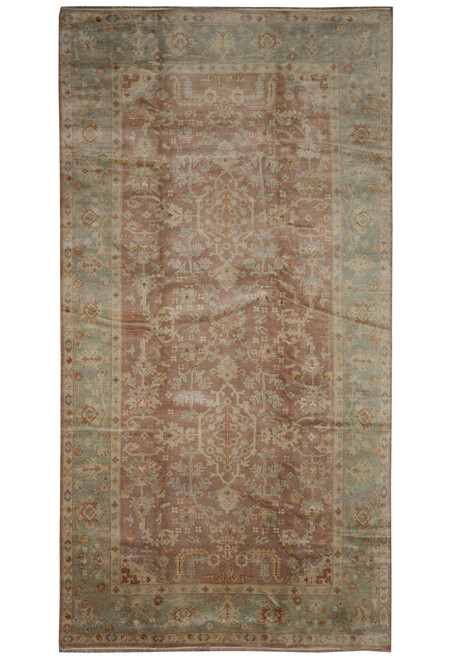
This is a hand-knotted Agra from India, woven in wool on a cotton foundation and drawn as a garden panel: 36 separate compartments, each one holding its own small tree, shrub or flowering vase, framed by a deep charcoal border of arched panels. It is the kind of Oriental rug that rewards walking around it, because no two panels repeat exactly and the palette shifts panel to panel from grey and taupe into ivory, rose and sage. The pile is full and even, the selvages are tight and the fringe is clean and original. Every rug we sell ships with a certificate of authenticity confirming it is 100% hand-knotted, and at 8'4" x 11'7" it belongs in the practical end of our large hand-knotted rugs, big enough to hold a full seating group or a 10 seat table.
Design and Motifs
The field is a compartment garden, one of the oldest formats in the weaving world and one Agra workshops handle particularly well. The panels are set out in 6 rows across, each divided by narrow ivory bands of tiny rosettes and sawtooth triangles, and each compartment carries a different subject: a weeping tree with fine feathered leaves, a cypress paired with flowering branches, a stylized vase throwing out palmettes, a boteh filled with diapered lattice, a niche arch resolved with split leaf scrollwork. The close-up photo shows how much drawing goes into a single panel, with the tree outlined in dark navy against a soft gold ground scattered with small crosses. Around the field run several borders: a wide charcoal main border of arched panels each holding its own little tree, flanked by guard stripes of running vine, reciprocal rosettes and a delicate ivory meander. This is an all over design with no central medallion, which makes it forgiving under furniture since nothing important gets covered.
The Color: Grey, Taupe and Rose Read as One Soft Neutral
Seen from across a room the rug reads as a warm grey, which is how it is catalogued, but up close the palette is far more layered. Individual panels run through pale ivory, oatmeal, mushroom taupe, a dusty rose that edges toward terracotta in the border trees, muted sage and olive green in the foliage, pewter blue in a handful of compartments and near-black charcoal in the outlines and the main border ground. The dividing lattice is ivory, which is what keeps the whole surface bright rather than heavy, and the outer selvage and fringe are a clean natural ivory. There is no high-contrast red or hot color anywhere in it, so it sits comfortably with grey upholstery, walnut and oak floors, black metal and white walls, and it does not fight with whatever is already in the room. Under lamplight the wool picks up a soft sheen and the rose tones warm noticeably.
Agra Weaving and Indian Craftsmanship
Agra has been a weaving center since the Mughal court commissioned carpets there in the 16th and 17th centuries, and the city never lost the trade. India today is where most of the world's good contemporary hand-knotted work is made, and we say that without hedging: the best Indian workshops are weaving at a level, and with a discipline of drawing and finishing, that competes directly with anything else being produced now. The back of this piece, shown against a ruler in the last photo, tells the story plainly: small, tightly packed knots on a cotton warp and weft, straight rows, no bowing in the borders and crisp registration where the panel lattice crosses. The wool is hand-spun and takes dye unevenly in the best way, which is what gives the panels their subtle tonal movement instead of a flat printed look. It is a rug built to be used, and at this size and weave it will stay this way for decades.
8'4" x 11'7" Agra Rug | Garden Panel Tree of Life Design | Hand-Knotted Wool from India
Ask about this rug
This piece is the only one of it, so the things worth knowing about it are particular to it. If you want to talk through the size, the colour in your own light, or the weave, speak to someone here first.