Watch the film
| Size in ft: | Width: 8'4" x Length: 11'7" |
| Size in Inch: | Width: 100" x Length: 139" |
| Size in meters: | Length: 3.53 x Width: 2.54 m |
| Colors: | Multi-Color, Ivory, Brick Red, Navy Blue, Rose, Sage Green, Brown |
| Shape: | Rectangular |
| Woven: | 100% Hand-knotted | Handmade |
| Foundation: | Cotton |
| Pile: | 3/8" Wool |
| Design: | Bakhtiari Garden Panel | Khesti Compartment | Cypress and Vase Panels |
| Origin: | Persian Bakhtiari | Made in Persia |
| Condition: | Excellent |
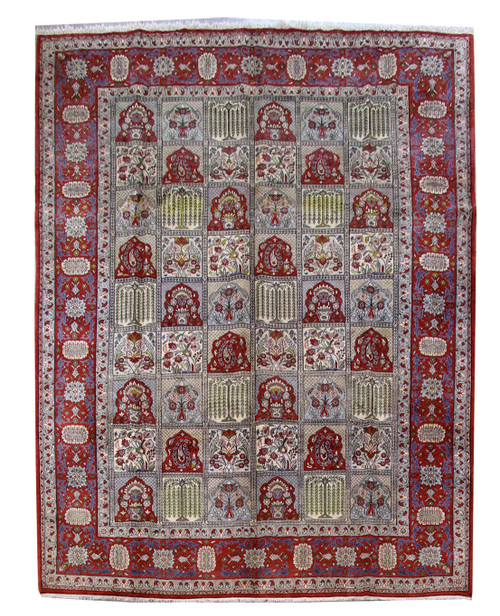
8'4" x 11'7" Persian Bakhtiari Rug | Garden Panel Khesti Design | Hand-Knotted Wool in Excellent Condition
This is the classic Bakhtiari garden panel, woven at a true room size and in excellent condition, with a full 3/8" wool pile that still stands up square across the whole field. The compartment grid runs 6 panels across and 11 rows deep, every square drawn with its own small garden, and the ivory main border carries a heavy palmette and paisley vine that frames the whole thing without crowding it. It sits comfortably as one of our large hand-knotted Persian rugs, wide enough to take a sofa group or a 8 seat table on all 4 legs. Each rug we sell ships with a certificate of authenticity confirming it as a hand-knotted piece made in Persia.
Design and Motifs
The khesti, or compartment, layout is the design Bakhtiari weavers are known for, and it reads as a walled garden seen from above: each square is a separate bed, divided by narrow flowering lattice strips with a small rosette at every intersection. Look across the field and the vocabulary repeats in rotation, never in the same order twice. There are dark cypress trees standing in ivory panels, branching trees with birds perched in the limbs, weeping willows, tall vases spilling blossom, latticed water beds drawn as fine cross-hatching, and single large roses filling a whole red square. The drawing is village drawing, angular and confident, with the outlines kept crisp by a dark navy or brown contour around most shapes. It is an all over design with no central medallion, which is why furniture can sit anywhere on it without breaking the composition. The main border answers the field with a turning vine of palmettes and boteh on ivory, flanked by narrow rose and navy guard stripes.
A Multi-Color Palette Built on Brick Red, Ivory and Navy
Multi-color here means the panels rotate through a set number of ground tones rather than scattering at random. Brick red and a warmer terracotta rose carry the most squares, deep navy blue and near-black indigo give the field its weight, and ivory panels break the rhythm and keep the surface from going heavy. Scattered through the rest are a soft sage green, a dusty rose, a camel beige and a walnut brown that shows up mostly in the tree trunks and small leaf forms. The ivory main border is the lightest element on the rug and lifts the whole perimeter, with rose, deep green, navy and brown worked into its palmettes. Because the wool is lustrous, the reds shift between rust and cherry as you cross the room, and the abrash, the gentle banding natural to hand-dyed village wool, is visible but quiet. The ends finish in clean white cotton fringe.
Bakhtiari Weaving and the Chahar Mahal Villages
Bakhtiari rugs come from the Chahar Mahal district southwest of Isfahan, woven in settled villages by families of the Bakhtiari tribal confederation. The wool from those highland flocks is coarse in the best sense, springy and high in lanolin, and the weavers pack it onto a cotton foundation with a firm beat, which is why a Bakhtiari of this size holds its shape underfoot for generations rather than years. The back of this rug, shown against a ruler, is even and tight for village work, with straight rows and no pulling at the sides. This is not a workshop rug chasing knot count; its value is in the drawing, the dye quality and the sheer durability of the weave, which is exactly what buyers of Persian tribal rugs look for in a garden panel piece this size.
8'4" x 11'7" Persian Bakhtiari Rug | Garden Panel Khesti Design | Hand-Knotted Wool in Excellent Condition
Ask about this rug
This piece is the only one of it, so the things worth knowing about it are particular to it. If you want to talk through the size, the colour in your own light, or the weave, speak to someone here first.