Watch the film
| Size in ft: | Width: 8' x Length: 10'4" |
| Size in Inch: | Width: 96" x Length: 124" |
| Size in meters: | Length: 3.15 x Width: 2.44 m |
| Colors: | Black, Ivory, Slate Blue, Sage Green, Blush Pink, Rust, Dark Brown |
| Shape: | Rectangular |
| Woven: | 100% Hand-knotted | Handmade |
| Foundation: | Cotton foundation |
| Pile: | |
| Age: | Recent | Unused |
| Design: | Dom Esfahan | Gonbad Dome Medallion | Multi Border |
| Origin: | Kashmir | Made in India |
| Condition: | Perfect | Never used |
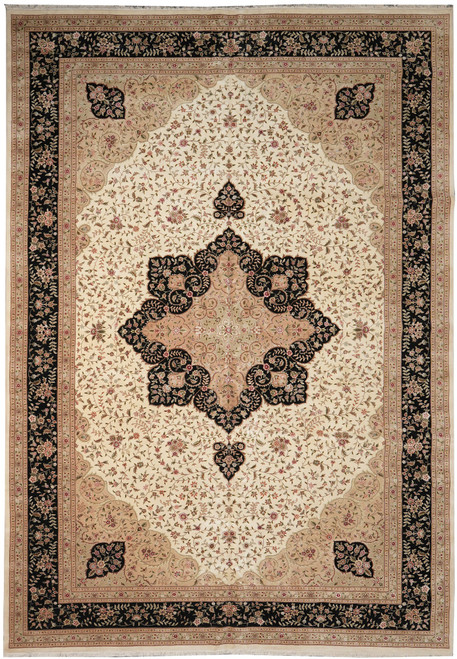
8' x 10'4" Kashmir Oriental Rug | Dom Esfahan Dome Medallion | Black Border | Never Used
This is one of the most ambitious drawings in the hand-knotted repertoire, the Dom Esfahan or dome pattern, in which the whole field is read as the underside of a domed ceiling seen from directly below. The weaver has to hold hundreds of radiating compartments in register from the center rosette out to the arched panels at both ends, and any drift in the count shows immediately. Here the registration is clean, the pile is full and upright, and the rug has never been laid in a home. It measures 8' x 10'4", which puts it in the most requested 8x10 rug size for a seating group or a dining table, and it ships with a certificate of authenticity recording its size, materials, weave and origin.
Design and Motifs
Everything begins at a small 8 petal rosette on a pale gold ground, ringed by a thin coral scrollwork band. From that point the field breaks into concentric rings of small lozenge compartments, each holding a single stylized bloom, and those rings widen outward into long ribbed segments that read exactly like the flutes of a dome. The outer ring of the dome ends in pointed arch panels, ivory and blush at the top and bottom of the field, each filled with a symmetrical flowering plant, while the 4 corners carry quartered spandrels with single flower heads on a dusty rose ground. The main border runs on a black ground with alternating ivory cartouche panels and 8 pointed star rosettes, and it is framed on both sides by narrow guard stripes of trailing vine and tiny paired buds. Note the small rosette inset into each inner corner, a detail the drawing did not strictly need and a sign of a weaver working carefully rather than quickly.
Black, Slate Blue and the Soft Middle Tones
The palette is quiet in the field and firm at the edge. Black does the framing work: it fills the main border ground, the narrow inner and outer bands and the selvage line, so the soft interior is held in place by a dark rectangle. Inside, alternating segments of the dome shift between a muted slate blue and a warm sage, almost khaki green, with ivory and cream ribs separating them. Blush and dusty rose carry the arched panels and the corner spandrels, dark brown and near black read the larger leaf forms, and small touches of rust and terracotta appear in the individual blooms and in the guard stripes, which is where most of the color energy sits. Under the black border, ivory panels lift the whole perimeter and keep the rug from feeling heavy. On a mid brown wood floor, as in the photographs, the grey blue and sage tones stay cool while the blush and rust warm to meet the boards.
Kashmir Weaving and the Quality of the Knot
This is honest contemporary work, made in India, in the Kashmir weaving tradition of northern India, where looms specialize in fine drawing rather than bold village geometry. India is where most of the world's good hand-knotted rugs are now made, and a dome composition like this one is a straightforward test of that: it cannot be woven at a coarse count because the curved ribs and the tiny compartment blooms would collapse into blocks. The back photograph, shot against a ruler, shows a tight, even wool knot on a cotton foundation with the pattern reading almost as clearly from behind as it does from the front, and the hand-tied cotton fringe is full and unworn at both ends. If you are weighing this against older workshop pieces, our guide on what actually separates an Oriental rug from other traditions is worth reading before you decide. The pile here is untouched, with no wear, no repair and no fading.
8' x 10'4" Kashmir Oriental Rug | Dom Esfahan Dome Medallion | Black Border | Never Used
Ask about this rug
This piece is the only one of it, so the things worth knowing about it are particular to it. If you want to talk through the size, the colour in your own light, or the weave, speak to someone here first.