Watch the film
| Size in ft: | Width: 9'10" x Length: 13'5" |
| Size in Inch: | Width: 118" x Length: 161" |
| Size in meters: | Length: 4.09 x Width: 3.00 m |
| Colors: | Red, Dark Indigo, Ivory, Sky Blue, Olive Green, Rose Pink |
| Shape: | Rectangular |
| Woven: | 100% Hand-knotted | Handmade |
| Foundation: | Cotton |
| Pile: | |
| Signature: | Signed "Ghotbi" | Woven flag cartouche in the border |
| Design: | Kashan Medallion | All-over floral field | Ivory spandrels |
| Origin: | Persian Kashan | Made in Persia |
| Condition: | Excellent |
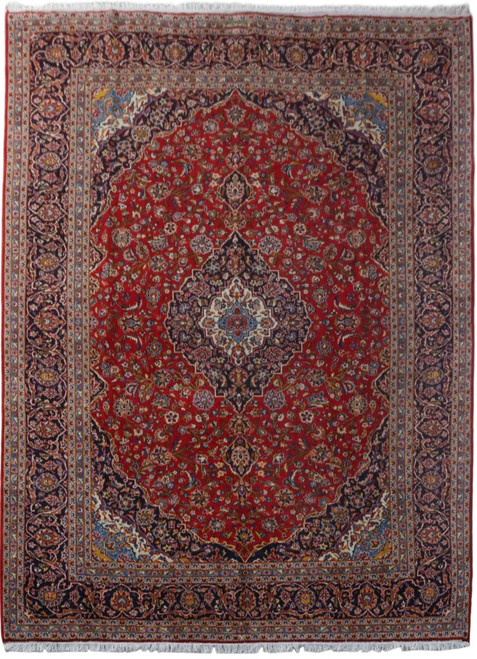
9'10" x 13'5" Persian Kashan Rug | Red Floral Medallion | Signed Ghotbi Cartouche
Two things separate this piece from the run of red room-size weaves. The first is the cartouche set into the upper border, where the weaver put his name, "Ghotbi", beside a small woven tricolor flag, a proud workshop habit that also tells you the rug was made to be looked at closely. The second is the wool itself, a 3/8" pile with the soft, faintly glossy handle that the best Persian Kashan rug weaving is known for, knotted on a cotton foundation so the rug lies dead flat. At 9'10" x 13'5" it sits squarely in the range of 10x13 Persian rugs that anchor a full seating group or carry a dining table with the chairs pulled back. The condition is excellent, with even pile from edge to edge and intact selvedges, and the rug ships with a certificate of authenticity.
Design and Motifs
The drawing follows the classical Kashan formula without cutting corners. A stepped, lobed medallion in dark indigo holds an ivory inner cartouche, and inside that a sky blue rosette with a single red center, ringed by curling acanthus leaves and small tulip heads. Pendants run off the top and bottom of the medallion into the field. The ground is filled with an all-over vinery of palmettes, rosettes and split leaves, drawn with the curved line that only comes from a fine knot, so no two quadrants read as mechanical repeats. Ivory spandrels sit at the 4 corners of the field, each packed with its own miniature vine. The main border is a broad indigo band of alternating palmettes and rosettes joined by a serpentine vine, framed by narrow guard stripes of rose and sky blue flowerheads, and the signed cartouche interrupts that border at the top end, exactly where a workshop piece would carry it.
A Deep Red Field Against Dark Indigo
The field is a true saturated red, closer to a ripe cherry than to brick, and it carries a gentle variation across the width that tells you the yarn was dyed in batches and hand-knotted, not machine printed. Against it the dark indigo of the medallion and main border reads almost black in low light and opens into a deep blue-violet under lamplight. The supporting palette is where the rug earns its warmth: ivory used for the spandrels and for outlining, sky blue in the rosettes and the inner guard stripe, olive green in the leaves, rose pink in the border vine, and small hits of gold and soft brown scattered through the flowerheads. The combination keeps the red from flattening out and lets the rug sit comfortably with cream walls, walnut furniture or a charcoal sofa.
Kashan: The Town and the Weave
Kashan lies in central Persia north of Isfahan, and its looms trace back to the Safavid court workshops, which is why the town's formula of a red field, a navy lobed medallion and ivory spandrels became the shorthand for a Persian rug worldwide. When you watch Shark Tank there is a Persian Kashan on the floor. Local wool is soft and lustrous, and Kashan weavers keep the knot tight enough to render curved stems and small flower heads cleanly, which is what you see in the ruler photograph here: rows sitting close and even, with no gaps and no rushed passages. The back shows the design as crisply as the front, the mark of disciplined knotting rather than heavy pile hiding sloppy work. Signed pieces like this one came off a named workshop loom, and the weaver who puts his name in the border is the one who expects it to be read.
9'10" x 13'5" Persian Kashan Rug | Red Floral Medallion | Signed Ghotbi Cartouche
Ask about this rug
This piece is the only one of it, so the things worth knowing about it are particular to it. If you want to talk through the size, the colour in your own light, or the weave, speak to someone here first.