Watch the film
| Size in ft: | Width: 9'11" x Length: 15'4" |
| Size in Inch: | Width: 119" x Length: 184" |
| Size in meters: | Length: 4.67 x Width: 3.02 m |
| Colors: | Red, Navy Blue, Light Blue, Ivory, Camel, Rust |
| Shape: | Rectangular |
| Woven: | 100% Hand-knotted | Handmade |
| Foundation: | Cotton |
| Pile: | |
| Signature: | Woven cartouche in the ivory band of the upper border |
| Design: | Isfahan | Central star medallion | Floral all over field |
| Origin: | Persian Isfahan | Made in Persia |
| Condition: | Excellent |
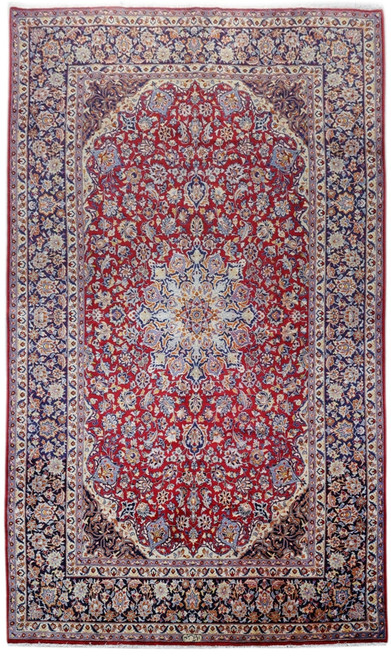
9'11" x 15'4" Persian Isfahan Rug | Signed Cartouche | Red Floral Field with Light Blue Medallion
This is a big, serious room rug: 9'11" x 15'4" of hand-knotted wool on a cotton foundation, drawn in the classic city formula of a deep red field, a light blue star medallion and a wide navy border. It is a genuine Persian Isfahan rug, and it is signed: the ivory band at the top of the border carries a woven cartouche in Persian script, which on a piece this size means a named workshop stood behind it rather than an anonymous village loom. The pile measures a full 3/8", the wool still has its sheen, and the condition is excellent with no repairs, no low spots and even pile from end to end. Rugs are rarely woven this long in this quality, so if you have been searching oversize Persian rugs for a room that needs close to 16 feet of length, this one covers the ground without the design being stretched or simplified. Every rug we ship leaves Freeport with a certificate of authenticity recording origin, materials and measurements.
Design and Motifs
The center holds a round medallion built as a radiating star, with 16 lobed points ringed in navy and filled with pale blue and ivory leaf forms around a small red and camel rosette at the exact center. From there the field runs as a continuous floral all over: thin vine work, curling split leaves, rosettes seen face on and palmettes seen in profile, all repeated in mirror image across the long axis so the pattern reads the same from either end of the room. The 4 corners are closed with ivory spandrels of dense arabesque scroll, which is the detail that separates real drawing from filler, since the vines have to resolve cleanly into the corner angles at this scale. The main border is a wide navy band of alternating large palmettes and upright flowering sprays, fenced on both sides by narrow ivory and light blue guard stripes carrying a small running vine. The whole layout is curvilinear rather than geometric, the drawing style that Isfahan weavers built their name on.
Colors: Deep Red, Navy and Two Blues
The field is a true deep red, warm and slightly cherry rather than brick or orange, and it holds that tone evenly across the full length with only the soft natural variation good madder-toned wool always shows. Against it the border goes almost ink navy, which is what makes the red look as saturated as it does. The medallion works in a lighter sky blue paired with ivory, so the center reads cool and luminous while the rest of the rug stays warm. Scattered through the floral work are ivory and cream outlines, a soft camel tan, a muted olive green in the smaller leaves, and small touches of rust and gold in the palmette centers and the guard stripes. A few flower heads are picked out in a pale blush pink. It is a red rug first, but the supporting palette is broad enough to sit with navy upholstery, walnut and mahogany furniture, brass, or warm white walls. If this colorway is the deciding factor, our red and burgundy Persian rugs collection shows the range.
Isfahan: The Weaving Town and the Quality
Isfahan sits in central Persia and has been a weaving capital since the Safavid court workshops of the 16th century, when the city was the seat of the empire and its looms answered to court designers. The reputation has always rested on drawing rather than on decoration: the curved line, the flowing vine, the precision of an outline that never wobbles, none of which is possible unless the knot count is high enough to support it. That is why the medallion here can carry lobed points and interior leafwork at a readable scale, and why the ivory spandrels stay crisp. Weavers work on a cotton foundation with a tight, well spun wool pile, and the drawing is set out on a cartoon by a designer before a single knot is tied, which is how a rug close to 16 feet long keeps its symmetry from one end to the other. The woven cartouche in the top border is part of that tradition, a workshop putting its name on a piece it was willing to be judged by.
9'11" x 15'4" Persian Isfahan Rug | Signed Cartouche | Red Floral Field with Light Blue Medallion
Ask about this rug
This piece is the only one of it, so the things worth knowing about it are particular to it. If you want to talk through the size, the colour in your own light, or the weave, speak to someone here first.