Watch the film
| Size in ft: | Width: 9'5" x Length: 12'10" |
| Size in Inch: | Width: 113" x Length: 154" |
| Size in meters: | Length: 3.91 x Width: 2.87 m |
| Colors: | Red, Ivory, Navy Blue |
| Shape: | Rectangular |
| Woven: | Hand-Knotted |
| Pile: | 3/8" Wool |
| Origin: | Persia |
| Design: | Kashmar |
| Condition: | Excellent |
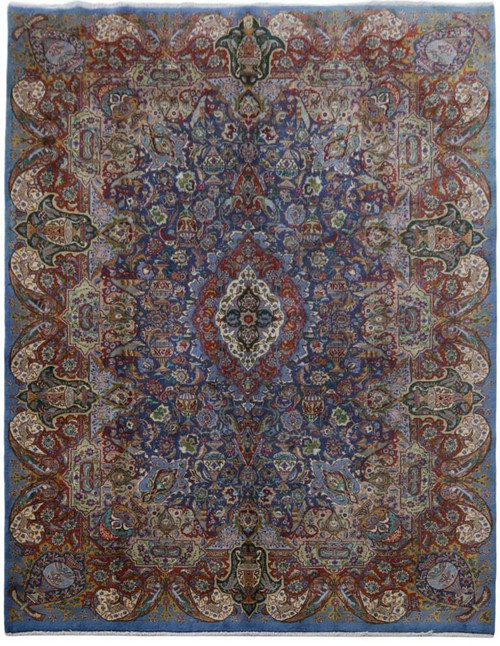
9'5" x 12'10" Persian Kashmar Rug | Signed Pictorial Vase and Bird Design | Red, Ivory and Navy Wool
A signed Kashmar of this scale is a workshop piece, not village production, and this one shows it in the drawing. The 9'5" x 12'10" format falls squarely into the 10x13 Persian rugs range that most formal living rooms and long dining rooms are built around, with hand-knotted wool pile at 3/8" on a cotton foundation and a weaver's cartouche woven into the ivory upper border. The field is a crowded pictorial garden of flower vases, perched birds, peacocks and grazing deer, held together by a single lobed medallion. Condition is excellent, the pile is even from end to end, and the rug ships with a certificate of authenticity documenting origin, materials and hand-knotted construction.
Design and Motifs
The center holds a lobed medallion built in layers: an 8 petal rosette at the core, then a gold and apricot cartouche, then a navy ring of curling split palmettes, and finally a wide halo of light blue arabesque scrollwork that spills out into the field. Above and below it the drawing changes register entirely and becomes pictorial. Tall footed vases and wide bowls of flowers stand in rows on either side of the vertical axis, each one drawn with its own profile, some with fluted pedestals, some squat and rounded, all filled with carnations and rosettes. Long-tailed birds sit in the vine work, and in the 4 corners of the field pairs of white deer and peacocks stand inside navy spandrels. The wide ivory and tan main border carries its own inhabited scroll with cabinet-like panels and 6 shield cartouches down the sides, framed by light blue guard stripes of running vine. Small fretwork panels in blue are tucked into the field, a detail borrowed from the old Khorasan repertoire.
The Color Palette: Deep Red, Ivory and Navy Blue
The field is a true tomato red, clean and slightly cool rather than orange, and it reads as one unbroken ground across nearly 13 feet. Against it the dominant secondary color is a soft mid light blue, used for the medallion halo, the vine work and most of the vases, which keeps the red from feeling heavy. Navy blue does the structural work: the medallion ring, the corner spandrels, the border cartouches and the outlining of the larger palmettes. The main border shifts to a warm ivory that tones toward tan and old rose in places, giving the rug a lighter frame and a visible break at the edge. Scattered through the field are small hits of ivory white in the bird bodies and blossom outlines, sage and olive green in the leaves, gold and apricot in the medallion core, and a few points of rose pink. The whole palette is traditional, saturated without being loud, and the wool has enough luster that the red shifts tone as you walk around the rug.
Kashmar and the Khorasan Weaving Tradition
Kashmar is a town in Khorasan province in northeast Persia, roughly southwest of Mashad, and it weaves inside the same regional tradition as the better-known city workshops. Kashmar built its own reputation on exactly this kind of piece: large-format, tightly drawn pictorial and vase designs on a strong cotton foundation, woven with the tough, lustrous Khorasan wool that takes red dye beautifully and holds up under decades of traffic. The weave is dense and regular, the curved lines in the medallion and the vine scroll are carried cleanly rather than stepped, and the woven cartouche signature marks it as the work of a named workshop rather than anonymous production. Buyers who like this look usually also study the related city work, and our guide to Persian Mashad rugs covers the Khorasan group in detail, while the full selection of Persian Mashad rugs shows how the same regional wool and drawing translate across other sizes.
9'5" x 12'10" Persian Kashmar Rug | Signed Pictorial Vase and Bird Design | Red, Ivory and Navy Wool
Ask about this rug
This piece is the only one of it, so the things worth knowing about it are particular to it. If you want to talk through the size, the colour in your own light, or the weave, speak to someone here first.