Watch the film
| Size in ft: | Width: 9'5" x Length: 12'8" |
| Size in Inch: | Width: 113" x Length: 152" |
| Size in meters: | Length: 3.86 x Width: 2.87 m |
| Colors: | Red is the main color, complemented by gold, navy blue, ivory, and light blue accents |
| Shape: | Rectangular |
| Woven: | 100% Hand-knotted | Handmade |
| Foundation: | Cotton |
| Pile: | |
| Age: | 1980's |
| Design: | Isfahan | Star medallion | All over floral |
| Origin: | Persian Isfahan | Made in Persia |
| Condition: | Excellent | Pre-owned |
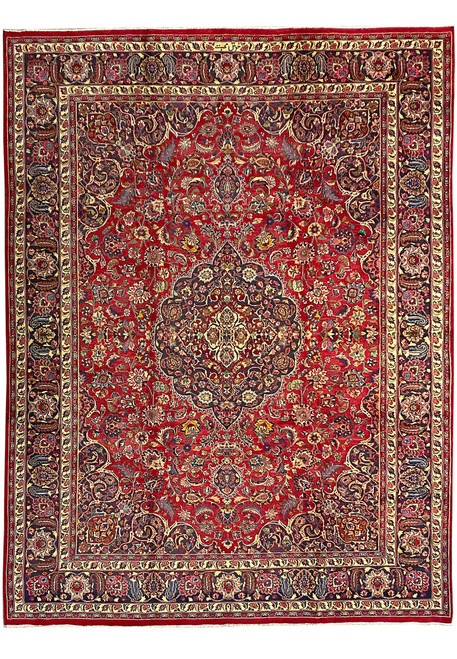
9'5" x 12'8" Persian Isfahan Rug | Red Field Star Medallion | 1980s Wool
Woven in the 1980s, this 9'5" x 12'8" Persian Isfahan rug carries the classic central-Persian formula at a scale that actually furnishes a room rather than decorating a corner of one. A deep red field, an ivory and navy star medallion, and an all over tracery of flowering vine are drawn tightly enough that you can still pick out individual blossoms standing over it. The wool pile shows a soft sheen in the photographs, the dyes have settled into the mellow register that only time gives, and the rug remains in excellent condition with full pile, intact selvages and original fringe at both ends. It is pre-owned, it has clearly been cared for, and it ships with a certificate of authenticity. At a hair under 10 by 13 feet it belongs with our other 10x13 Persian rugs.
Design and Motifs
The center holds an 8 petal rosette with a small green core inside a ringed ivory disc, set on a pale blue ground and framed by an ivory cartouche of scrolling arabesque. Around it runs a navy lobed star medallion with pendants at the 4 compass points, and beyond that the field opens into a continuous all over of palmettes, serrated leaves, rosettes and lotus heads carried on thin curling vines. The drawing is curvilinear throughout, with no straight line anywhere in the field, which is exactly what separates the Isfahan idiom from the village geometry of northwest Persia. Ivory spandrels finish the 4 corners with their own arabesque scroll and a single large palmette each. The main border is navy, filled with alternating palmettes and rosettes joined by vine, and it is bracketed by matching ivory guard stripes and a narrow light blue ribbon; the corner turns resolve cleanly, a reliable tell of a cartoon drawn properly and followed carefully.
The Color Palette
Red is unmistakably in charge here, a cool crimson that reads slightly blue rather than orange and stays even from end to end across the whole field. The navy of the medallion and main border is nearly inky in the close-up photographs, dark enough to let the floral drawing sit on it in high contrast. Between those 2 anchors the palette is lighter than most red Persian rugs of this period: buttery ivory in the spandrels and guard borders, a warm olive-gold through the leaves and petals, a soft powder blue in the small blossoms, and scattered notes of rust, soft brown and a single green in the medallion core. The overall effect at floor level is a jewel-toned red ground that never goes heavy, because the gold and light blue keep lifting it. Under daylight the wool picks up a low sheen that shifts the red a shade lighter as you walk around it.
Isfahan Origin and Weaving Quality
Isfahan sits in central Persia and has been a weaving capital since the Safavid court workshops of the 16th century. Its reputation rests on drawing rather than on any single material: the curved line, the flowing vine, the precision of a repeated palmette, all of which only hold together at a serious knot count. The design tradition spread into the surrounding district, and the villages west of the city, Najafabad among them, built a long trade weaving the Isfahan repertoire at room size on cotton foundations with a sturdier wool pile, which is precisely the kind of piece this is. The back photograph shows a tight, regular knot grid with no slubs or crowding, and the pile is clipped low and level so the fine detail stays legible. That combination, city drawing with a hard-wearing wool handle, is why rugs like this one are still flat, square and fully piled after 4 decades of use.
9'5" x 12'8" Persian Isfahan Rug | Red Field Star Medallion | 1980s Wool
Ask about this rug
This piece is the only one of it, so the things worth knowing about it are particular to it. If you want to talk through the size, the colour in your own light, or the weave, speak to someone here first.