| Size in ft: | Width: 9'6" x Length: 11'2" |
| Size in Inch: | Width: 114" x Length: 134" |
| Size in meters: | Length: 3.40 x Width: 2.90 m |
| Colors: | Navy Blue, Sky Blue, Red, Ivory, Green, Gold |
| Shape: | Rectangular |
| Woven: | 100% Hand-knotted | Handmade |
| Foundation: | Cotton |
| Pile: | |
| Age: | 1970s |
| Design: | Zirkhaki | Palace Pictorial | Central Medallion |
| Origin: | Persian Kashmar | Made in Persia |
| Condition: | Excellent |
9'6" x 11'2" Persian Kashmar Rug | Zirkhaki Palace Pictorial | 1970s Wool
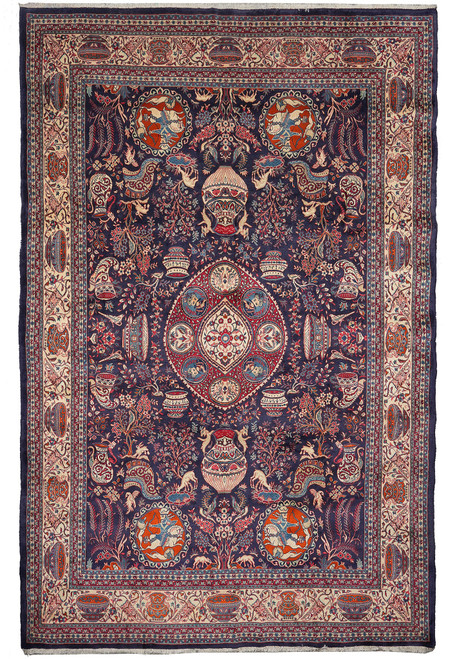
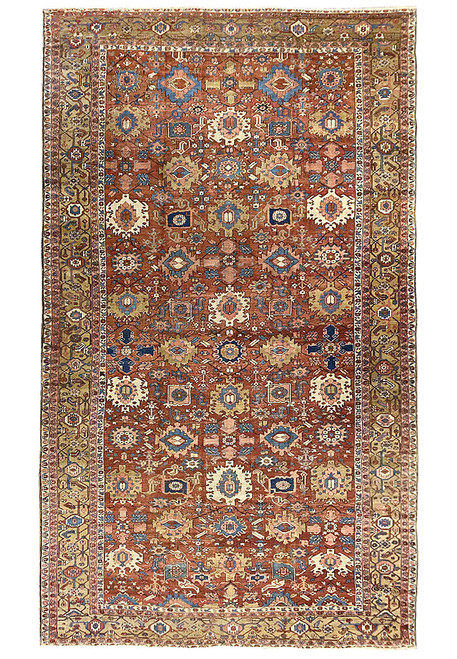
This is a picture rug before it is a floor rug. Woven in Kashmar in the 1970s, the 9'6" x 11'2" field is laid out like the plan of a royal garden palace: colonnaded pavilions along the top and bottom, arched gateways, cypress trees, flower vases set in tiled panels, and oval cartouches holding pairs of courtiers under striped parasols. The near-square proportion makes it unusually easy to place under a wide seating group or a round dining table, and among large Persian rugs that shape is the hardest one to find in good condition. The wool pile is full, the drawing is crisp, and the rug ships with our certificate of authenticity.
Please Note About the Photographs:
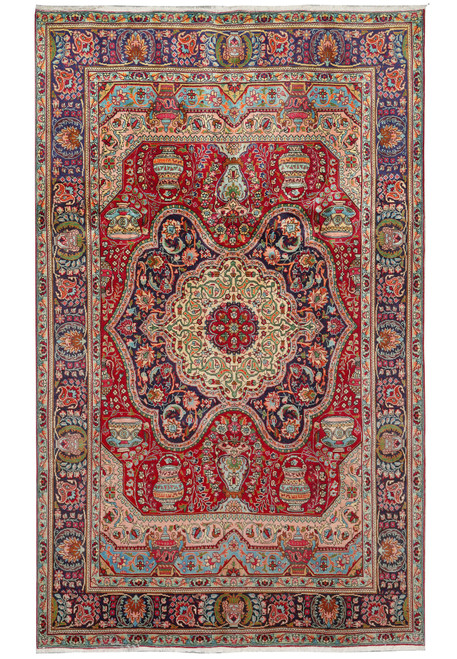
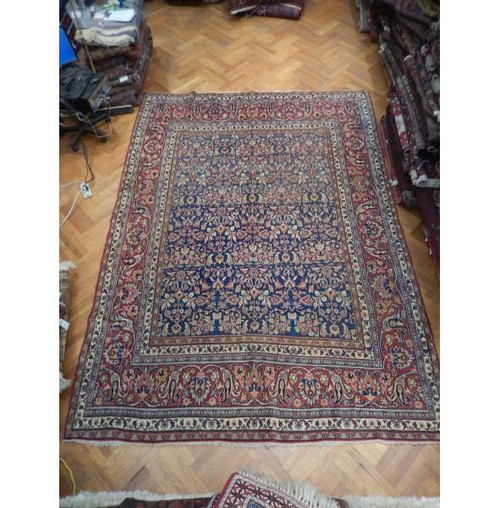
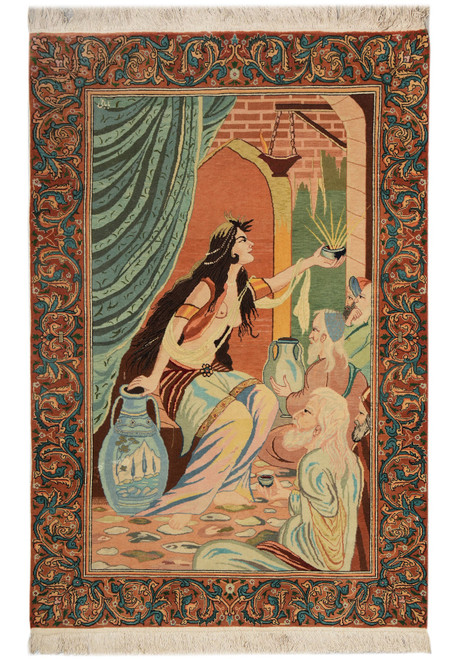
The first full overhead photograph was taken under warmer studio light and reads darker and duller than the rug is in person. The angled and close-up photographs were shot in daylight and show the true navy, sky blue, crimson, ivory and gold tones of the wool.
Design and Motifs
The zirkhaki drawing reads from the outside in. Each end of the field carries a two-storey palace facade with rows of arcades, a central arched portal and a formal pool set in front of it, flanked by cypress and flowering trees. Inside those, 4 large oval cartouches frame standing figures beneath a fringed canopy, while smaller tiled panels in turquoise and ivory hold footed vases of blossoms and ribbed columns that act as the architecture of the garden. The center is anchored by a lobed crimson medallion with a stepped outline and pendant finials at both ends, filled with paired birds facing a striped column, a motif repeated in miniature through the surrounding field. The ivory main border breaks the formality with animals: grazing deer, horses and small birds wandering through leafy vinework and red rosette panels, contained by narrow guard stripes and a saw-tooth outer band in navy and ivory. Nothing is machine-regular here, and the small shifts from panel to panel are what tell you a person drew and knotted it.
A Full Palette of Navy, Crimson and Gold
The open field is a deep navy blue, cool and slightly inky, and it is the background that lets everything else glow. Over it sits a broad halo of soft sky blue around the medallion, which itself is drawn in a warm crimson red with an ivory outline. The palace panels are built from ivory, straw gold and pale blue, with the arcade columns striped in red and white so they catch the eye from across a room. Turquoise and a muted bottle green appear in the tiled vase panels and again in the flower heads, giving the whole surface a cooler cast than a typical central Persian rug. Gold is used sparingly but decisively, in the birds flanking the columns, in the cartouche scrollwork and in the border blossoms. The main border reverses the scheme entirely: an ivory ground with wine red panels, so the rug frames itself in warm tones and keeps the cool blue center from reading heavy. Pink, black and brown outlines do the fine work, separating shapes at a scale you only see up close.
Kashmar and the Khorasan Weaving Tradition
Kashmar sits in Khorasan in northeastern Persia, southwest of Mashad, and its workshops built their reputation on exactly this kind of narrative weaving: palaces, gardens, historic reliefs and court scenes rendered in wool rather than the endless repeating floral of the commercial trade. The town shares wool sources, dye traditions and the asymmetric knot with nearby Persian Mashad rugs, which is why the handle here feels familiar to anyone who knows Khorasan weaving: a soft, slightly heavy wool with a good sheen that takes deep blues and reds without going flat. The reverse, visible in the last photograph, shows an even cotton foundation and a knot count high enough to carry all the fine detail in the figures and the architecture. Age is consistent with 1970s production, and if you want to understand the markers that place a piece in that window, our guide on how to date an Oriental rug walks through the same clues we use. The pile has retained its height throughout, the ends and sides are sound, and the colors have mellowed just enough to look settled rather than new.
9'6" x 11'2" Persian Kashmar Rug | Zirkhaki Palace Pictorial | 1970s Wool
Ask about this rug
This piece is the only one of it, so the things worth knowing about it are particular to it. If you want to talk through the size, the colour in your own light, or the weave, speak to someone here first.