Watch the film
| Size in ft: | Width: 9'8" x Length: 10'3" |
| Size in Inch: | Width: 116" x Length: 123" |
| Size in meters: | Length: 3.12 x Width: 2.95 m |
| Colors: | Burgundy, Blue. |
| Shape: | Square |
| Woven: | Hand-Knotted |
| Pile: | Wool |
| Origin: | Persia |
| Design: | Traditional |
| Age: | 1980's |
| Condition: | Excellent |
9'8" x 10'3" Square Persian Mashad Rug | Signed Traditional Medallion | 1980s Burgundy & Navy
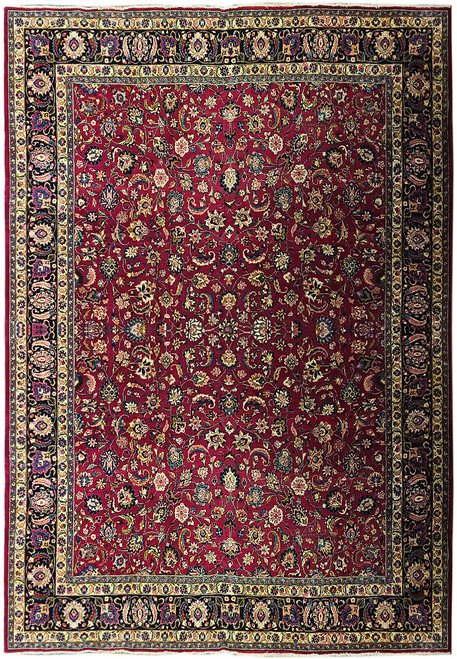
A true square is one of the hardest formats to find in a Persian rug, and at 9'8" x 10'3" this 1980s piece sits almost perfectly square on the floor. It is hand-knotted in wool on a cotton foundation, with a deep burgundy field, a navy main border and a stepped medallion that pulls the whole composition to its center. A small cartouche woven into the ivory guard border carries the weaver's signature, which tells you this came out of a named workshop rather than an anonymous village loom, a habit that runs through the best Persian Mashad rugs. The pile is full and even, the colors are still saturated after four decades, and a certificate of authenticity ships with the rug.
Please Note About the Photographs:
Some photos show a soft diagonal shadow across the field. That is a fold mark from pallet storage, not wear, not fade and not damage. It relaxes once the rug is laid flat, and every rug leaves us professionally steamed and pressed before shipping.
Design and Motifs
The center holds a stepped star medallion drawn in rust orange over a navy ground, layered inward through forest green lobes to a small tiered rosette with cobalt petals and an olive eye. Pendants drop from the medallion at top and bottom, each one an ivory and green cartouche outlined in orange. Around it the burgundy field is filled edge to edge with curling palmettes, serrated leaves, rose sprays and small paisley forms strung on a thin ivory vine, so there is no empty ground anywhere in the composition. All 4 corners carry navy spandrels that repeat the medallion drawing in miniature, complete with the same hooked outlines and ivory palmette anchors. The navy main border runs a steady alternation of large rosettes and leaf paisleys, and it is framed on both sides by ivory guard stripes of small blue and rose blossoms on a scrolling stem.
A Burgundy Field Worked in Navy, Rose and Rust
The field reads as a deep burgundy with a raspberry cast in daylight, cooler and more wine-toned than the brick reds of the northwest weaving towns. Against it the main border is a near black navy, dense enough that the ivory guard stripes look almost white by comparison. The medallion supplies the heat: rust orange and tomato red, banked against forest green and a raspberry core. Scattered through the field are cornflower and cobalt blues, clear rose pink, olive and antique gold, chocolate brown and small touches of soft grey green, all of them held together by the thin ivory vine that traces across the ground. Close up the wool has real luster, which is what makes the pinks and blues glow rather than sit flat. In a room this reads as a warm, saturated, formal floor: strong enough to carry a large seating group, and easy alongside dark woods, brass and cream walls.
Mashad Weaving in Khorasan
Mashad is the great weaving city of Khorasan in northeast Persia, a pilgrimage center whose workshops have supplied large formal room-size rugs for well over a century. The region's wool is long-stapled and glossy, which is why Mashad pile takes dye so deeply and keeps its sheen as it ages, and the local drawing style favors a big curvilinear medallion floating in a dense floral field exactly as it is handled here. A signed piece means a workshop piece, woven from a cartoon under a master's name and finished to his standard, and the square format on top of that would have been a commission rather than a stock size. The 1980s date shown in the specs is consistent with the wool, dyes and finish seen here; if you want to understand how those clues are read, our guide on how to date an Oriental rug walks through the same checks we use on the floor.
9'8" x 10'3" Square Persian Mashad Rug | Signed Traditional Medallion | 1980s Burgundy & Navy
Ask about this rug
This piece is the only one of it, so the things worth knowing about it are particular to it. If you want to talk through the size, the colour in your own light, or the weave, speak to someone here first.