| Size in ft: | Width: 9'8" x Length: 13'4" |
| Size in Inch: | Width: 116" x Length: 160" |
| Size in meters: | Length: 4.06 x Width: 2.95 m |
| Colors: | Ivory, Cream, Taupe, Camel, Navy Blue, Sky Blue, Red accents |
| Shape: | Rectangular |
| Woven: | 100% Hand-knotted | Handmade |
| Foundation: | Cotton |
| Pile: | |
| Signature: | Signed | Woven cartouche in the end border |
| Design: | Kashan Floral Medallion | All-over flowering field |
| Origin: | Persian Kashan | Made in Persia |
| Condition: | Excellent | Full even pile |
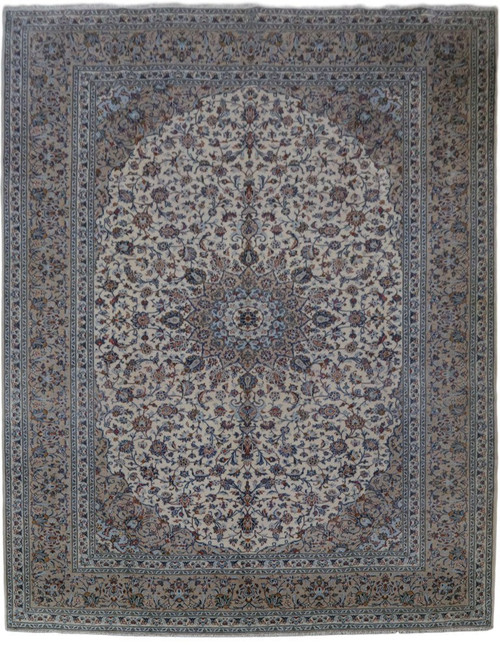
9'8" x 13'4" Persian Kashan Rug | Ivory Floral Field with Blue Medallion | Signed Workshop Piece
This 9'8" x 13'4" Kashan is a full room-size workshop weaving with a signed cartouche in the end border, which tells you it left a named loom rather than an anonymous one. The ivory ground is unusually pale for a Kashan, and the drawing on top of it is dense and disciplined: a soft blue and taupe lobed medallion in the centre, matching spandrels in the 4 corners, and a field packed edge to edge with palmettes, rosettes and curling vine. The wool has the slightly glossy handle that good central Persian fleece takes on after years of pile compression, and the pile is even from selvedge to selvedge with no low spots. Among 10x13 room-size Persian rugs this is the format that actually fits under a sofa group or a 10 seat table without crowding the walls. If you want the background on the type before you buy, our guide to Persian Kashan rugs covers the workshop tradition in detail. Every rug ships with a certificate of authenticity.
Design and Motifs
The layout is the classic Kashan formula worked in reverse tonality: instead of a red ground, the weaver set the whole composition on ivory. At the centre sits a lobed medallion filled with an 8 petal rosette core, ringed by small paired palmettes and tiny cloud bands, with slender pendant finials reaching top and bottom. Matching quarter medallions anchor the 4 corner spandrels, and between them the field never rests, with serrated acanthus leaves, split arabesques, lotus palmettes and small multi petal flower heads on a vine system that curls back on itself in mirrored pairs. The main border carries a procession of large palmettes and cypress-like floral cartouches on a taupe ground, framed by narrow guard stripes of running rosette and vine. In the 4th photograph a small woven cartouche interrupts the inner guard stripe, the weaver's signature panel, worked in dark script on an ivory cell. Look closely at photo 3 and you can see how cleanly the outlines are drawn, each curve carried in a single fluid line rather than stepped, which is the mark of a cartoon drawn by a professional designer and followed knot for knot.
The Ivory Ground and Its Blues
The field reads as a warm ivory, closer to unbleached cream than to stark white, and it takes light differently depending on which way the pile is laid. Against it the palette is restrained and mostly cool: a soft powder blue in the medallion body, deeper navy for the outlining and for the dark leaf forms scattered through the field, and a mid sky blue used for flower centres and small buds. Warm tones do the balancing work, with camel and tobacco brown in the vine scroll, a dusty taupe across the main border ground, and a pale honey beige in the corner spandrels. Small hits of deep red and old rose appear as flower hearts and as pin dots along the guard stripes, just enough to keep the whole thing from going monochrome. Dark charcoal navy outlines every major motif, and that is what holds the design legible from standing height. In a room with pale walls, oak or light stone floors and mixed metals, this is a rug that lightens the floor instead of darkening it, which is why ivory ground Kashans remain the easiest formal Persian rugs to live with.
Kashan, the Town and the Weave
Kashan sits in central Persia, north of Isfahan on the edge of the desert, and its looms trace straight back to the Safavid court workshops. The town has always had two advantages: soft, lustrous local wool that takes dye deeply and polishes with use, and a design tradition strict enough that a Kashan is recognisable across a room. Weaving here is workshop weaving, warp set on cotton, asymmetrical knots pulled tight, pile clipped low so the drawing stays crisp, and a designer's cartoon governing every line. A signature cartouche like the one in this piece is how the workshop put its name to the result. Kashan is also the most familiar Persian rug in American life whether people know the name or not: when you watch Shark Tank there is a Persian Kashan on the floor. This example, at 9'8" x 13'4" with a tight low pile and a fully realised ivory ground design, is a straightforward, honest example of what that town does best.
9'8" x 13'4" Persian Kashan Rug | Ivory Floral Field with Blue Medallion | Signed Workshop Piece
Ask about this rug
This piece is the only one of it, so the things worth knowing about it are particular to it. If you want to talk through the size, the colour in your own light, or the weave, speak to someone here first.