Watch the film
| Size in ft: | Width: 9' x Length: 11'11" |
| Size in Inch: | Width: 108" x Length: 143" |
| Size in meters: | Length: 3.63 x Width: 2.74 m |
| Colors: | Ivory, Rust Red, Slate Blue, Navy, Sage Green |
| Shape: | Rectangular |
| Woven: | 100% Hand-knotted | Handmade |
| Foundation: | Cotton Foundation |
| Pile: | 3/8" Wool |
| Design: | Serapi | Lobed Central Medallion | Floral Spandrels |
| Origin: | Made in India |
| Condition: | Excellent | Full even pile |
9' x 11'11" Serapi Rug | Ivory Field, Rust Palmette Border | Fine Wool, Made in India
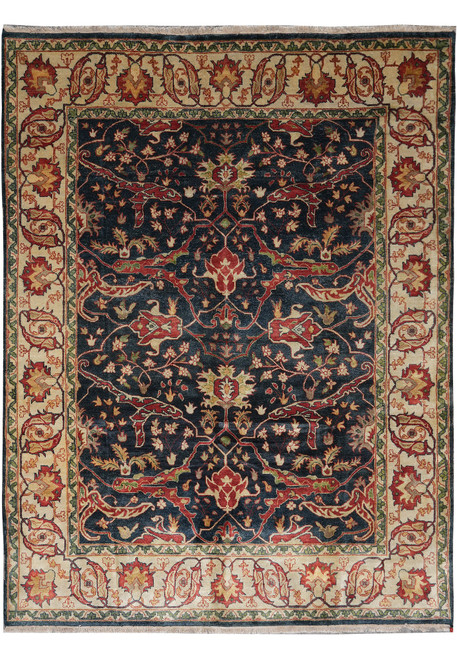
This is a Serapi design worked in fine hand-knotted wool, and it follows the classic formula without cutting a corner: an ivory field, a lobed rust medallion dead center, slate blue spandrels, and a wide brick red border of palmettes and leaf sprays. The 3/8 inch pile is full and stands upright across the whole surface, the selvedges are tight, and the back reads evenly from end to end. At 9' x 11'11" it lands almost exactly on the 9x12 area rug footprint most buyers are measuring for, which means a full sofa group sits on it or a 6 to 8 seat dining table keeps all chair legs on the pile. It ships with a certificate of authenticity confirming it was knotted entirely by hand, knot by knot, and as a traditional Oriental rug it reads formal from across a room and surprisingly soft underfoot once you are standing on it.
Design and Motifs
The center holds a lobed rust medallion drawn with hooked ivory arabesques curling out of its four sides, filled inside with a small grid of rosettes and a single pale green boss at the very middle. Navy outlines pull the shape forward off the ivory ground, and a stepped slate blue surround frames it like a second, larger medallion. Four quarter medallions anchor the corners of the field, each one a rust teardrop with a sage green and grey center ringed by ivory sickle leaves, set into deep slate blue spandrels that carry their own palmettes and split leaf vine. Across the open ivory field runs a loose scroll of thin vines, cypress-like leaf tips, small rosettes and bud forms, spaced rather than crowded, so the drawing breathes. The main border alternates large shield palmettes with paired leaf clusters on a brick red ground and squares off cleanly at the 4 corners, while narrow ivory guard stripes on both sides carry a repeating trefoil and rosette chain. The drawing is the Serapi idea done with a steadier curve than most village work, geometric in its bones and floral on the surface.
A Study in Ivory, Rust and Slate Blue
The field is a warm ivory, closer to unbleached cream than white, and it is the color that sets the tone for the whole piece: it keeps a 9 by 12 footprint from darkening a room. Against it the border runs a dry brick rust, a touch of terracotta in it rather than a cherry red, and that same rust returns in the medallion and the corner teardrops to tie the layout together. The spandrels and the inner frame are a smoky slate blue that cools the red down, deepening to near navy in the outlines and lifting to a soft powder blue in the small flower heads. Sage green, pale grey, soft salmon pink and a bone ivory fill out the flowers, with the green doing most of the quiet work in the palmette centers. It is a restrained, aged-looking palette rather than a bright one, which puts it with the more livable ivory and beige rugs and makes it easy to sit beside oak, walnut, linen or leather.
Made in India in the Serapi Tradition
Serapi is a pattern name, not a place name on this rug: it describes the big medallion and palmette drawing of the old Heriz district weaving that collectors have chased for more than a century, and this piece was knotted in India, where the great majority of the world's good contemporary hand-knotted work is now made. We say that with confidence rather than apology. The weavers worked on a cotton foundation with a hand-spun wool pile cut to 3/8 inch, and the back view tells you what you need to know about the execution: straight, consistent rows, no pulled or wandering knots, honest flat-lying corners and a rug that measures true at 9' x 11'11" instead of drifting off square the way loose weaving does. Wool of this grade takes dye cleanly and burnishes rather than frizzes with traffic, so the pile should keep its luster under a dining table or a coffee table for decades of normal use.
9' x 11'11" Serapi Rug | Ivory Field, Rust Palmette Border | Fine Wool, Made in India
Ask about this rug
This piece is the only one of it, so the things worth knowing about it are particular to it. If you want to talk through the size, the colour in your own light, or the weave, speak to someone here first.