Watch the film
| Size in ft: | Width: 9' x Length: 11'4" |
| Size in Inch: | Width: 108" x Length: 136" |
| Size in meters: | Length: 3.45 x Width: 2.74 m |
| Colors: | Orange |
| Shape: | Rectangular |
| Woven: | Hand-Knotted |
| Origin: | Persia |
| Design: | Sarouk |
| Condition: | Excellent |
9' x 11'4" Antique Persian Sarouk Rug | Vase and Flowering Sprays on Apricot Field | Excellent Condition
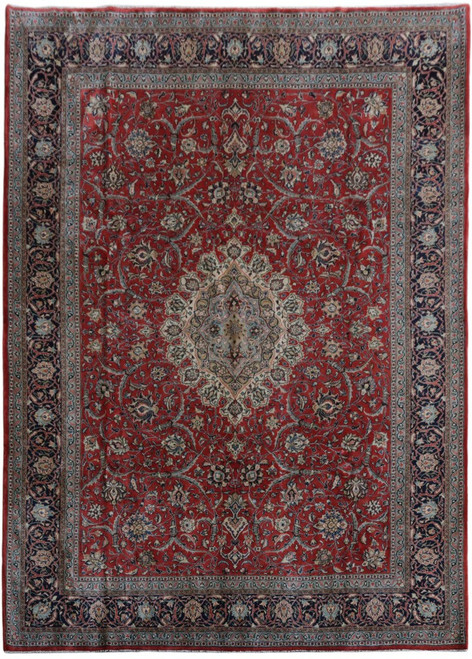
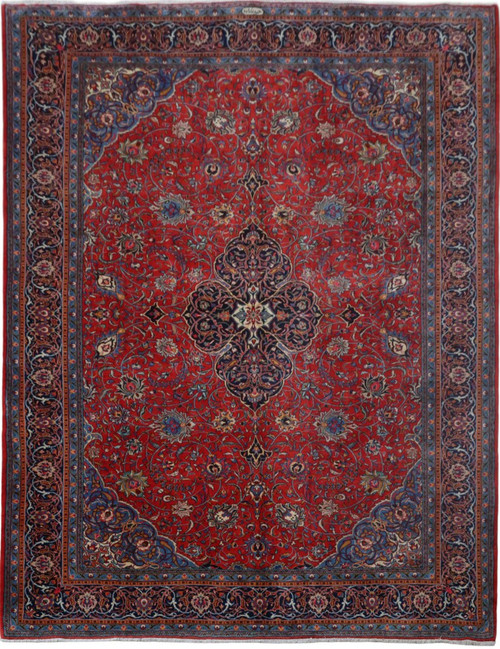
At 9' x 11'4" this is the classic room size in which antique Persian Sarouk rugs were woven for export, and it is the size that still works hardest in a real house: a full seating group sits on it with pile to spare at the walls. The pile is hand-knotted wool on a cotton foundation, clipped low and even, with the slightly glassy handle that older Sarouk wool develops once decades of use have polished it. The drawing is symmetrical and entirely floral, built around a footed vase at the base of the field, and the whole thing is framed by a deep navy border that reads almost black in low light. Pile depth is consistent from end to end with no bald areas, the selvedges are intact and the fringe is original, as the folded corner photograph shows. Every rug we sell ships with our certificate of authenticity recording origin, materials, size and hand-knotted construction.
Please Note About the Photographs:
The first studio photograph was taken under strong lighting and reads a shade more golden than the rug looks in person. The floor level photographs on the parquet are the truer record: the field is a soft orange that shifts between apricot and salmon as the daylight moves. This is camera and lighting variation, not a difference in the rug itself.
Design and Motifs
There is no medallion here. Instead the weaver worked an all-over floral field that mirrors itself along the long axis: an ivory footed vase sits low in the field, a tall spray of leaves and blossoms rises out of it toward the center, and to either side run rows of detached flowering branches, feathery cypress-like fronds, serrated leaves and small rosettes on thin stems. Read from the short end the design resolves into a garden seen in elevation, which is the traditional reading of this Sarouk layout. The main border carries alternating rust palmettes and ivory rosettes with blue rosette centers on the navy ground, each palmette separated by a small stepped flowerhead, and that band is held between narrow rust and ivory guard stripes drawn with a continuous vine of tiny four petal flowers. Corner resolutions in all 4 corners are handled cleanly, with the border pattern turning rather than colliding, which is a mark of a competent workshop drawing rather than a copied cartoon.
Color: Apricot Orange Against Navy and Sage
The field is the reason to buy this piece. It is a warm orange with an apricot to salmon cast, soft rather than saturated, with gentle abrash that lightens toward the upper end and gives the ground a faintly sunlit look. Against that the botanical drawing sits in sage green, olive, deep midnight navy, cream and a muted brick rust, with pinpoints of pale sky blue in the rosette centers and small flashes of true ivory in the vase and the larger blossoms. The main border reverses the scheme: a near black navy ground makes the rust palmettes and cream rosettes glow, while the ivory guard stripes draw a bright line between border and field and stop the two dark elements from running together. It is a palette that suits warm woods, brass and stone, and it belongs with the softer end of orange and rust Persian rugs rather than the heavy raspberry reds usually associated with the type.
Sarouk Weaving in West Central Persia
Sarouk is a weaving village north of Arak in west central Persia, at the heart of the district that also produced Mahal and Sultanabad weaving. What separated Sarouk from its neighbors was density: a tighter knot count on a cotton warp, a firm beat-down and locally grown wool with enough lanolin to keep its spring through generations of use. The back of this rug, visible in the final photograph, shows a compact and regular knot with straight rows and no pulling, which is what you look for when you are dating an antique Persian rug by structure rather than by design alone. The floral vocabulary reflects the same workshop discipline, since these patterns were drawn on paper and followed closely, yet the small variations from one spray to the next confirm the piece was knotted by hand and never machine reproduced. Sarouks of this vintage and size are steadily leaving the market, and one with even pile and an unusual apricot ground is not a rug that reappears often.
9' x 11'4" Antique Persian Sarouk Rug | Vase and Flowering Sprays on Apricot Field | Excellent Condition
Ask about this rug
This piece is the only one of it, so the things worth knowing about it are particular to it. If you want to talk through the size, the colour in your own light, or the weave, speak to someone here first.