Bakhtiari Rugs
The Bakhtiari are a large tribal confederation of the western Zagros, and the rugs sold under the name come from the settled villages of their territory rather than from tents. They are thick, heavy, strongly coloured and drawn on a grid of panels. In a big room a Bakhtiari does something no city rug does: it fills the floor without asking for quiet.
Tribal name, village looms
Bakhtiari is a confederation, not a town, and its weaving is a village industry in the highlands of Chahar Mahal and Bakhtiari province, south-west of Isfahan. That matters for what the rugs are. Fully nomadic weaving is small, because a loom has to be carried. Village weaving on a fixed loom can be any size, and can use a cotton foundation, which is why Bakhtiari rugs come in dimensions no genuinely migratory group produces. What stays tribal is the design sense and the colour nerve. These are tribal rugs made under a roof.
Khesti: the garden, in panels
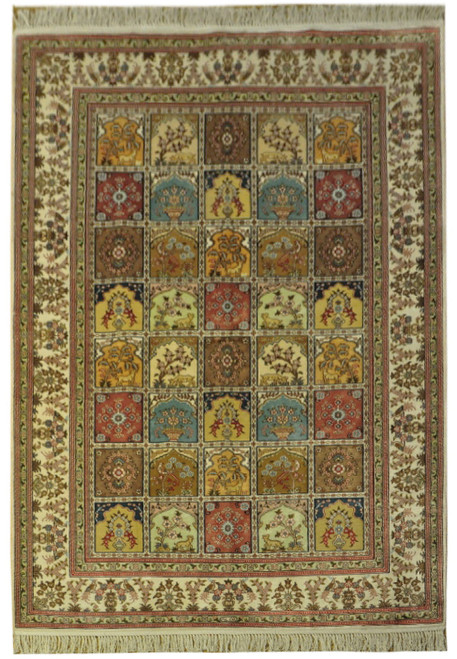
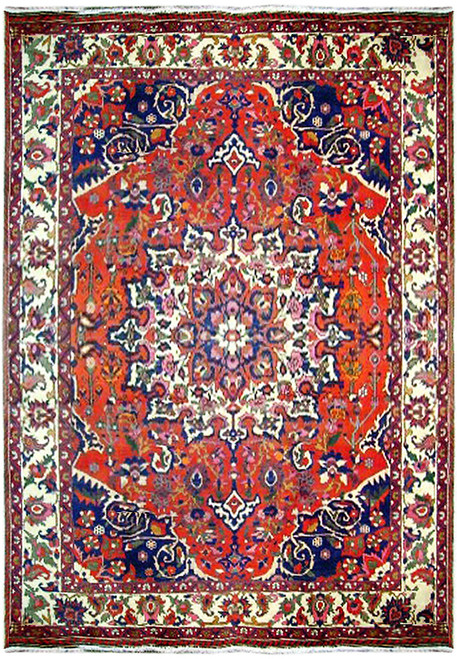
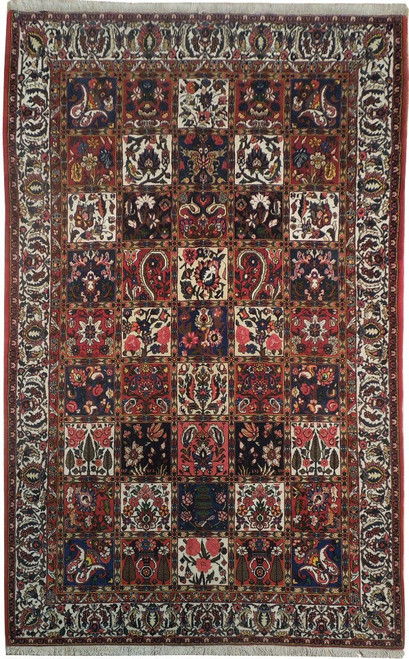
The design the name is attached to is the Khesti, a grid of compartments covering the whole field, each panel holding its own small motif: a cypress, a flowering tree, a weeping willow, a vase, a single blossom. The trade also calls it the garden design, and the ancestry is the walled Persian garden divided by its water channels. What makes the Bakhtiari version distinct is that the panels do not agree with each other. One is red with a blue tree, the next is ivory with a green one, the next gold. The grid holds, the colour does not repeat, and the eye keeps moving. Other layouts occur, including a medallion field and an all-over of large stylised blossoms, but the panel grid is the one that carries the name.
Colour set down without a transition
City weaving graduates its colour. A Kashan moves from madder ground to ivory vine through a mediating outline, and the whole surface resolves. Bakhtiari weavers put saturated blocks directly against each other: deep red beside indigo, both beside yellow-gold, all of it outlined in dark brown or black. It works because the values are close and the outlines are firm, and because the wool takes dye deeply enough to hold up under the collision. Anyone after a quiet rug should look at another group entirely. Anyone shopping for multi-colour should start here, and the greens and golds are used more freely in Bakhtiari than in almost any other Persian group.
Built heavy
The wool is the coarse, long-fibred fleece of the Zagros, spun thick and knotted at moderate density on a cotton foundation, usually with the symmetrical knot. The pile stands tall and the rug is substantial to move. That combination wears extremely well, because a thick pile has a long way to go before the drawing is affected, and the geometry does not depend on fine detail to stay legible. What it will not do is fine drawing. A Bakhtiari cannot render a scrolling arabesque, and the ones that try look worse than the ones that do not. For drawn detail, the answer is a city rug: Isfahan is three hours away and a different craft entirely.
Size is not a detail here
Panel designs need room. A garden grid in a small rug shows three panels by four and reads as a fragment of something bigger, which it is. The same design at nine by twelve reads as a floor covered in a garden. Bakhtiari is consequently at its best large and holds up in 12x18, where many tribal traditions simply run out of drawing. It is a rare case of a tribal rug that actually suits a big formal dining room, helped by a pile dense enough to take chair legs.
Neighbours in the south-west
The Zagros produce several weaving groups and they are easy to confuse. Qashqai work is finer, more mobile and more medallion-driven; Yalameh runs columns of stepped diamonds up the field; Gabbeh abandons pattern altogether for thick plain wool. Bakhtiari is the architectural one of the family, the group that organises its field before it decorates it. Within Persian weaving it is the best argument that tribal design and formal scale are not opposites.
-
-

9'10" x 12'7" Persian Bakhtiar Rug | Khesti Garden Panel Design | Semi Antique Sage Green Wool
Was: $6,150.00Now: $5,800.00 -

-
-

-

-

-
-

-
-

-
