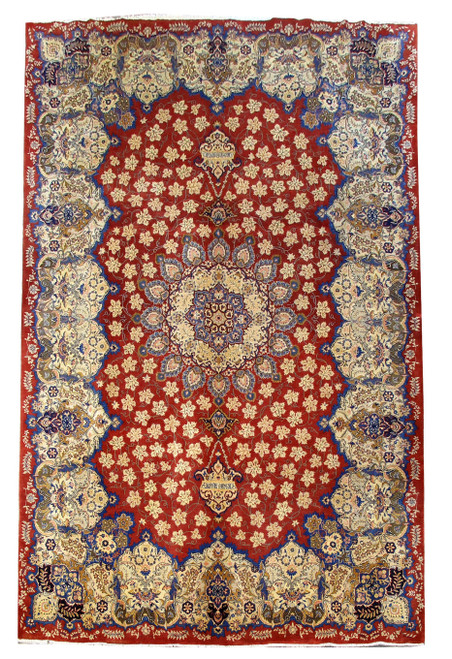
At the Loom
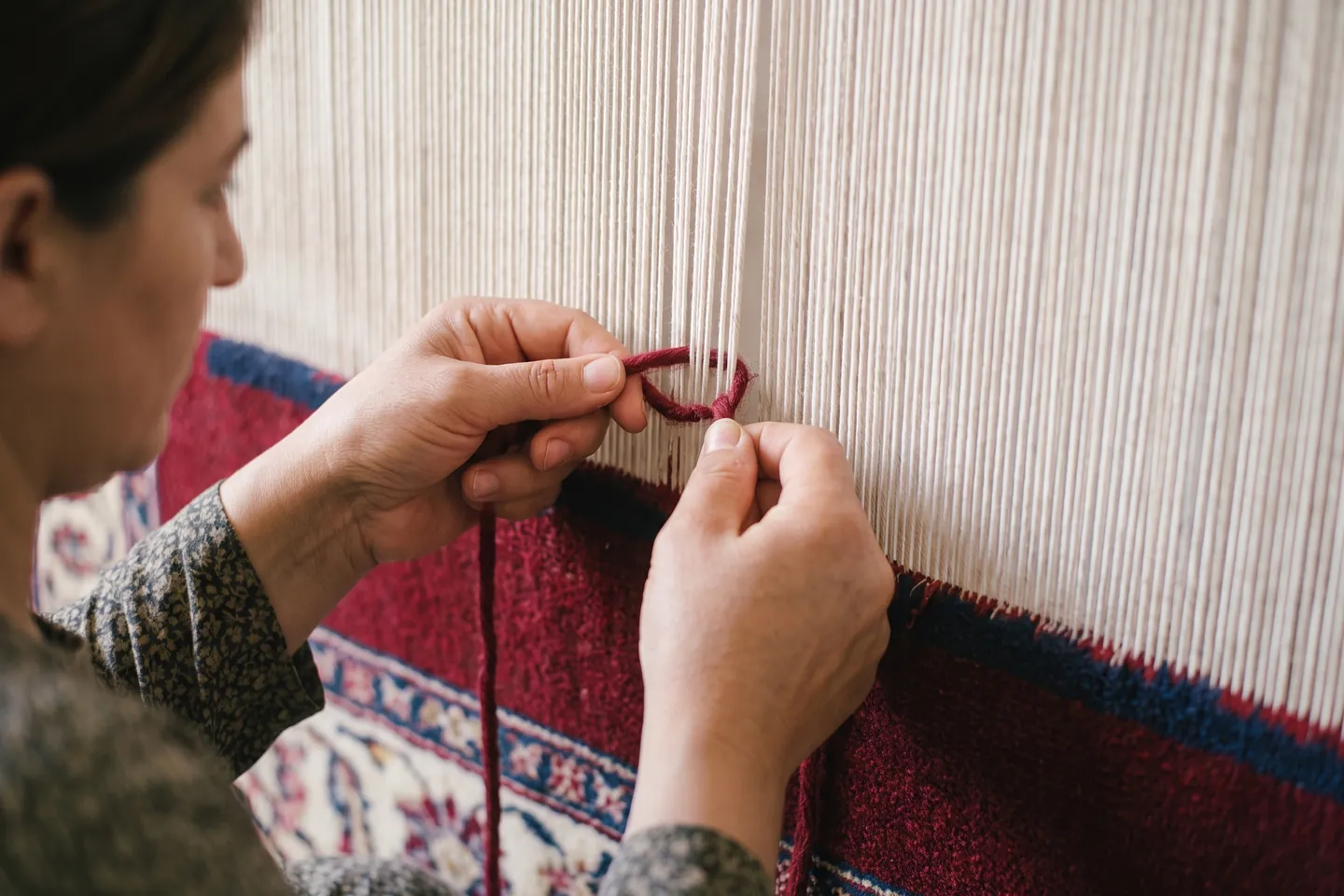
The loom is a clamp
A rug loom does almost nothing. It holds several hundred cotton threads at even tension and goes on holding them for as long as the weaving takes, which on a large fine piece can run to two or three years. Those threads are the warp. They run the length of the rug, they are counted and spaced before a single knot is tied, and they settle more about the finished object than anything that happens afterwards.
Warp spacing fixes how many knots can sit across an inch. Warp thickness fixes how heavy and how stiff the rug will be. Tension fixes whether it will lie flat. A loom dressed carelessly gives a rug that pulls to one side for the rest of its life, and there is no later stage at which that gets corrected. It is the least visible part of the work and the part nobody rushes.
Most workshop weaving uses cotton warp, because cotton moves very little with humidity. Wool warp turns up where cotton was not to hand, largely in tribal weaving, and it gives a lighter, more flexible rug that is also likelier to go out of square. Silk warp appears only under a pile fine enough to need it, which in practice means the silk pieces and very little else.
Two knots, and the difference between them
There are two knots in general use across the whole tradition. The asymmetric knot, called Persian or Senneh, wraps the wool right around one warp thread and passes behind its neighbour, so the two cut ends come up together between the pair. The symmetric knot, called Turkish or Ghiordes, loops around both warps and pulls both ends up through the middle.
The asymmetric knot sits at a slight angle and packs closer, which is why the finest drawing in Persian weaving is done with it. The symmetric knot is bulkier and grips harder, which is part of why Anatolian rugs and Caucasian work feel tougher under a hand and hold a crisp geometric line so well. Neither is the better knot. They are suited to different drawing.
There is a third, the jufti, tied across four warps rather than two. It covers ground at roughly twice the speed and leaves half as much pile standing on the same area of foundation. It has a long history in parts of Khorasan, so its presence alone does not condemn a rug, but a jufti-knotted piece goes thin sooner than its knot count suggests and belongs at a different price. Nobody volunteers this. You find it by turning the rug over.
The weft, and then the comb
A completed row of knots is still a row of loose loops. What locks it down is the weft: one, two or three shoots of thread passed right across the width, over and under the warps, after every row. Then the iron comb comes down on the whole row, hard, several times. That beating is what makes the back of a good rug flat and grainy instead of lumpy, and it is why a weaving shed is a loud place.
How many wefts go in, and how hard they are pulled, changes the rug entirely. Single-wefted weaving, common in the Hamadan villages, gives a flatter, more flexible piece. Double wefting with one weft pulled tight drags alternate warps down behind their neighbours, so only half of each knot shows on the back and the pile leans firmly in one direction. That is the construction behind the deep, dense feel of a Kerman or a Sarouk. Pack the wefts hard enough and you get a Bijar, a rug so heavy the trade has called it the iron rug for a century.
Ten thousand knots and a working day
The reason the pace holds is that every step above is a decision taken by a person with wool in one hand and a knife in the other. A weaver on coarse work can tie far more knots in a day than a weaver on fine work, because the knots are larger and the drawing changes less often. On the finest pieces the count per hour falls sharply, and the weaver stops every few rows to shear the new pile level so the pattern stays readable while it is being made.
A wide rug is not woven by one person. Two or three weavers sit shoulder to shoulder on the same bench, each responsible for their stretch of the row, and the rug is wound onto the lower beam as it grows so the working line stays at chest height. Their hands are not identical. In a good workshop that difference is trained down until it cannot be seen. In ordinary work you can sometimes find the seam between two pairs of hands by running a palm across the back.
A ground loom and a workshop loom
The horizontal ground loom is four stakes and two beams, pegged into the earth, and it comes apart and travels. It is the loom behind most nomadic and village weaving: the Qashqai pieces, the Shiraz and Yalameh work, the shaggy Gabbeh. Re-pegging it at a new camp never restores exactly the former tension, and a weaver working from memory or from a small woven sampler will edit as she goes. Those rugs narrow, widen, drift in colour and occasionally change their minds about a border. That is the record of how they were made.
The workshop loom is vertical, fixed to a wall or a frame, with rollers top and bottom. Above the weaver hangs a cartoon: the design squared off on graph paper, one square to one knot, colour by colour, drawn by a designer who never touches the loom. A master calls the colours, the weavers answer, and the rug that results is symmetrical because it was specified that way. This is the machinery behind Nain, Isfahan, Qom and the better Tabriz production.
Between the two sits the fixed village loom, vertical but at home, one or two weavers, a pattern half remembered and half copied. Most of what the market calls traditional weaving came off that middle sort of loom.
Cut free, and then the rest of the work
Weaving finishes when the rug is cut off the warp, and the rug is nowhere near finished. Those cut warp ends are the fringe, which is structure rather than trim, and they are knotted or braided so the weft cannot start walking out. The sides are wrapped in wool to make a selvedge. Then the rug is washed, stretched damp on a frame until it squares up, dried, and sheared again to an even height.
A rug that skipped the stretching will not sit right on a floor. A rug that was sheared too low at this stage looks sharper in a photograph and has less life in it than a rug left a little longer in the pile.
What the loom does not do for you
Hand-knotting is a method, not a grade. A dull design in mediocre wool is hand-knotted too, and it will be a dull rug for eighty years rather than eight. The loom guarantees construction and nothing about judgement.
It also does not settle where the rug should go. A fine workshop piece with a short pile is the wrong thing to put in a hallway with a dog in it, and a heavy village rug is the wrong thing to put under a glass table where every irregularity reads. For a kitchen or a hall that takes boots, a flatweave or a coarse wool piece is the better answer, and that is a judgement about the room rather than about the weaving. If the room is long and narrow, the shape decides first, which is what runners exist for.