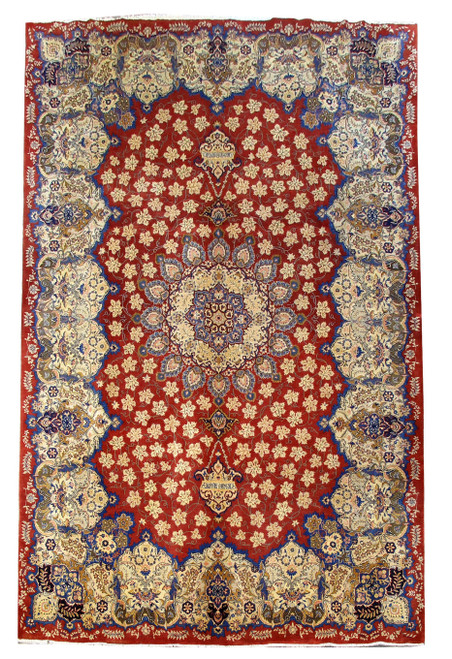
Isfahan on Silk
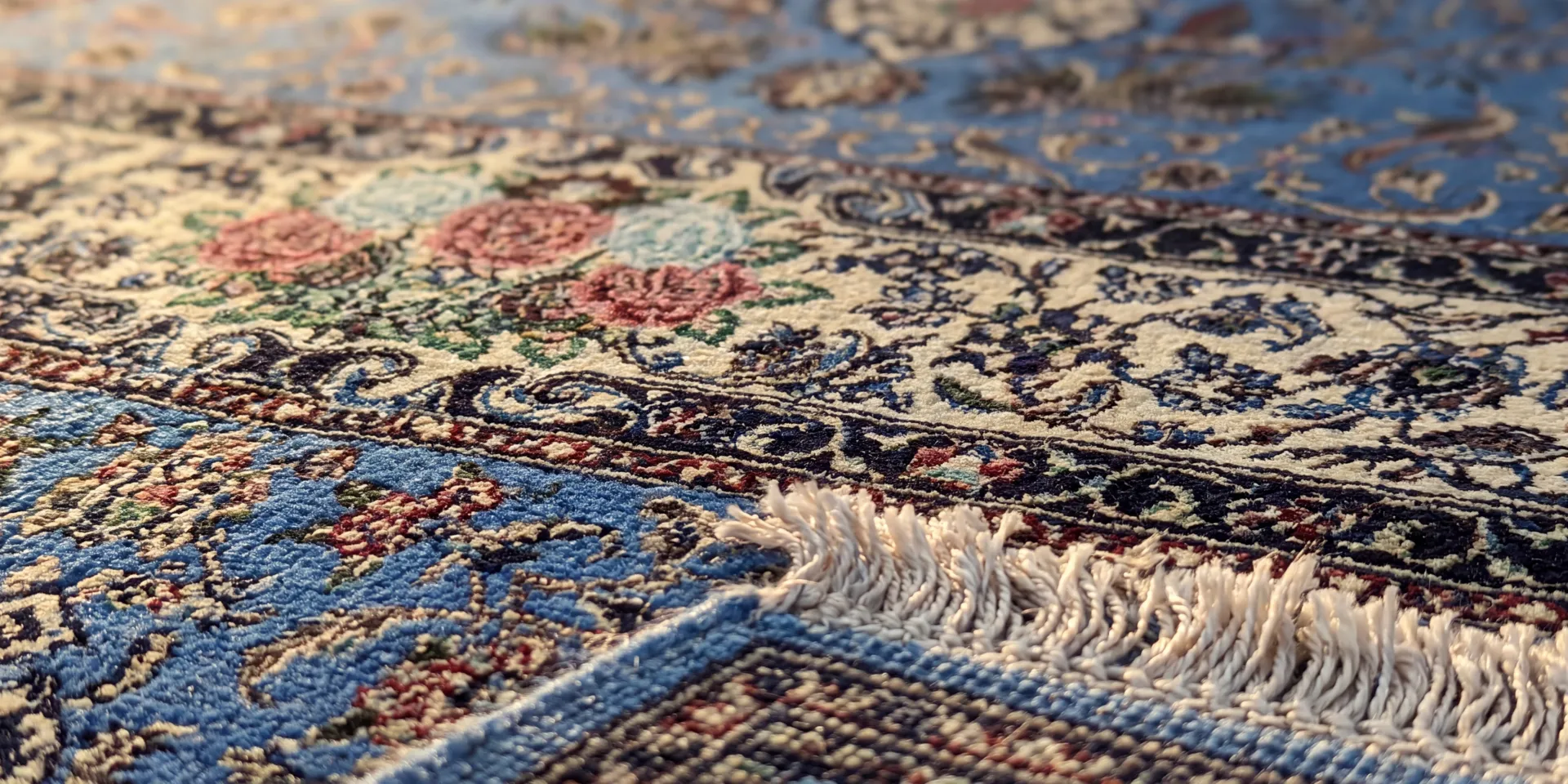
The foundation is the part nobody looks at
Every knotted rug is two materials doing two different jobs. The pile is the part you see and walk on. Underneath it is the foundation: the warps running the length of the rug under tension, and the wefts crossing between every row of knots to lock them in place. The pile gets all the attention. The foundation decides what the pile is allowed to do.
Most rugs are built on cotton. Cotton is cheap, stable, holds tension well and does not stretch much, which is why it replaced wool foundations across most of the weaving world. It has one limit: to carry the tension of a loom, a cotton warp has to be a certain thickness. That thickness sets the spacing of the warps, and the spacing of the warps sets the maximum number of knots that can be tied across an inch. Everything about fineness begins there.
What silk does that cotton cannot
Silk is the strongest natural fibre relative to its diameter. A silk warp carrying the same load as a cotton one can be dramatically thinner, which means more warps per inch, which means more knots per inch. That is the whole mechanism. Fineness is not achieved by tying smaller knots onto the same grid. It is achieved by building a finer grid to tie them onto.
The effect is a resolution change, and it shows in exactly one place: curves. A tendril crossing a border, the outline of a palmette, the shading where one blue turns into another. At 150 knots to the square inch a curve is a staircase, and the drawing tradition adapts by using geometry. At 500 knots it is a curve. A silk foundation buys drawing, and the drawing is what you are paying for.
Three side effects follow. The rug is thinner and lighter for its size, because the whole structure is finer. It is more flexible, closer to cloth than to board. And the fringe, which is nothing more than the warp ends emerging at each end, is silk: softer, glossier and considerably more fragile than a cotton fringe.
What Isfahan actually looks like
The Isfahan convention is a central medallion with pendants at top and bottom, set on a field of curling vine and palmette, framed by a border that repeats the field's vocabulary at a smaller scale. Grounds run to ivory and deep indigo more often than to red. The symmetry is close to exact: fold the rug in half along its length and the two sides answer each other.
The pile is generally kork wool, the fine wool taken from the neck and shoulder of the lamb, with silk used to outline motifs so that the drawn line catches light differently from the ground it sits on. Pure silk pieces exist. Knot counts in the trade run broadly from 350 to 700 to the square inch, with the top of the range higher still, and the knot is the asymmetric Persian knot, which wraps one warp and passes behind the next and is better suited to fine curvilinear work than the symmetric knot is.
The design vocabulary descends from the Safavid court workshops of the sixteenth and seventeenth centuries. The modern industry is a revival, rebuilt in the twentieth century on the drawings and the standards of that earlier period. Knowing that explains why the pieces look composed rather than evolved: these are cartoons drawn by designers, not patterns carried in a weaver's memory.
Where it sits against the other fine weaves
- Nain works in the same fine curvilinear register but a quieter palette, ivory and light blue, with silk outlining. It is graded by the number of plies in the warp, and fewer plies means finer.
- Qom is the silk specialist. Many pieces are silk pile on silk foundation throughout, with a brighter and more varied palette, and a great deal of Qom output is designed to be looked at rather than walked on.
- Tabriz covers an enormous range, from commercial weaving to workshop pieces as fine as anything made. It is graded in raj, a count of knots across a fixed width, and the finest carry silk in the foundation and the pile alike.
- Kashan is coarser than any of these and better for it: strong reds and indigo, excellent wool, a rug you can actually use.
- Moud weaves a fine all-over herati pattern on a subdued palette, and tends to be the most usable of the fine weaves.
Worth separating out: bamboo silk is a regenerated cellulose fibre, not silk. It takes dye beautifully and has real lustre, and it behaves nothing like silk under wear or water. It is a different material with different rules, and the two are worth keeping apart in your head when comparing what a rug is made of.
What a rug like this is not for
This is the part that gets left out. A fine silk-foundation rug is a genuinely poor choice for most of the places people want to put a rug.
Not a hallway or an entry. Concentrated traffic on a low fine pile crushes it in a way that does not recover. Not a dining room, where chair legs drag across the same eight spots at every meal. Not a room with a dog. Not under a window that gets direct afternoon sun, because silk degrades in ultraviolet light faster than wool does and loses tensile strength as it goes, which is a structural problem and not only a fading one. Not under the legs of a heavy sofa, which will crush the silk highlights permanently.
Silk also loses strength when wet and is damaged by the alkaline detergents in ordinary carpet cleaning. A spill on a fine rug is a job for a specialist, and the wrong first response can do more harm than the spill. The silk fringe will not survive a vacuum with a rotating beater bar, and neither will the pile.
What it is for
A formal sitting room that is used rather than lived in. A bedroom. A study. A wall, which is where a great many of the finest pieces have always ended up, and which is not a waste of a rug: the nap means the field changes value as you move past it, and that effect is stronger vertically than horizontally.
If what you want is a rug that takes a family, the answer is a different object and not a lesser one. A Heriz on a cotton foundation with a thick wool pile will absorb decades of feet and look better at the end of them. A Bakhtiari in good wool is built for exactly the traffic that would ruin an Isfahan. The fine weave is an argument about drawing, and it only makes sense in a room where drawing is the thing being asked for. Everywhere else in the house, the coarser traditions are simply the better tool.