Knots per Square Inch
The number is a multiplication, not a grade
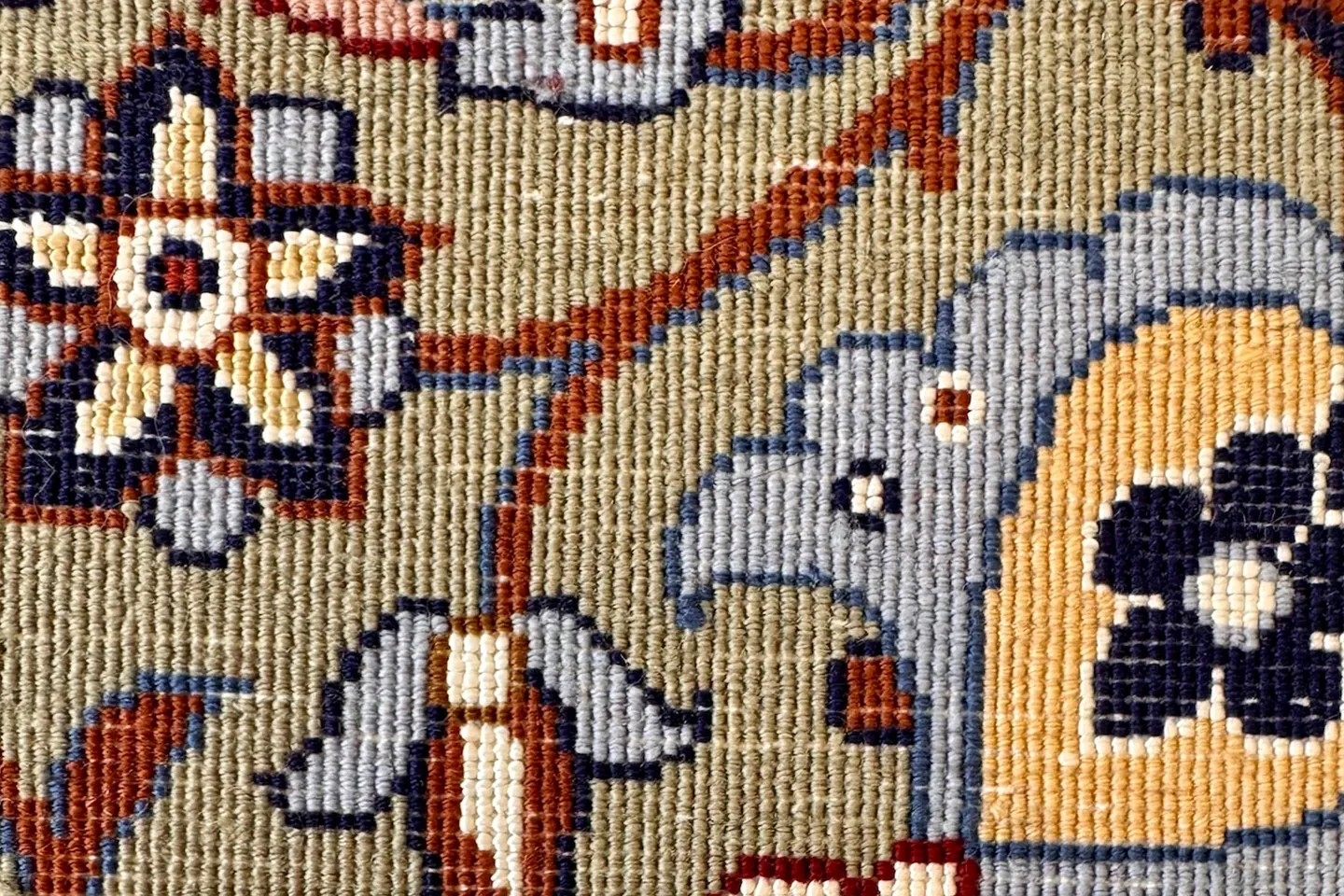
Knot count is arrived at by turning the rug over, counting the knot nodes along one inch horizontally, counting them along one inch vertically, and multiplying the two. Twelve across and fourteen up gives 168 knots per square inch. That is the whole calculation. It describes how finely the foundation was set and how hard the weft was beaten down, and it describes nothing else about the rug.
The two figures are rarely equal, which matters more than people expect. A rug at 14 by 20 and a rug at 17 by 17 both land near 280, but the first has knots that are taller than they are wide and will draw a horizontal line more cleanly than a vertical one. Weavers know this and design around it.
Not every tradition even uses the same unit. Tabriz work is quoted in raj, the number of knots across seven centimetres of width, so a 40 raj rug and a 60 raj rug are separated by a great deal of labour. Nain grades by la, the number of plies twisted into the warp threads: 9la is the standard good grade, 6la is finer, 4la finer still, and the count goes up as the number goes down. Chinese production has long been sold by line count, and much of Europe quotes knots per square decimetre, which produces impressive four-figure numbers for perfectly ordinary rugs. Ask which unit is being used before comparing two numbers.
The honest ranges
These are broad bands rather than specifications, and every one of them has exceptions at both ends. Any given weaving town produces across a range in a single year.
- Coarse tribal and nomadic weaving, including most Gabbeh, sits somewhere around 25 to 60 knots per square inch.
- Village weaving, the Hamadan output, the Heriz and Serapi tradition, most Bakhtiari, generally runs from roughly 50 to 130.
- Town and workshop weaving, which covers the bulk of Tabriz, Kashan and Kerman production, spans a very wide band from about 120 up past 400.
- Fine workshop weaving, the Isfahan and Moud sort of piece, commonly falls between about 300 and 700.
- Above that sit the finest silk pieces, where counts of 800 and beyond are reached and where the work stops being furnishing and starts being something closer to a painted miniature.
A useful check on any quoted figure: count it yourself. Pick a spot in the open field, away from the border and away from the ends, and count in three different places. The number will vary within one rug, because a person made it.
What density actually buys
Fineness is a drawing tool. Every knot is one square of colour, so the knot count is the resolution the weaver has to work with, and the design has to be chosen to suit it.
At high density a weaver can put in a curve that stays curved where it crosses a border, a leaf that turns over to show its underside, a bird with an eye in it, the small interlocking tendrils of an arabesque, a line of script inside a cartouche, the crowded animals of a hunting-ground field. Those things are not available at 60 knots to the inch in any hands at all. That is the argument for fineness, and it is a real one.
At low density a diagonal comes out as a staircase. Coarse traditions did not treat that as a defect; they designed for it. The stepped medallion, the hooked lozenge, the latch hook, the big single boteh, the broad reciprocal border: the whole vocabulary of tribal drawing is built out of forms that survive being rendered in large squares. Put a fine floral cartoon on a coarse loom and you get a muddle. Put a bold geometric design on a very fine loom and you have spent two extra years on resolution the pattern never asked for.
Why the higher number is not the better rug
Knot count says nothing about wool. Wool is where a rug's life actually is: whether the fleece came from a mountain sheep with a long staple and high lanolin, whether it was hand spun with a slightly uneven twist that takes dye in a living way, whether it was sheared from a living animal or pulled from a hide with lime, which leaves a dead, dry fibre that will never develop a sheen. A densely knotted rug in poor wool ages worse than a coarse one in good wool, and it does so faster.
Knot count also says nothing about the dyes, the drawing, the foundation or the finishing. And it can be gamed: the jufti knot, tied across four warp threads instead of two, shows the usual number of nodes on the back while leaving half as much pile standing on the floor.
Then there is the plain physics. Fine weaving requires a short pile, because tall pile on tiny knots would flop. Short pile means there is less wool between a shoe and the foundation. A 600 knot rug with a five millimetre pile has less material to lose in a traffic lane than a 90 knot rug with a fifteen millimetre pile. This is why a Bijar, which is moderate in count and extraordinarily dense in structure, will outlive finer rugs that cost more.
When coarse is the right choice
Coarse is right whenever the rug has to work rather than be looked at closely. A hall, a family room, a kitchen doorway, a house with dogs: all of these want a long pile, a forgiving pattern and a rug that can be cleaned without ceremony.
Coarse is right when the pattern has to read from across a room. A fine field of half-inch floral tracery resolves into a haze at four metres, while a Heriz medallion still reads from the doorway. Scale the drawing to the viewing distance, not to the invoice.
Coarse is right when it is the difference between buying the size the room needs and buying something too small. A rug that leaves the front legs of the furniture off it looks wrong at any knot count, and going up a size in a village weave is almost always a better room than going down a size in a fine one. If the room takes a large rug, buy a large rug.
And coarse is right whenever a fine rug would be spent on the wrong thing. The honest version of the trade's own rule: at any given budget, buy the best wool you can find first, the best drawing second, and the knot count last. The number is the easiest thing to quote and the last thing you will notice in twenty years of living with a rug. What you will notice is whether the wool came up with a sheen or went grey, and whether the design is still worth looking at.