How Rugs Are Mended
You have to know what a rug is made of
A hand-knotted rug is three things. Warps run the length of it, usually cotton, and they are the skeleton. Wefts cross them after every row of knots and hold the rows apart. The knots themselves are short lengths of wool tied around pairs of warps: they are the visible rug, and they carry no structural load at all.
That separation is the whole reason restoration works. The pile is a wearing surface sitting on a frame, and a wearing surface can be replaced. Almost nothing else in a house is built that way. A sofa's frame and its covering are made for each other once, at a factory, and a floor is a single material all the way through.
Re-knotting: the everyday repair
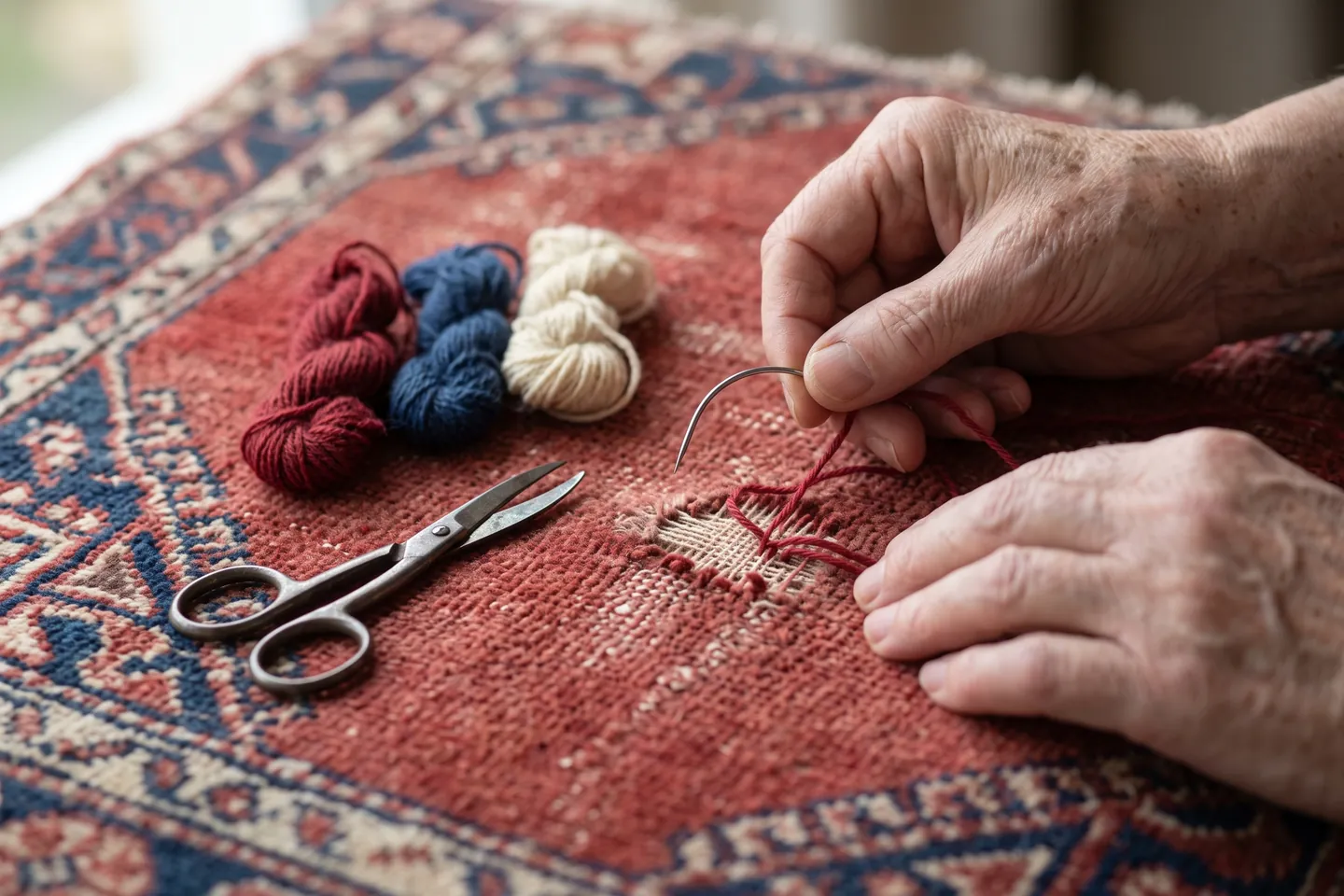
A worn patch is rebuilt with the same knot the rug was made with, tied into the original warps. The restorer picks out what is left of the damaged knots, clears the foundation without cutting it, and works row by row, following the design from the surrounding pile and from the back, where the pattern survives in the knot heads long after the face has gone. Each row is packed down before the next one starts, at the same density as the rest of the rug: a patch tied looser will sink, a patch tied tighter will dome.
Then it is sheared level with the pile around it, which is done by feel, with scissors, in several passes.
The hard part is the wool, not the knotting. The new yarn has to match a colour that is eighty years into its own settling, not the colour the rug left the loom with, and it has to be wool that will behave like its neighbours from here on. Good restorers keep old yarn, unravel donor rugs of the right age, and dye small lots to match. Matching by eye under one light is how you get a repair that is perfect in the workshop and obvious at home.
The ends, where rugs actually die
Most rugs fail at the ends first, and the reason is dull: vacuum cleaners, door thresholds and feet all attack the top and bottom before they attack the field. Above and below the pile sits a band of plain weaving with no knots in it, and once that band goes, the last row of knots has nothing holding it and begins to unravel row by row. A rug can lose an inch a year like that without anyone noticing, and a runner in a doorway loses it fastest.
The repair is to rebuild the plain weave and secure the final row, by hand, across the full width. It is unglamorous work, it is the cheapest intervention on this page relative to what it saves, and it is the one most often left too late. If the ends of an old piece are fraying, that is not an argument against the rug. It is a job that wants doing.
Selvedges and fringes
The long sides are bound by wrapping the outer warps with wool or goat hair, and that wrapping takes every knock from furniture legs and every pass of a vacuum head. When it goes, the edge warps are exposed and the rug starts losing width. Overcasting it again is quick. Waiting until the edge itself has gone is not.
Fringes need saying clearly, because they are widely misunderstood. The fringe is not a trim. It is the warp threads of the rug, coming out of the end, knotted or plied so they cannot pull back. Restoring a fringe means securing and rewrapping those warps. Sewing on a length of ready-made fringe is a cosmetic operation: it covers a failing end, it adds nothing structural, and it is one of the things to check for on any old rug with suspiciously tidy tassels. A hand-knotted rug that has had its fringe shaved off and replaced has been treated as decor.
What can be made invisible, and what cannot
Invisible, routinely: small re-knotted areas, corroded dark outlines rebuilt, moth grazing in the field, rebuilt ends, re-wrapped selvedges, old repairs redone properly.
Invisible with difficulty: large patches in an open field, because a plain ground shows any difference in the direction the pile lies; and anything in silk, where the fibre is unforgiving and a fine Qom at a thousand knots to the square inch demands a restorer working at that count.
Never invisible: a rotted foundation, which has to be replaced rather than repaired; dog and cat urine, which runs the dyes into each other before it rots the cotton; and a rug that has been cut down to fit a room. Reducing a rug means removing rows from the middle or the ends and joining what is left, and the join always reads on the back. It is legitimate work. It is not a secret, and it should be priced as what it is.
One more, because the trade sees it constantly: a new patch in a very worn rug will look right for a while and then diverge, because the surrounding pile keeps wearing and the patch does not. That is not bad work. It is a repair aging at its own speed in a rug that is still in use.
What it costs, and when not to do it
Restoration is charged by the hour or by the area rebuilt, and the rate reflects a person tying knots by hand at roughly the speed they were tied originally. Which leads to the arithmetic that stops most projects: on a low-value rug the bill routinely exceeds what the rug is worth, and no honest restorer pretends otherwise. Machine-made rugs cannot be re-knotted at all, because there is no knot to tie.
Before any of this, two cheaper things. Most rugs brought in for restoration actually want a proper wash: decades of grit sits at the base of the pile and cuts the wool from underneath every time someone walks across it. And most rugs want a pad, because a rug ground between its own foundation and a hard floor wears from the back. Those two together do more for a pre-1970 piece in ordinary wool than any amount of knotting.
Why this changes what to buy
If the wearing surface can be rebuilt into its own frame, then the sensible question about an old rug is not how much life is left in it but whether the foundation is sound and the drawing is worth the work. A dense Bijar or a big-scale Heriz is built heavily enough to take a hallway for generations and take repair when it eventually needs it. A workshop Tabriz or a Kerman from the first half of the last century has already spent most of a lifetime on somebody's floor and is still being mended rather than replaced.
That is the argument for the old one, and it is the only category of handmade rug where it holds. A semi-antique piece is far enough along to have settled, and everything else is a question of which decade you want to start in. Buy the sound foundation. The rug is not finished with its working life when you get it, and it will not be finished with it when you are done.