Getting the Size Right
Three ways a rug can meet the furniture
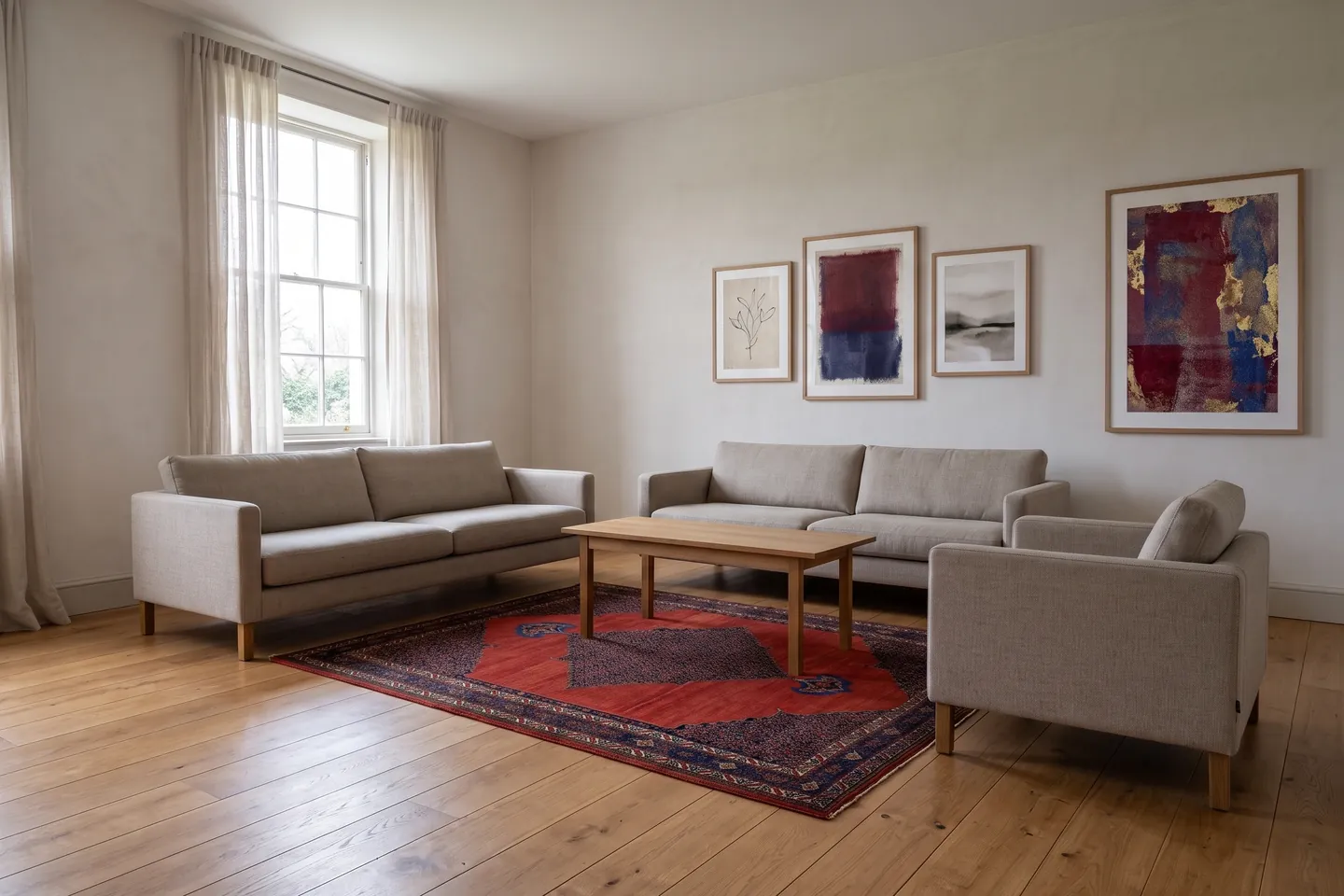
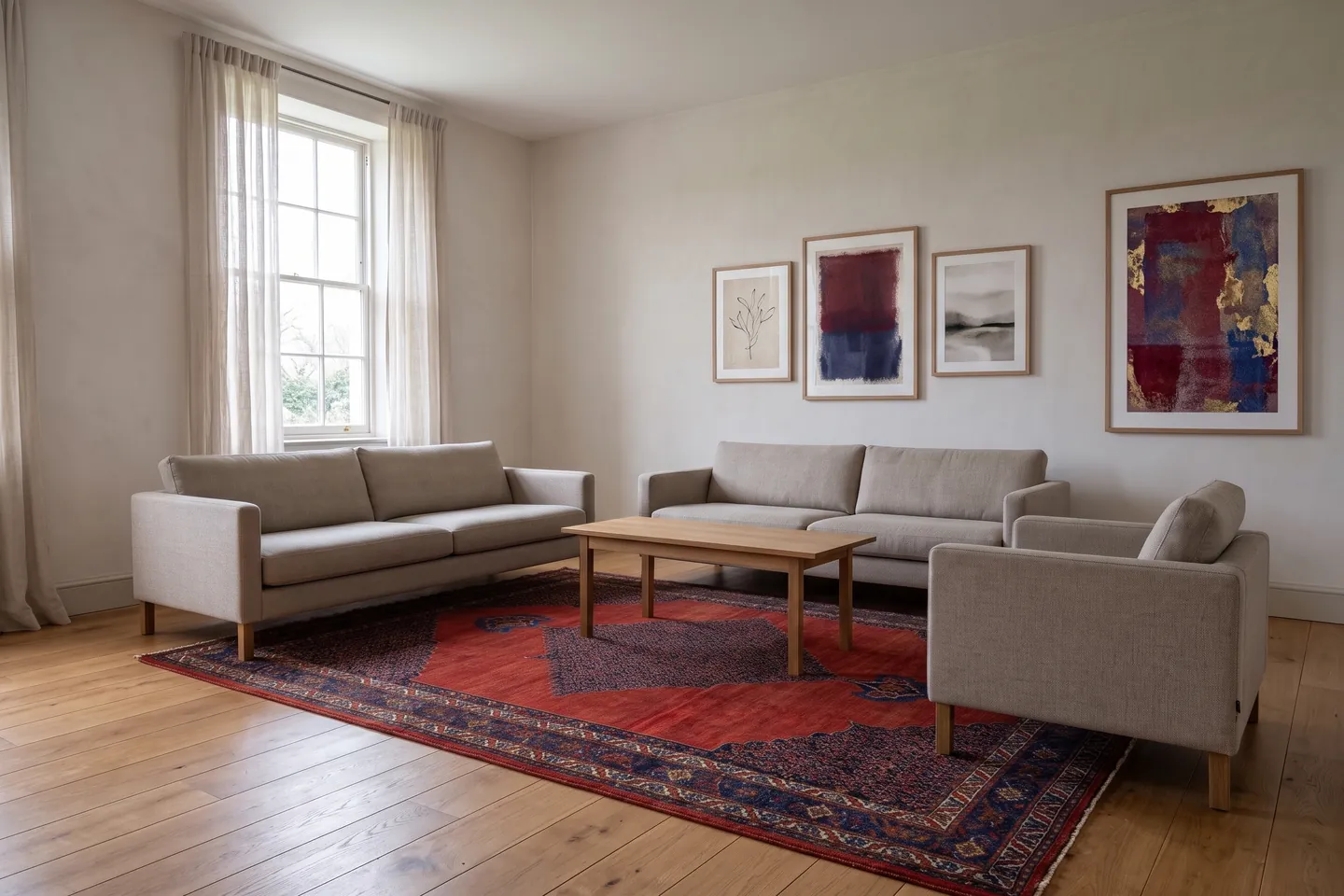
There are only three arrangements, and they are not equally good.
All legs on. Every piece of seating stands wholly on the rug, with bare floor showing as a border between the rug's edge and the walls. This is the version that reads as a designed room. It needs the most rug and it is the most forgiving of everything else, because the seating group becomes one object sitting on one plane.
Front legs on. The front feet of the sofa and every chair stand on the pile, the back feet on the floor. This is the working compromise, and in most rooms it is the honest target. It still ties the group together, because the eye reads the rug as continuing underneath.
Floating. Nothing touches it. A rectangle of rug sits in the middle of a ring of furniture with floor all around it. This is the arrangement that makes a room look smaller and an expensive rug look like a bath mat, and it is what most people end up with by accident.
The numbers for a living room
Work from the furniture outward, never from the walls inward. Push the seating into the layout you actually want, then measure the outside of the group and add what you need for the legs to land. For front legs on, the rug has to reach roughly 30 to 45 cm, call it 12 to 18 inches, under the front of each piece. For all legs on, add another 20 to 30 cm beyond the back feet so the rug does not stop at the exact edge of the sofa.
At the other side of the equation, leave bare floor showing at the walls. The usual range is 20 to 60 cm, 8 to 24 inches, and it is a range rather than a rule: a small room reads better at the low end, a large one at the high end. What matters is that the border is roughly even on the sides that are visible. A rug with 60 cm of floor on one side and 5 cm on the other reads as a mistake.
In practice a normal three-seat sofa with two chairs facing it wants something in the 8 by 10 to 10 by 14 range. Rooms that take a sofa, chairs and a second seating area want bigger again. A 6 by 9 under a full seating group is the classic floating failure, though the same rug is exactly right in a study or a small den.
The dining table, where the number is not negotiable
A dining rug has one job that has nothing to do with looks: a chair has to be pulled back, sat in and pushed forward again without its back legs catching the edge. That takes about 60 cm, 24 inches, of clearance beyond the table on every side. You can survive on 45 cm if nobody is tall, but 60 is the number to design to.
Run the arithmetic and the answer surprises people. A six foot table, 180 by 90 cm, needs roughly 300 by 210 cm of rug, which is an 8 by 10. An eight foot table needs a 9 by 12. Those are minimums, not generous allowances. A dining rug is almost always one size larger than the one a buyer first reaches for.
The failure mode is not aesthetic. Chair legs that catch the edge on every meal will destroy a binding in a few years, and a fine rug is the wrong object to put under a table anyway. Something flat and dense survives this better than something with a deep pile, which is why a flat weave or a tightly packed village rug earns its place in a dining room more often than a fine one does.
The bedroom
Two conventions, both workable. Put the whole bed on the rug with 45 to 60 cm showing along each side and at the foot, which for a king generally means a 9 by 12. Or set the rug so it starts below the pillows and runs out past the foot, which uses less rug and puts the pile exactly where feet land in the morning. The third option is a pair of runners, one each side, which is the oldest arrangement of the three and still the most practical in a small room.
A runner is measured against the traffic
The hall is the wrong thing to measure. What matters is the line people actually walk, which is rarely the full length of the corridor and almost never wall to wall.
- Leave 10 to 20 cm of floor at each end. A runner that reaches the skirting board at both ends reads as failed carpet.
- Leave floor showing at the sides too, around 8 to 12 cm each. If the runner touches both walls it will ride up.
- Stop short of any door that swings inward. Work out the clearance under the door before you buy, not after.
- Stop short of a threshold rather than crossing it. A rug that bridges two floor levels wears through at the ridge.
- In a hall long enough to need two, two runners with a gap look deliberate. One runner stretched past its natural length does not.
The same logic decides shape. A round rug belongs under a round table or in a room with a circular ceiling detail, not as a general softener. A square suits a square room, and almost nothing else does.
Measure it with tape, not with imagination
Mark the rug's outline on the floor with painter's tape and leave it there for two days. Walk through it. Pull the dining chairs back. Open the doors. Nobody has ever judged 300 by 400 cm correctly by looking at an empty floor.
One more thing that catches people out: hand-knotted rugs are not cut to size. They come off the loom at whatever dimension the warp and the weaver produced, so a rug sold as 9 by 12 may measure 8 foot 9 by 11 foot 10, and the two ends may differ by an inch or two. Old rugs are rarely perfectly rectangular, so plan with the measurements of the actual piece.
The honest reason people buy small
Price, and the arithmetic is unforgiving. A hand-knotted rug is priced by area, and area grows as the square of the dimension. A 9 by 12 is twice the floor of a 6 by 9 and costs roughly twice as much for the same quality. The jump from one size band to the next is not a small step, and telling someone to go up a size without saying that is not advice, it is sales.
So here is the useful version. If the right size is out of reach at the fineness you had in mind, buy the right size at a coarser weave rather than the wrong size at a finer one. A Heriz in good wool at 9 by 12 will do more for a room, and last longer under actual feet, than a much finer rug two feet too short in every direction. An older piece with some wear in it costs less than a new one of the same size and has already proved it survives.
And the genuinely small rug is not a failure, it is a different job. An accent piece at a bedside, in front of a fireplace or inside a door is doing exactly what it was woven to do. The mistake is never buying a small rug. The mistake is asking a small rug to hold a room together.