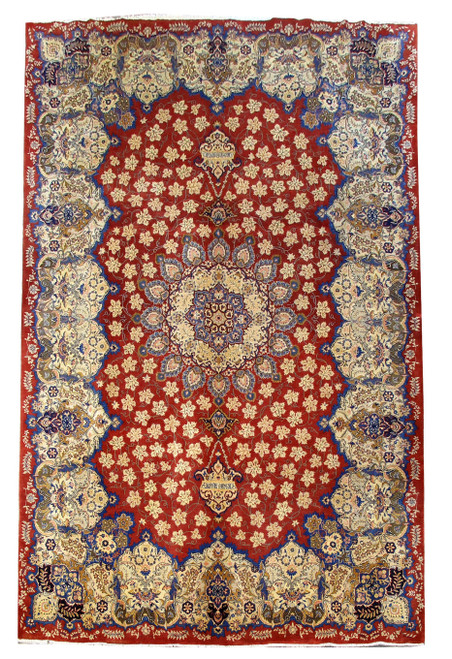
Reading a Signature
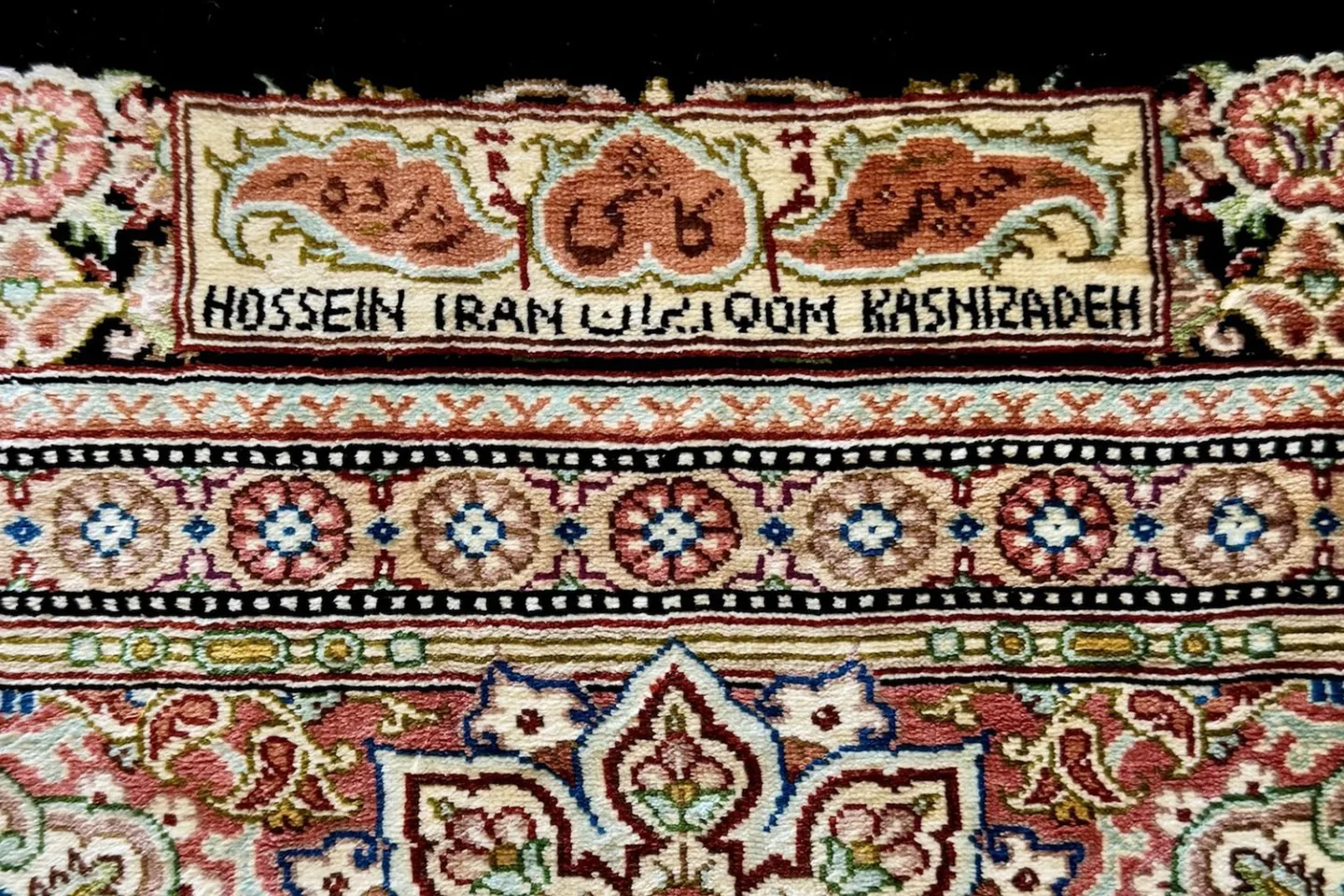
Where the name sits
A woven signature almost always occupies a small panel set into the border at one end of the rug, a cartouche, sometimes lobed, sometimes a plain rectangle. Occasionally it floats in the field just above or below the medallion. It is tied in the same knots as everything around it, usually in a pale thread against a dark ground so that it reads from standing height. Nothing is stitched on afterwards and nothing is printed. The weaver reaches that row of the cartoon like any other row and ties the name in as part of the day's work.
The panel reads upright from one end only, which settles a question people otherwise guess at: that is the end the design was drawn to be seen from. Lay the rug the other way round and the whole composition, medallion pendants included, is upside down.
What the words actually say
Most woven inscriptions are not bare names. The standard Persian formula opens with a word meaning work of, then a personal or family name, and often a city after it: Qom, Isfahan, Nain, Kashan, Tabriz. Some add a date in the Islamic lunar calendar, which converts to a Gregorian year and is the closest thing to a birth certificate a rug will ever have. Some add the word Iran, which tells you the piece was made for export.
Plenty of woven text is not a signature at all. Couplets from Hafez or Saadi run through the borders of pictorial rugs. Dedications name a patron rather than a maker. Prayer pieces carry religious phrases. On a great many rugs the only thing in the cartouche is a date. Treating any of these as authorship is a common and expensive mistake, and the only way to avoid it is to have the text read by someone who reads the script.
What a signature proves
It proves that a workshop was prepared to be identified with the piece, which is a real thing and a narrow one. Signing belongs almost entirely to organised urban production, where a master ran looms, supplied the cartoon and the dyed wool, and sold into a market that asked whose work it was. That is why the signed rugs you meet are overwhelmingly fine city weaving: Qom, Isfahan, Nain, Tabriz and Kashan, in silk or in wool with silk, at the top of the knot counts.
Within a workshop's output, the signature usually tracks the best of it. A house that signs selectively signs the pieces it wants judged, and leaves the rest of the year's production to travel on its own.
What it does not prove
It does not tell you whose hands tied the knots. The name in the cartouche is generally the master or the workshop, the person who drew or bought the design and set the standard. The weavers at the loom are almost never recorded anywhere. A rug signed by a famous atelier may have been tied by three people whose names nobody wrote down, which is worth sitting with before paying a premium for authorship.
It does not prove quality on its own. Workshops have weak years, apprentice looms and commercial lines. It does not prove age, since a name can be woven in at any date. And it does not prove itself: a cartouche can be cut out of the border and a replacement knotted into the gap, and a workshop in one town can weave another town's famous name into its own borders and has.
How the trade tests one
Turn the rug over first. The back should show the cartouche running in exactly the same structure as the border around it: the same warp spacing, the wefts passing through uninterrupted, the foundation the same colour and thickness. An inserted panel shows as a rectangle of disturbed weave with its edges joined in, and it shows from the back long before it shows from the front.
- Pile height inside the cartouche should match the border beside it. A signature that has not worn at the rate of everything around it was not there for the same eighty years.
- The script should be drawn by someone who could read it. Copied inscriptions garble the letter joins and the proportions, in the way a copied word in an unfamiliar alphabet always does.
- The dye should have aged with the rug, not against it.
- The fineness should be consistent. A signature drawn at a resolution the rest of the rug cannot reach is a contradiction, not a flourish.
The anonymous majority
Almost every rug ever made is unsigned, and the absence is structural rather than a shortfall. Tribal and village weaving had no authorship convention at all. A Qashqai woven on a horizontal loom by a woman weaving for her own household, a Gabbeh made to be sat on by the people who made it, a village Heriz sold through a town agent: none of them entered a market that asked for a name, so none of them carries one.
That is not a lower tier. The antique room-size Serapis that the collecting world has chased for a century are unsigned. So is most of what hangs in museums. If signature were a proxy for quality, the auction records would look entirely different from the way they look.
What to do with the information
Read the signature last. Judge the wool by handling it, the structure by turning the rug over, and the drawing by looking at whether a curved line stays curved where it crosses a border. Those three take ten minutes and cannot be faked. Then read the cartouche, and let it confirm or unsettle what you already decided.
If the name is what you are buying, the premium is real and so is the risk, and the two are attached to each other. If the rug is what you are buying, an unsigned piece from a tradition that never signed is not a compromise. It is simply the rest of Persian weaving, which is most of it, and it is where the majority of good rugs have always lived.