How the Pile Lies
The lean is built in, not applied
Every knot in a hand-knotted rug is looped around two warp threads, cut, and beaten down with an iron comb. The cut ends do not stand upright afterwards. They lean, and they all lean the same way, back toward the end the weaver started from. When the finished pile is sheared level, that lean is locked into the surface for the life of the rug. Nothing can be done about it, and nothing should be. It is a record of the direction the rug was built in.
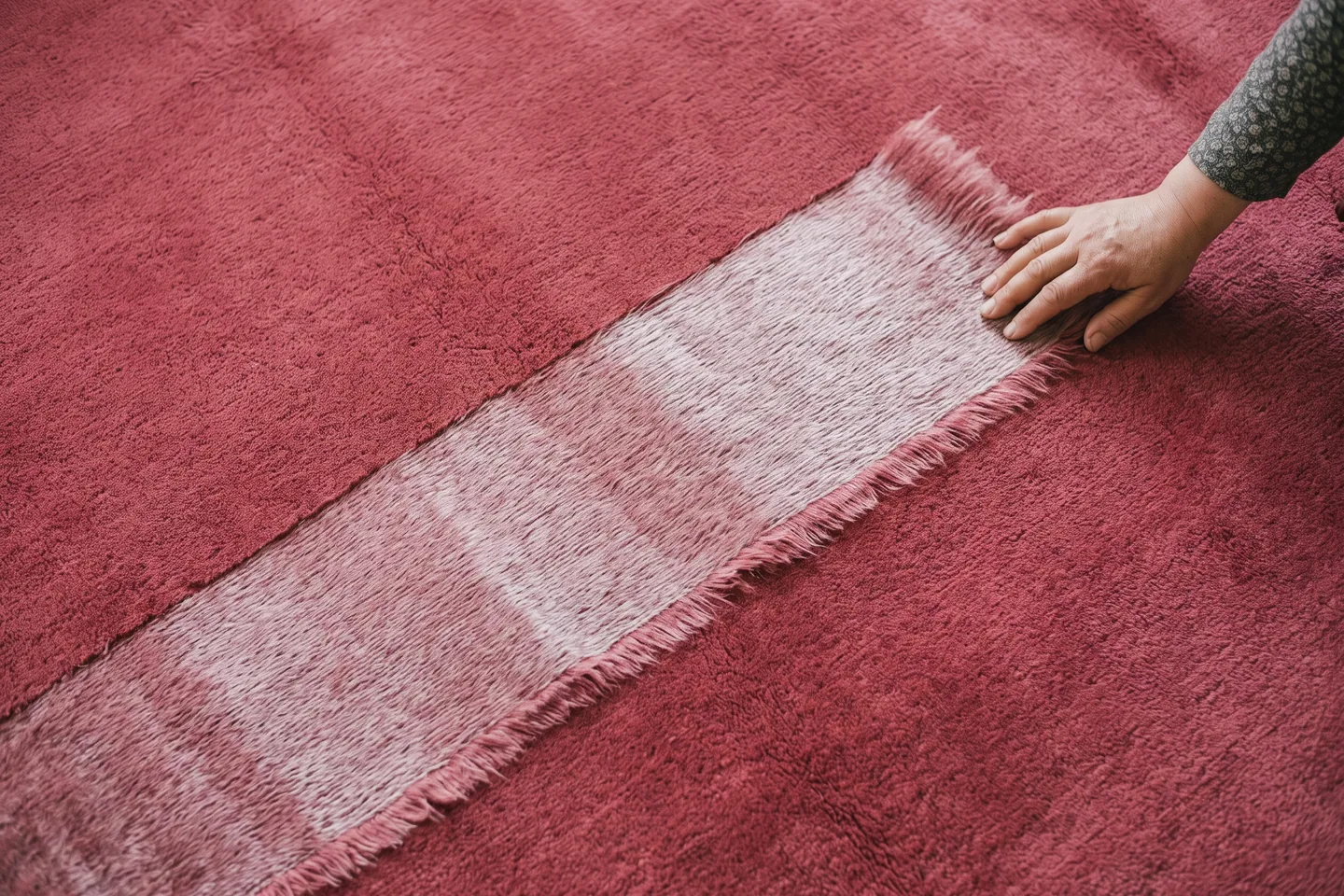
Finding it takes five seconds. Put a flat palm on the field and draw it toward one end, then toward the other. One direction runs smooth and leaves the wool looking dark. The other ruffles, lifts the tips and leaves a pale band behind your hand. Smooth is with the nap. Rough is against it. On a wool pile the difference is easy to feel; on a fine, short pile you may see it before you feel it.
Why one dye lot gives you two colours
This is optics, not dyeing. A pile of leaning fibres presents two different surfaces depending on where you stand. Look from the end the tips point toward and you are looking along the sides of the fibres, which throw light back at you. The colour reads pale, bright, slightly silvered. Walk to the other end and you are looking into the cut tips and the shadowed gaps between them. Light goes in and much less comes out. The same wool now reads deep and velvety.
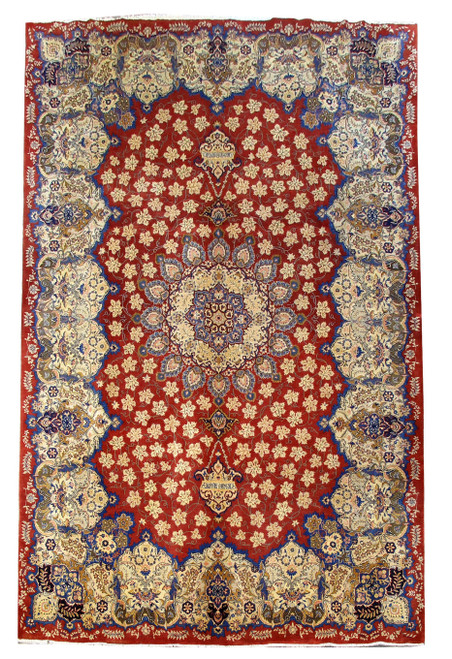
Open ground shows it most, because there is more uninterrupted pile leaning the same way. Dense drawing, tight borders and small motifs break the surface up and mute the effect. A large field in a single tone, the sort of thing a Kerman or a Sarouk is built around, will swing furthest between the two readings. A tribal piece covered edge to edge in small figures will swing least.
Telling nap apart from abrash
Both make a rug's colour change from one end to the other, and they are constantly confused. Abrash is drift between dye batches, fixed in the wool before the first knot was tied. Nap is a trick of position. There is a test and it is free: walk to the opposite end of the rug and look back. Nap reverses. The pale half goes dark, the dark half goes pale. Abrash does not move, because it is actually in the wool. If you sweep a hand across the pile and a band appears where you touched it, that band is nap, and you can rub it out again by sweeping the other way.
Which end faces the window
A rug has two correct orientations and one of them will suit your room better. Lay it so the nap runs away from where you usually sit and you look into the pile: the field goes deep, reds get their full weight, the drawing sits down into the ground. Turn it 180 degrees and the nap runs toward you: the same field lifts, goes lighter, and the whole rug looks more open and more reflective.
Light complicates it. A low sun raking along the pile from a window at one end exaggerates whichever reading you have chosen, and a ceiling downlight directly overhead flattens both. The only honest method is to lay the rug, live with it for an evening, then have two people turn it end for end and live with it for another. It takes ten minutes and it decides how the room reads for the next forty years. Most people never do it, and most people have their rug the wrong way round.
Runners are the case with no answer. A hall is walked in both directions, so the rug will read one way going in and the other coming out, and you cannot have both. Pick the direction that matters more, usually the approach a visitor makes, and accept the other.
The part nobody mentions before you buy
A pile that changes colour when you touch it also changes colour when anyone walks on it. In a busy hallway or a kitchen doorway, traffic pushes the nap around all day and the rug holds footprints and drag marks the way a vacuumed carpet does. On a deep, lustrous pile this is permanent housekeeping. It is not wear and it does no harm, but if the sight of tracks across a rug is going to bother you, do not put a high-sheen piece where the family walks.
Two sensible ways out. A coarse, long-pile weave like a Gabbeh shows direction strongly but hides individual footprints in its own texture. Or drop the pile entirely: a flat weave has no nap at all, because it has no knots, and it therefore reads the same from every corner of the room. That is the real argument for a kilim in a hall, and it has nothing to do with price.
Silk swings furthest
Silk is a long, smooth filament with none of the crimp and scale structure of wool, so it returns far more of the light that hits it. The gap between the two readings widens from noticeable to startling. A silk rug can look like ivory and old gold from one end of a room and like bronze from the other, and people who have owned one for years still stop at the door.
Weavers use this deliberately. In a wool and silk piece the silk is reserved for the vines, the flower heads or the medallion outline, so those elements flip while the wool ground holds steady. Walk past it and the drawing appears to switch on and off. The effect is the point of the construction, and it is the reason so many Qom and fine Isfahan pieces end up hung rather than laid. Hung, you choose one angle, one light, and keep it.
Why a photograph will not settle it
A photograph is one camera position and one light. Shoot the same rug from its two ends and you get two pictures that look like two different rugs, and both are accurate. Neither tells you what the thing does in a room where you move around. This is also why a rug photographed on a showroom floor and the same rug in your hallway disagree: different nap direction relative to the window, different height of eye, different everything.
So treat images as evidence of pattern, proportion and condition, which they record well, and treat colour as something to confirm in person or to ask about directly. Asking which end the nap runs to is a reasonable question and an answerable one. If you are working from pictures alone, assume the truth sits between the lightest and darkest frame you have seen, and plan the room for the darker reading, because that is the one a seated adult usually gets.
None of this changes what to buy. It changes how you place it. The same logic applies whether you are looking at Persian weaving, a workshop Tabriz, or anything else in the whole range: pick the rug on drawing, wool and structure, then spend ten minutes deciding which way round it lies.