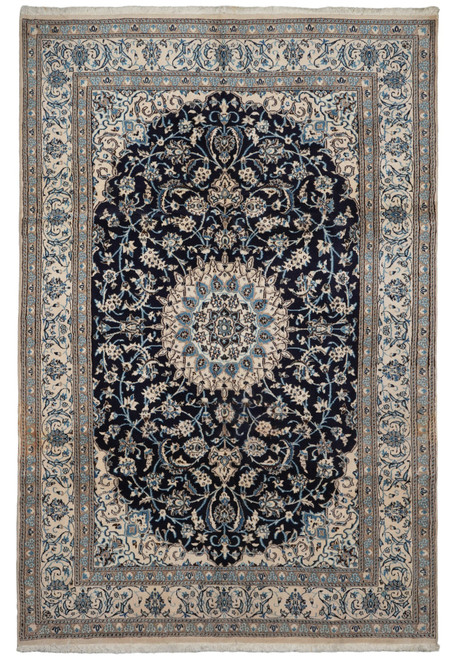
Nain Rugs
Nain is a desert town east of Isfahan that wove fine wool cloth for centuries and carpets only from the 1930s, when the cloak trade that supported it collapsed. It came to weaving with an existing reputation for fine wool work and no coarse village habit to shake off. The result is a young tradition with no cheap end and a palette of its own.
From cloaks to carpets
For a long time Nain's business was the aba, the fine wool cloak worn by men across Iran. When dress changed in the early twentieth century that market disappeared, and a town full of skilled wool workers with nothing to weave turned to carpets in the 1930s. Two things followed. The first is that Nain has no old rugs: an antique Nain does not exist, and anything offered as one is mislabelled. The second is that Nain skipped the coarse stage entirely. It aimed at the top of the market from the start, which it shares with Qom, the other great twentieth-century Persian name.
La, and how fineness is graded
Nain is graded by a system of its own. The trade quotes 9la, 6la and 4la, and lower is finer. The number refers to the threads twisted together in the rug's warp, and fewer threads means a thinner cord, a tighter grid and more knots in the same space. So 9la is the standard commercial grade and perfectly good, 6la is markedly finer, and 4la is exceptional and rare. The grade is worth asking about, because unlike a design it cannot be judged across a room. Explanations of exactly what la counts vary between dealers, but the ranking does not, and the ranking is what affects the rug.
Silk outlines on a wool pile
The Nain signature is a construction, not a motif. The field is wool. The outlines around each leaf, tendril and palmette are silk. Because silk reflects light along its fibre and wool scatters it, the drawing lifts off the ground and appears to be lit from inside, and it changes as anyone walks around the rug. It also means the fine detail is carried by the most fragile element in the rug, which is worth knowing: silk outlines go before wool pile does. The mixed construction is sold as wool and silk, and all-silk Nains exist at the fine end, behaving like any other silk rug.
Ivory and blue, and what they do in a house
Nain uses a palette almost no other Persian city uses: an ivory or pale beige ground, two or three values of blue from indigo to a soft sky, and a little pale rose, celadon or gold. There is no madder red ground here, which is the quickest way to tell a Nain from a Kashan at ten paces. Light grounds do something useful in a dark room and something inconvenient in a busy one. A pale ivory field shows a walked path, and it shows what a glass of red wine does, sooner and more plainly than a red ground would. A Nain belongs where it will be seen rather than crossed: a sitting room, a bedroom, a dining room with adults in it.
Habibian and the workshop names
Nain weaving is workshop weaving, and the good workshops sign. The name that matters most is Habibian, the master weaver whose workshop set the standard for the town in the middle of the twentieth century, and whose signed pieces are the reference point. Other workshops sign too. A signature woven into the field or a cartouche is a genuine mark of a named workshop and is also the easiest thing in a rug to copy, so it supports a judgement rather than replacing one. The wool, the grade and the evenness of the knotting say more.
Sizes, shapes, neighbours
Nain weaves the full run of workshop formats, and it is one of the more reliable Persian sources of round and square rugs, because a workshop drawing a design on paper can draw it in any outline. The commonest useful sizes are six by nine to eight by ten. The nearest relation is Isfahan, an hour away and four centuries older, finer and more elaborate. All Nain production is recent by the standards of Persian weaving, which is why so much of it appears as new or nearly new, with the pile intact.