Watch the film
| Size in ft: | Width: 10'3" x Length: 13'7" |
| Size in Inch: | Width: 123" x Length: 163" |
| Size in meters: | Length: 4.14 x Width: 3.12 m |
| Colors: | Tomato Red, Black, Ivory, Sky Blue, Gold |
| Shape: | Rectangular |
| Woven: | 100% Hand-knotted | Handmade |
| Foundation: | 100% Cotton |
| Pile: | |
| Design: | Herati | All Over Field | Stepped Diamond Medallion |
| Origin: | Persian Mahal | Made in Persia |
| Condition: | Excellent | Full even pile |
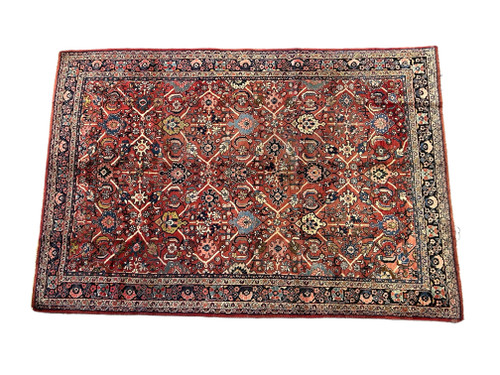
10'3" x 13'7" Persian Mahal Rug | Semi-Antique Herati All Over Design | Tomato Red | Excellent Condition
A room-size village weaving with real age to it, this 10'3" x 13'7" Persian Mahal is hand-knotted in wool on a cotton foundation and still carries a full, even 3/8" pile across all 141 square feet. The field is a deep tomato red drawn with a continuous Herati lattice, held by a single stepped diamond medallion and framed by a broad black border, and the proportions sit squarely in the 10x14 Persian rugs range that suits a long living room or a 10 chair dining table. The weave is heavy and flat, the selvages are sound, and the ivory fringe at both ends is intact. Every rug we ship leaves Freeport with a certificate of authenticity recording its origin, materials and measured size.
Please Note About the Photographs:
The close-up of the medallion was taken under warmer indoor light and reads lighter and more orange than the rug actually is, with a purple cast in the navy black center. The full overhead photograph is the accurate reference for color.
Design and Motifs
The field is pure Herati, the pattern weavers also call mahi or fish: a diamond lattice with a rosette at each intersection, flanked by paired lancet leaves that curl back on themselves like fish turning in water. Here the drawing is enlarged and loosened in the way village looms handle it, so each repeat carries weight instead of disappearing into fine detail, and the whole surface reads as a generous all over design rather than a strict grid. At the center sits a small stepped diamond medallion outlined in ivory, filled with an 8 petal rosette and four radiating palmettes, with matching stepped spandrels pulling the same black into the 4 corners. The main border runs a vine of palmettes and serrated leaves, and it is flanked on both sides by narrow rosette guard stripes and a reciprocal ivory zigzag that keeps the red and black from colliding.
Tomato Red, Midnight Black and the Accent Palette
The ground color is a bright tomato red with a faint coral warmth where the pile catches light, lighter and livelier than the brick reds of city workshops, and it stays consistent from end to end with only the gentle tonal movement good hand-spun wool always shows. Against it the border, medallion and spandrels are a near black midnight navy that looks solid black across the room and opens into deep indigo up close. The drawing itself is carried in ivory and soft cream, which outline the medallion and the leaves, plus two distinct blues, a dusty sky blue in the rosette centers and a darker teal in the leaves, along with mustard gold, apricot and small touches of chocolate brown and olive. It is a warm, saturated palette that anchors oak and walnut floors, cream plaster walls, leather and dark woods.
Mahal Weaving and Village Quality
Mahal rugs come from the cluster of villages in the Sultanabad district of west central Persia, around present day Arak, the same weaving area that produced the large decorative carpets Western dealers bought by the container load from the late 19th century onward. Mahal work is village work by definition: a looser knot count than Kashan or Isfahan, but woven on heavy cotton warps with thick, lustrous local wool, which is exactly why these rugs survive a century of family traffic and still show pile. The back of this piece is tight and regular with clean straight edges, and the wool has the greasy handle that takes a sheen with use rather than shedding it. If you want to understand what the weave, the dye behavior and the handle tell you about a rug of this period, our guide on how to date an Oriental rug walks through the same signals we read on this one.
10'3" x 13'7" Vintage Mahal Rug | Semi-Antique | Herati Design | Tomato Red |
Ask about this rug
This piece is the only one of it, so the things worth knowing about it are particular to it. If you want to talk through the size, the colour in your own light, or the weave, speak to someone here first.
Related rugs
-

-

-

-
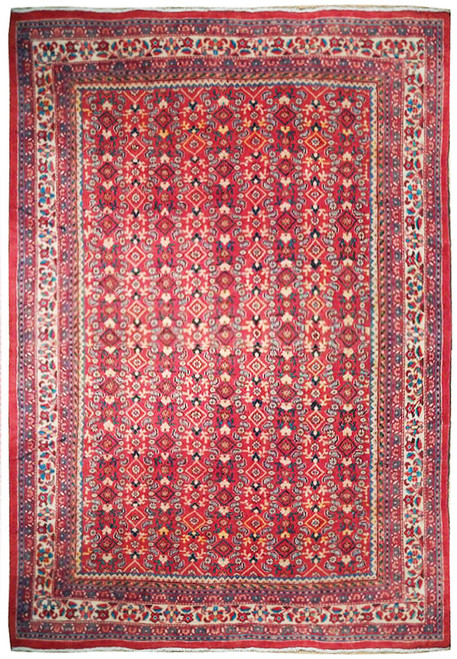
9'4" x 12'6" Persian Mahal Rug | Red Field | All-Over Herati Design | Diamond Compartments
Was: $3,640.00Now: $3,499.00 -