Watch the film
| Size in ft: | Width: 10'7" x Length: 14'6" |
| Size in Inch: | Width: 127" x Length: 174" |
| Size in meters: | Length: 4.42 x Width: 3.23 m |
| Colors: | Navy Blue, Red, Ivory, Beige, Light Blue, Soft Rose Floral Accents |
| Shape: | Rectangular |
| Woven: | 100% Hand-knotted | Handmade |
| Foundation: | Cotton |
| Pile: | |
| Age: | 1970's |
| Design: | Herati | Fish Pattern | Center Medallion |
| Origin: | Persian Mahal | Made in Persia |
| Condition: | Excellent |
10'7" x 14'6" Persian Mahal Rug | All Over Herati Fish Design | 1970s, Excellent Condition
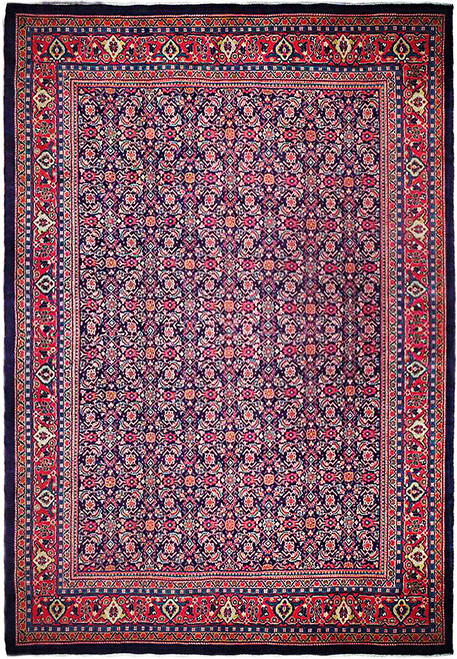
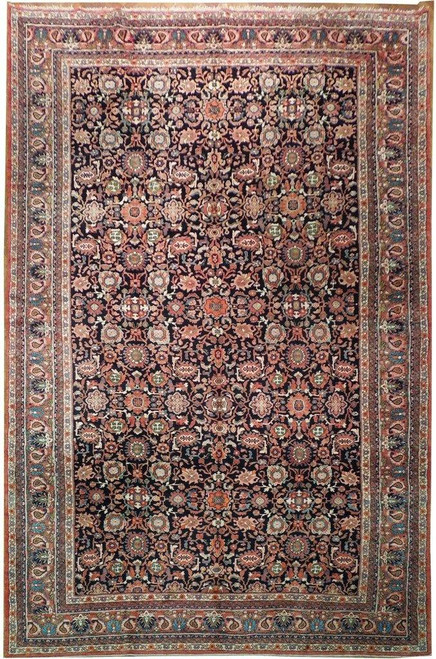
This is a room-filling 1970s Persian Mahal rug measuring 10'7" x 14'6", hand-knotted in wool on a cotton foundation and still carrying a heavy, springy pile after five decades. The drawing is the classic Herati repeat, worked edge to edge across a deep red and navy field, anchored by a small ivory diamond medallion and framed first by a wide red palmette border and then by a plain navy blue band that finishes the rug like a mat around a painting. It is a serious piece of floor for a large room, one of the more usable proportions among 10x14 Persian rugs, and it ships with a certificate of authenticity confirming the origin, age, materials and hand-knotted construction.
Please Note About the Photographs:
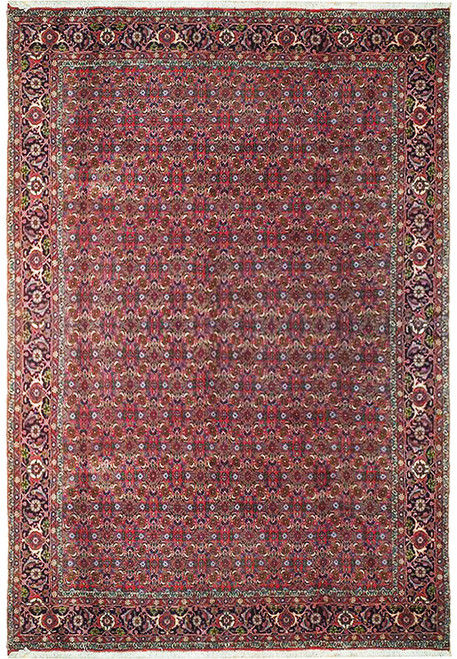
The first studio photograph reads darker and more plum than the rug is in person. The floor shots and the close-ups show the truer color: a clear red field with navy tracery. The soft horizontal shadows across the field are fold marks from rolled storage, not wear, fade or damage. They relax once the rug is laid flat, and every rug is professionally steamed and pressed before it ships.
Design and Motifs
The field carries a strict all over Herati design, the mahi or fish pattern: a lattice of small diamonds, each set with a rosette and flanked by four curved lanceolate leaves, the leaves that gave the pattern its fish name. The repeat runs unbroken from selvage to selvage, and the weaver held the count steady across more than 14 feet of length, which is where you see the discipline of the workshop. At the center sits a modest ivory lozenge medallion filled with blue and red florets and finished with stepped pendants at each end, deliberately small so it punctuates the field instead of dominating it. Four broad spandrels in ivory and light blue break the corners of the field, each one drawn with its own Herati lattice on a lighter ground. The main border runs a red ground with alternating turtle palmettes and blue rosettes, backed by beige guard stripes of reciprocal hooks and a fine barber-pole minor stripe, with the plain navy outer band framing the whole composition.
A Navy, Red and Ivory Palette
Color is what carries this rug across a big room. The field ground alternates between a deep madder red and a dark navy that the Herati lattice moves through, so from a standing height the surface reads as a single rich burgundy-navy tone, while up close it separates into two distinct grounds. Against that depth the weaver set cool ivory and cream for the medallion, the spandrels and the fish leaves, with beige and sand in the guard stripes warming everything down. Light blue appears everywhere in small doses, in the rosette centers, in the border palmettes and in the fine outline of the medallion, and it is the color that keeps the rug from going heavy. Soft rose and salmon flicker through the flower heads in the main border, a few brown and near-black outlines give the drawing its edge, and the plain navy outer band closes the palette on the darkest note in the rug. The wool has a natural sheen that shifts the reds lighter or deeper depending on which direction you walk around it.
Mahal Weaving in the Arak Region
Mahal rugs come from the village weaving belt around Arak in west-central Persia, the same district that produced the Sultanabad carpets that furnished large Western houses from the late 1800s onward. Those villages have always specialized in big, honest room-size rugs: a sturdy cotton warp and weft, a medium knot count, and a generous pile of local wool that takes decades of traffic without thinning. That is exactly what you have here. The handle is thick and dense, the selvages are tight and intact, and the foundation lies flat with no buckling across a 14 foot length. A rug of this age gives you the two things new production cannot buy, fully settled vegetable-toned color and wool that has already proved itself, and if you want to understand how weavers, dealers and collectors read those signals you can learn how to date an Oriental rug before you buy.
10'7" x 14'6" Persian Mahal Rug | All Over Herati Fish Design | 1970s, Excellent Condition
Ask about this rug
This piece is the only one of it, so the things worth knowing about it are particular to it. If you want to talk through the size, the colour in your own light, or the weave, speak to someone here first.