| Size in ft: | Width: 10' x Length: 10'3" |
| Size in Inch: | Width: 120" x Length: 123" |
| Size in meters: | Length: 3.12 x Width: 3.05 m |
| Colors: | Rich Ruby, Ivory, Olive, Brown |
| Shape: | Square |
| Woven: | Hand-Knotted |
| Pile: | Wool And Silk |
| Origin: | India |
| Design: | Tabriz Mahi |
| Age: | New |
| Condition: | Perfect |
10' x 10'3" Square Tabriz Mahi Rug | Rich Ruby Wool and Silk Herati Design | Brand New
A true square at 10' x 10'3", this is a hand-knotted wool and silk rug drawn in the Tabriz Mahi tradition and woven on a cotton foundation. The proportions are the first thing a buyer notices: genuine square Oriental rugs in this size are hard to find, and this one fills a square great room, a games room or a space under a round dining table without the awkward leftover floor a rectangle leaves behind. The pile is dense and evenly clipped, the silk shows as a quiet sheen in the small white and grey motifs, and the rug has never been on a floor. It ships with a certificate of authenticity confirming it as a genuine hand-knotted piece.
Please Note About the Photographs:
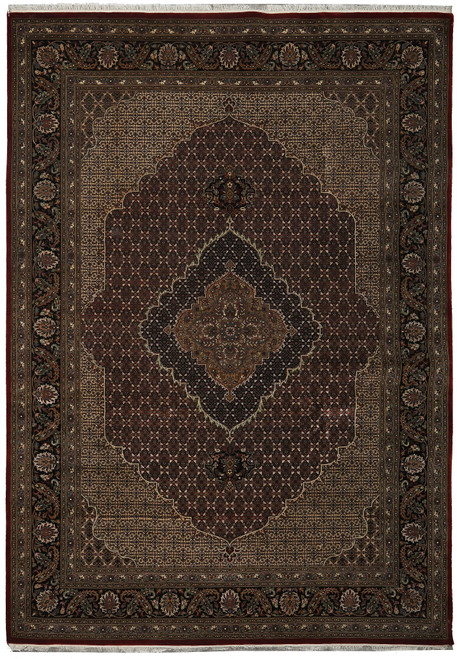
The first flat overhead photograph was shot under bright studio light and reads lighter and slightly mauve. The true field colour is the deep rich ruby you see in the floor shots and the close-up detail images. That is a lighting effect only, not fading, wear or a colour run.
Design and Motifs
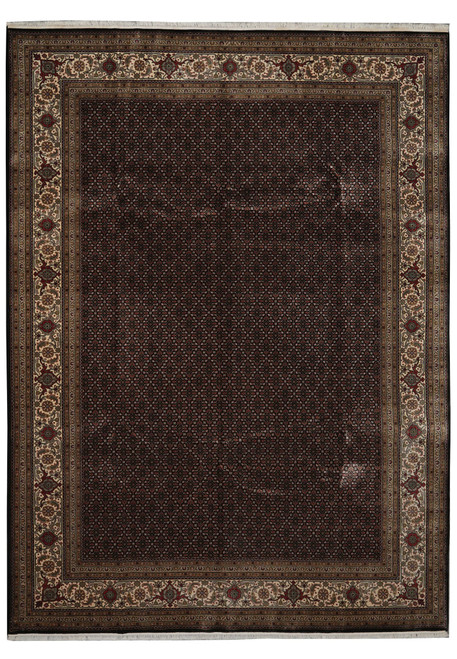
The field is a full herati lattice, the pattern weavers call mahi, or fish: a small diamond framed by 4 curling leaves around a rosette, repeated across the entire ground in strict diagonal rows. At the centre sits a scalloped ivory medallion with a dark inner cartouche, finished top and bottom with slim anchor-shaped pendants. Large brown and camel corner spandrels break the field and carry their own herati drawing at a slightly larger scale, outlined by a delicate scalloped ivory line. The border system runs several bands deep: an ivory main border of turtle palmettes and curving vine, flanked by narrow camel and grey guard stripes filled with small rosettes and a fine reciprocal edge, then a plain ruby outer band and ivory cotton fringe. Because the format is square, the medallion sits perfectly centred from every approach, which is exactly what this layout was drawn to do.
A Rich Ruby Field Lit by Ivory, Olive and Brown
The ground is a deep rich ruby, closer to wine than to fire engine red, and it holds its saturation right into the corners. Against it the herati motifs are picked out in bright ivory, soft dove grey, olive green, tan and near-black, so the lattice reads as a fine confetti of light rather than a heavy pattern. The central medallion is ivory with a black interior panel, its rosettes touched in coral and green, and a pale blush outline separates it from the field. The spandrels shift to warm brown and camel, giving the square a visible frame within a frame, while the main border returns to ivory with rust, olive, grey and burgundy florals. The selvedge is a solid deep ruby and the fringe a clean natural ivory. Silk appears in the small white and grey highlights, which catch light from one direction and go quiet from the other, so the whole rug changes tone as you walk around it.
Woven in India in the Tabriz Mahi Tradition
This rug was made in India, today the source of most of the world's best contemporary hand-knotted work, and we say that with confidence rather than apology. Indian workshops weaving the Mahi cartoon aim at the standard set in northwest Persia, and the evidence is in the drawing: the lattice rows stay straight across 10 feet, the medallion curve is smooth rather than stepped, and the guard stripes keep their rhythm through all 4 corners. The knot count is high enough to resolve motifs only a few knots wide, which is why the small fish leaves stay legible instead of blurring. A cotton warp and weft keep a square this large flat and stable, while the wool pile with silk highlights gives it the surface you want underfoot. If you are weighing this against Persian production, our guide to what actually separates a Persian rug from an Oriental rug is worth reading before you decide.
10' x 10'3" Square Tabriz Mahi Rug | Rich Ruby Wool and Silk Herati Design | Brand New
Ask about this rug
This piece is the only one of it, so the things worth knowing about it are particular to it. If you want to talk through the size, the colour in your own light, or the weave, speak to someone here first.