Watch the film
| Size in ft: | Width: 10' x Length: 12'10" |
| Size in Inch: | Width: 120" x Length: 154" |
| Size in meters: | Length: 3.91 x Width: 3.05 m |
| Colors: | Red, Ivory |
| Shape: | Rectangular |
| Woven: | 100% Hand-knotted | Handmade |
| Foundation: | Cotton |
| Pile: | |
| Signature: | Woven cartouche reads "Najaf Abad" |
| Design: | Floral Medallion | All-Over Arabesque Vine |
| Origin: | Persian Najafabad | Made in Persia |
| Condition: | Excellent | Ready to use |
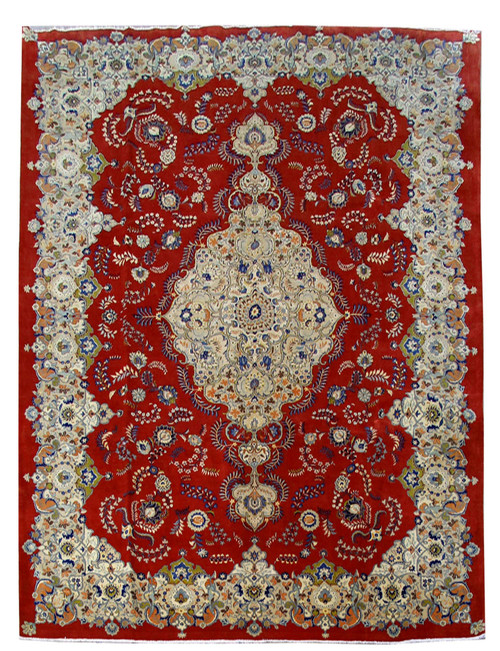
10' x 12'10" Persian Najafabad Rug | Signed Ivory Floral Medallion | Fine Wool Pile, Excellent Condition
A signed piece is always the more interesting piece, and this one tells you where it comes from in its own hand: a small ivory cartouche set into the border at one end, drawn in Persian script, reading "Najaf Abad". Najafabad is a weaving town on the plain west of Isfahan, and the rug behaves exactly the way work from that corner of central Persia should, with a curved, flowing vine drawn tight enough to hold the eye at close range and an ivory ground that keeps a room of this size light rather than heavy. The pile is fine wool at 3/8", low and even, over a cotton foundation, and the wool still has its natural sheen where the light crosses it. At 10' x 12'10" this is a genuine main-room rug that sits comfortably among 10x13 Persian rugs, and it ships with a certificate of authenticity naming origin, materials and construction.
Please Note About the Photographs:
The two full-rug photographs were shot from a distance and read slightly flatter and lighter than the rug does in person. The close-up images of the medallion and the corner show the true saturation of the rose, the blue and the brick red. Every rug is professionally steamed and pressed before it leaves our Freeport warehouse.
Design and Motifs
The center holds a lobed floral medallion built in layers: a rose-red ground carrying 8 small flower sprays and paired paisley curls, a mid-blue inner medallion outlined in navy, and at the very core a gold and olive rosette no bigger than a hand. Slender pendants reach out from the medallion toward each end, and the 4 corners are filled with deep red spandrels drawn with the same vocabulary in reverse, so the ivory field reads as a shaped cartouche between them. Across that field runs a dense all-over arabesque of thin navy vines, palmettes, serrated saz leaves, rosettes and curling boteh, every element outlined and no two adjacent flowers given the same filling. The main border is a red palmette-and-leaf meander with scrolling ivory arabesque, framed on both sides by narrow ivory guard stripes of running vine and a pair of blue minor stripes. The signature cartouche breaks the guard stripe at one end, which is where a workshop piece announces itself.
A Close Look at the Colors
The field is a warm ivory, closer to unbleached cream than to white, and it shifts a shade lighter or deeper across the width the way naturally dyed wool does. Against it the drawing is carried in navy, a clear mid blue, and a soft powder blue, with flower heads picked out in brick red, terracotta, olive green, camel gold, and small notes of pale pink and white that keep the vinework from going flat. The medallion works in a rose red that leans slightly magenta, ringed in blue and navy, with the gold core reading almost bronze under lamplight. The main border is a deep brick red, a full step darker than the reds in the field, and that contrast is what gives the rug its frame from across a room. Guard stripes in ivory and blue separate every zone cleanly, so the overall impression is light and formal rather than dark, which is unusual and welcome in a rug this large.
Najafabad and the Isfahan Weaving Tradition
Najafabad lies roughly 20 miles west of Isfahan, and its looms have always worked in the drawing tradition of that city, which is the tradition that made central Persia famous: curved line, continuous vine, and precision in the outlines. Najafabad workshops typically weave on a larger scale than the Isfahan city ateliers, and in a heavier, longer-wearing wool pile, which is why the town is the source of so many of the best room-size ivory-ground floral rugs from the region. If you want the background on how that school of drawing developed and what separates its grades, our guide to Isfahan rugs covers it, and the wider Isfahan rug collection shows the city work for comparison. The back of this rug, shown against a ruler, tells the rest of the story: small, regular, tightly packed knots on a cotton warp, with the pattern legible from the reverse, and a low even pile that has stayed in excellent condition.
10' x 12'10" Persian Najafabad Rug | Signed Ivory Floral Medallion | Fine Wool Pile, Excellent Condition
Ask about this rug
This piece is the only one of it, so the things worth knowing about it are particular to it. If you want to talk through the size, the colour in your own light, or the weave, speak to someone here first.