Watch the film
| Size in ft: | Width: 10' x Length: 12'4" |
| Size in Inch: | Width: 120" x Length: 148" |
| Size in meters: | Length: 3.76 x Width: 3.05 m |
| Colors: | Red |
| Shape: | Rectangular |
| Woven: | Hand-Knotted |
| Pile: | Wool |
| Origin: | Persia |
| Design: | Heriz |
| Condition: | Perfect |
10' x 12'4" Persian Heriz Rug | Stepped Geometric Medallion | Ivory Spandrels | Village Wool
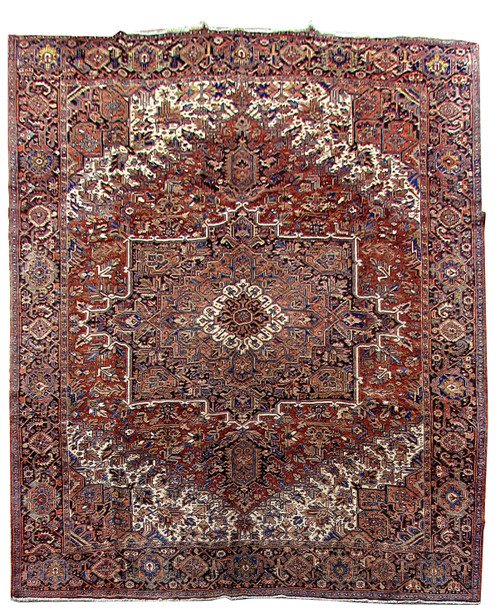
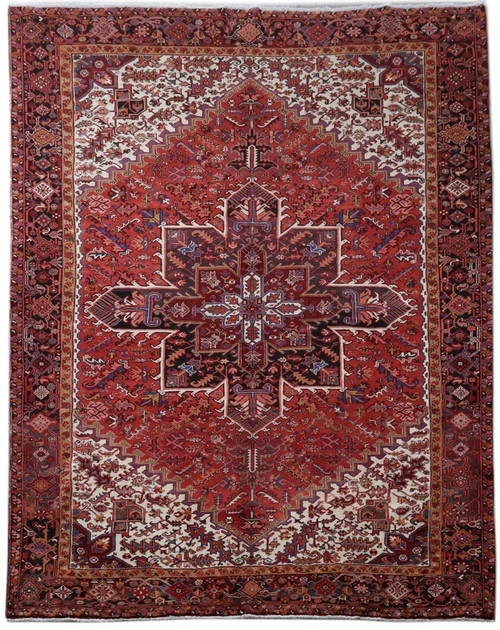
This is a full room size Heriz from the villages of northwest Persia, hand-knotted in wool on a cotton foundation and drawn entirely in straight lines and angles. The red field carries a broad stepped medallion with a navy core, matched by deep ivory quarter spandrels at the 4 corners and framed by a navy main border of alternating palmettes and flowering plants. The pile is thick and even across the whole 10' x 12'4", the sides and ends are original, and the wool has the dry, springy handle that Heriz weavers are known for. It sits comfortably in the 10x13 Persian rugs size class, covering a large seating group or a long dining table without crowding the walls. A certificate of authenticity ships with the rug.
Please Note About the Photographs:
The overhead full view was shot under cooler light and reads darker and more wine toned than the rug actually is. The close-up images of the medallion and the field show the true color: a warm brick red with clear slate blue, olive and rose accents. Nothing in the darker frame indicates fading or wear.
Design and Motifs
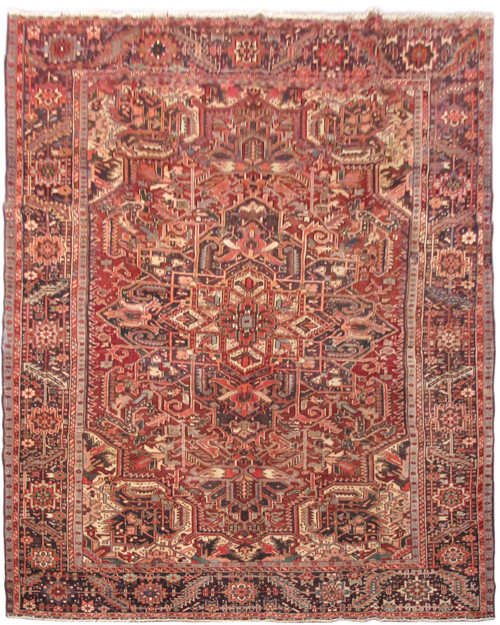
The layout is the classic Heriz formula executed at generous scale. A large 8 sided stepped medallion holds a small navy lozenge at its center, with a white outlined diamond at the core and hooked anchor pendants reaching north and south. Around it sit blocky rosette cartouches and serrated leaf forms, each one outlined in ivory so the shapes read cleanly from across a room. The corner spandrels break sharply into deep ivory, filled with angular vine, hooked palmettes and small stylized plant heads, and the diagonal where ivory meets red is stepped rather than curved, which is exactly how these geometric Persian rugs are drawn from memory rather than from a full cartoon. The navy main border alternates upright flowering plants with squared palmette panels, bracketed by narrow guard stripes of running vine and small rosettes.
The Red Field, Navy Border and Ivory Corners
The field is a warm brick red that shifts gently between lighter and deeper passages as the dye lots change across the width, the natural abrash of a village weave and one of the things collectors look for. Against it, the medallion interior runs dark indigo navy, nearly black in the shadow lines, with a soft slate blue used for the outlines, the small cross forms in the corner cartouches and the flanking leaf shapes. Ivory does the structural work: it outlines every major motif, fills the 4 corner spandrels and forms the thin guard stripe that separates field from border. Scattered through the drawing are muted olive green, a dusty rose pink and touches of camel gold, small quantities that keep the red from reading flat. The navy border grounds the whole piece and makes the red field look warmer than it would on its own.
Heriz Weaving, East of Tabriz
Heriz is a group of villages east of Tabriz, on the slopes below Mount Sabalan, and the reputation of the weave comes as much from the sheep as from the looms. The mineral-rich water there produces famously tough, high-lanolin fleece, and that wool knotted at a moderate count on a stout cotton foundation is what makes a Heriz one of the hardest wearing floor rugs in Persia. Village work of this type is generally woven below 200 knots per square inch, which suits the design rather than limiting it: the drawing is angular by intention, built from straight lines and stepped corners that gain nothing from a finer knot. The back of this piece, shown against a ruler, is firm and regular with clean color separation between knots. Rugs of this construction routinely stay in families for generations and only look better as the pile burnishes.
10' x 12'4" Persian Heriz Rug | Stepped Geometric Medallion | Ivory Spandrels | Village Wool
Ask about this rug
This piece is the only one of it, so the things worth knowing about it are particular to it. If you want to talk through the size, the colour in your own light, or the weave, speak to someone here first.