Watch the film
| Size in ft: | Width: 9'2" x Length: 12' |
| Size in Inch: | Width: 110" x Length: 144" |
| Size in meters: | Length: 3.66 x Width: 2.79 m |
| Colors: | Red, Black, Navy, Ivory, Olive |
| Shape: | Rectangular |
| Woven: | 100% Hand-knotted | Handmade |
| Foundation: | Cotton |
| Pile: | |
| Design: | Heriz | Stepped geometric medallion | Ivory corner spandrels |
| Origin: | Persian Heriz | Made in Persia |
| Condition: | Excellent |
9'2" x 12' Persian Heriz Rug | Stepped Geometric Medallion, Ivory Spandrels | Excellent Condition
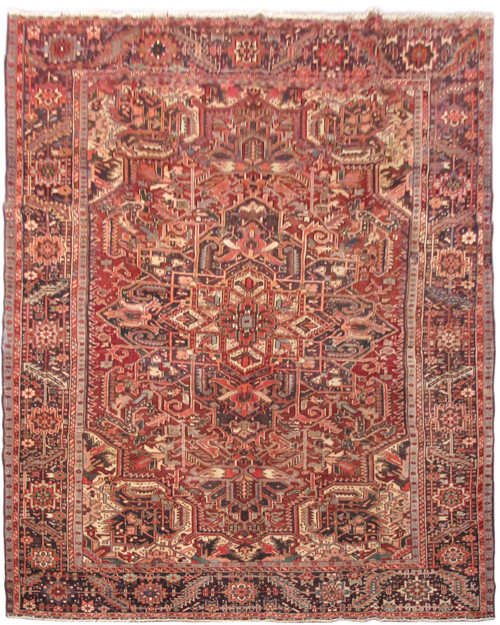
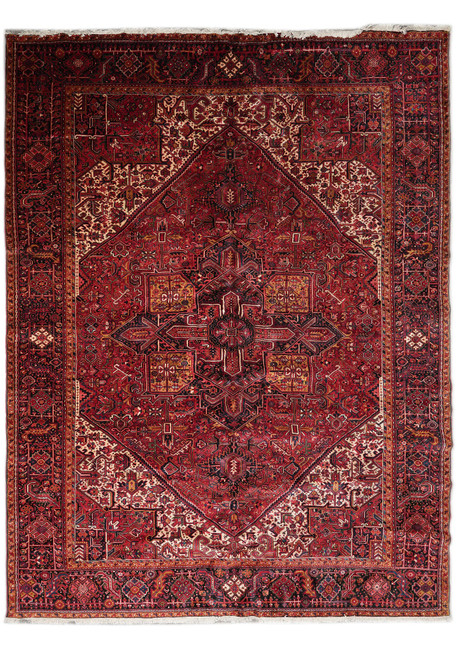
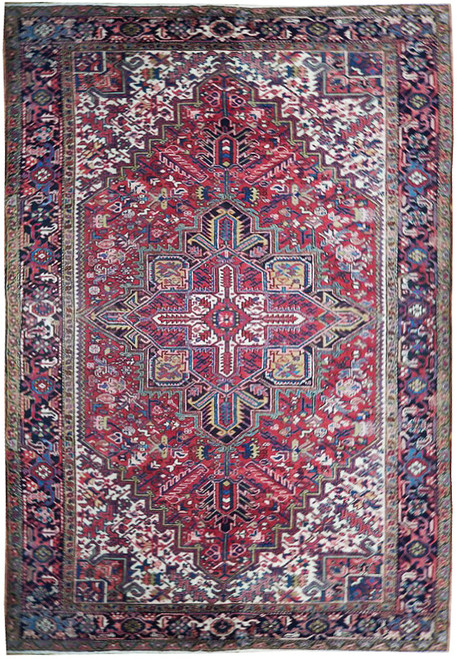
This is a full room-size Persian Heriz, hand-knotted in wool on a cotton foundation and measuring 9'2" x 12'. The drawing is pure Heriz: a large stepped medallion holding the center, ivory spandrels cutting into all 4 corners, and a field of angular vinework on deep madder red. Heriz wool is famously tough, and this piece has the dense, tight handle those villages are known for, with the pile standing evenly across the field and the selvedges and ends intact in the photographs. At 110" x 144" it sits comfortably under a sofa group or a 10 seat dining table, and it is one of the more useful proportions among 9x12 Persian rugs because the extra 2 inches of width fills a standard living room wall to wall. Every rug we ship carries our certificate of authenticity, confirming origin, materials and hand-knotted construction.
Design and Motifs
The center medallion is built in stepped tiers rather than curves, a black outlined diamond enclosing a rose toned cartouche and a small ivory 8 petal rosette at the exact center, with hooked pendants running off the top and bottom points. Around it the weaver has filled the field with angular flowering vines, small serrated leaves, stiff little blossoms and hooked latch shapes, all drawn on the diagonal so the pattern reads as movement rather than repetition. The 4 corner spandrels are worked in ivory and rose with coiling vine scrolls, and they meet the field along a stepped, staircase edge that is a signature of village drawing in this tradition. The main border carries alternating palmettes and serrated leaf forms on a near black ground, flanked by narrow guard stripes of small rosettes. Small asymmetries between one corner and the next, visible in the close-up photographs, are the honest marks of a loom drawn from memory rather than a printed graph, and they are exactly what buyers of geometric Persian rugs look for.
A Deep Madder Red Field with Ivory, Black and Olive
The dominant color is a deep, slightly cool madder red, the kind that reads brick in daylight and turns almost wine colored under lamps. Against it the medallion outline and the main border ground are a dense black that shifts toward navy where the light catches it, giving the composition its structure. The ivory is not a bright white but a warm oatmeal tone, used through the corner spandrels, the inner rosettes and scattered highlights across the field. Olive green appears in the border leaves and in fine details of the vinework, and there are clear supporting notes of rose pink through the medallion and spandrels plus rust and gold accents in the border palmettes and outer stripe. Soft blue grey outlines separate motifs from the red ground and keep the pattern legible from across a room. The overall effect is warm and saturated rather than pastel, so the rug anchors cream walls, wood floors and leather furniture without needing anything else to carry the room.
Heriz: Village Weaving East of Tabriz
Heriz is a cluster of villages east of Tabriz, on the slopes below Mount Sabalan in northwest Persia. The local water is mineral rich, and it is generally credited with the exceptional strength and springiness of Heriz wool, which is why these rugs are the ones you find still in service after 3 or 4 generations of family use. The weaving is done on a coarser gauge than the city workshops of Tabriz or Kashan, and the design is adapted to it: straight lines, stepped corners, angular medallions and bold scale, because a curved arabesque needs a much higher knot count to draw cleanly. Village Heriz work typically sits under 200 knots per square inch, and that is a feature rather than a shortcoming, since the heavier knot and thick wool pile are what make the rug walkable for decades. This example shows the Heriz formula at its most confident, in a true room size, with the clean angular geometry and hard-wearing wool pile that made these rugs the standard choice for American rooms more than a century ago.
9'2" x 12' Persian Heriz Rug | Stepped Geometric Medallion, Ivory Spandrels | Excellent Condition
Ask about this rug
This piece is the only one of it, so the things worth knowing about it are particular to it. If you want to talk through the size, the colour in your own light, or the weave, speak to someone here first.