Watch the film
| Size in ft: | Width: 10' x Length: 13'4" |
| Size in Inch: | Width: 120" x Length: 160" |
| Size in meters: | Length: 4.06 x Width: 3.05 m |
| Colors: | Indigo Blue, Red, Green, Ivory |
| Shape: | Rectangular |
| Woven: | 100% Hand-knotted | Handmade |
| Foundation: | Cotton Foundation |
| Pile: | |
| Design: | Tabriz | Sheikh Safi Medallion | Boteh and Vase Motifs |
| Origin: | Persian Tabriz | Made in Persia |
| Condition: | Excellent | Full even pile |
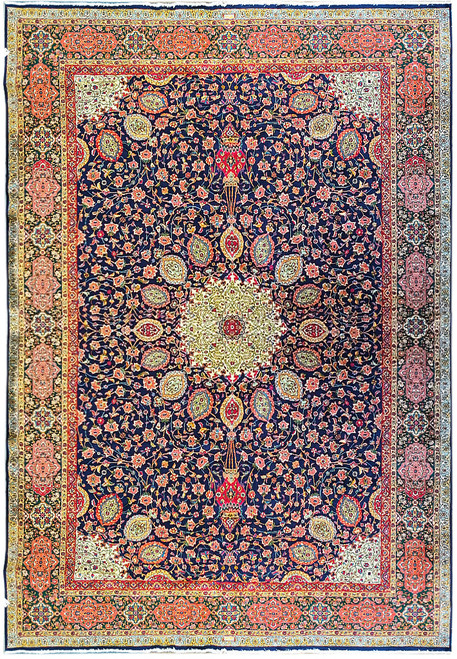
10' x 13'4" Persian Tabriz Rug | Sheikh Safi Medallion | Indigo Blue Wool, Excellent Condition
This 10' x 13'4" Persian Tabriz carries the Sheikh Safi medallion, one of the most demanding drawings in the Tabriz repertoire, over a deep indigo blue field. It is hand-knotted in wool on a cotton foundation with a 3/8" pile that still stands full and upright edge to edge, and the condition is excellent with no repairs, no low areas and original selvages and fringe. At 10 feet across and just over 13 feet long it seats a full sofa group or a 10 seat table without the furniture crowding the border, which puts it squarely in the most usable band of 10x13 Persian rugs. It ships with a certificate of authenticity recording origin, materials, weave and measurements.
Please Note About the Photographs:
The pale band that runs through the middle of the showroom floor photographs is overhead light reflecting off the natural luster of the wool. It is not wear, not fading and not a bare spot. The flat overhead photograph, shot under even light, is the truest record of the color and the density of the pile.
Design and Motifs
The center holds a ringed rosette medallion on an ivory ground, built from a small teal star at the core, a red arabesque ring around it and an outer ring of stepped ivory cusps. From that center a full ring of boteh cartouches radiates outward, each one drawn with its own small palette of red, teal, gold and cream, so no two neighbors read alike. On the vertical axis, above and below the medallion, sit a pair of red footed vase motifs with slender handles, a classic Tabriz signature that fixes the top and bottom of the drawing. The rest of the indigo ground is filled with fine scrolling vine, serrated lancet leaves and small blossoms worked right up to the corner spandrels, which lift into ivory and carry split leaf arabesques in all 4 corners. The main border is madder red with alternating floral cartouches and green rosettes, framed by camel gold guard stripes of running vine and an outer teal guard of small blossoms.
Color: Indigo Ground with Red, Green and Ivory
The field is a saturated indigo that shifts with the light, reading as a violet leaning blue under bright overhead light in the detail photographs and settling into a darker navy indigo across the room shots, which is typical of a deep indigo dye on lustrous wool. Against it the reds do the structural work: a clear madder red in the main border and the vase motifs, and a deeper brick red in the medallion arabesque. Greens appear in two distinct tones, a cool teal in the boteh centers and the outer guard, and a darker bottle green in the border rosettes. Ivory is the relief color, used for the medallion ground, the corner spandrels and the fine outlines that keep the dense field legible from standing height. Small hits of gold, peach and soft rose sit inside the boteh, so the rug belongs with both the navy blue and indigo Persian rugs and the multi-colored traditional pieces.
Tabriz Origin and Weaving Quality
Tabriz sits in the far northwest of Persia and has been the commercial and design capital of Persian weaving for centuries, the town that revived the classical court drawings and sold them to the world. Fineness there is measured in Raj, the count of knots per gereh of about 2.75 in across the width, and the drawing on this piece tells you where it sits: the curved arabesque ring, the fine vine work and the clean outlining of dozens of separate boteh require a workshop weave on a taut cotton warp, not a village loom. The back shows a tight, even knot line with straight rows and no pulled or waisted areas, which is why a rug of this age still lies flat and holds a true rectangle at 10 feet wide. The wool is firm and glossy, the kind that takes indigo and madder deeply and then polishes rather than dulls with use.
10' x 13'4" Persian Tabriz Rug | Sheikh Safi Medallion | Indigo Blue Wool, Excellent Condition
Ask about this rug
This piece is the only one of it, so the things worth knowing about it are particular to it. If you want to talk through the size, the colour in your own light, or the weave, speak to someone here first.